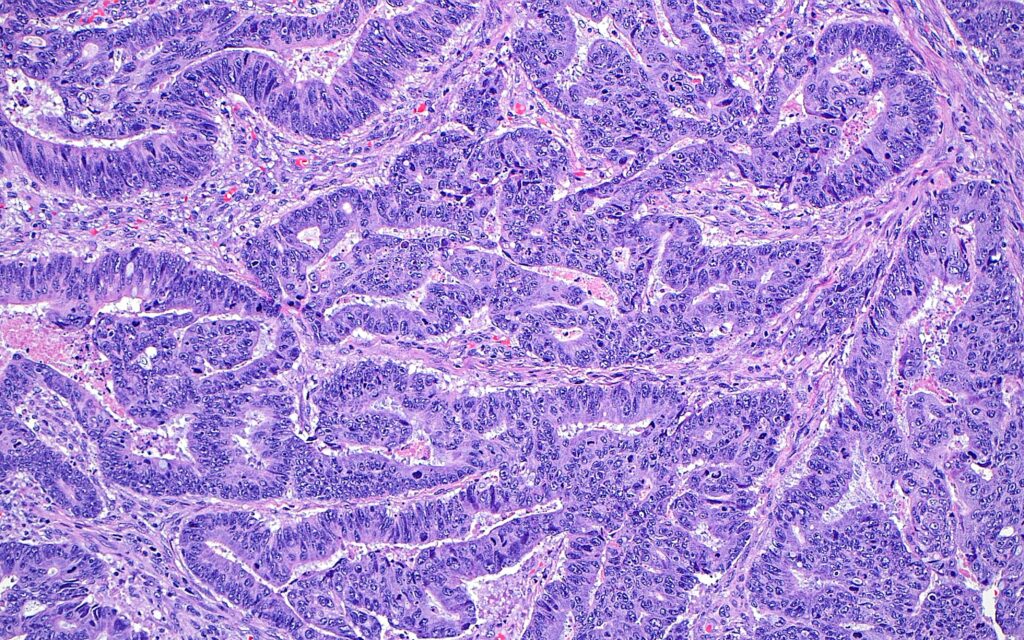
The rise of colorectal cancer in patients under 50 continues to stump researchers, who are still trying to work out why, in younger people, the cancer is more aggressive and carries a worse prognosis even with more intensive treatment.
A study last week shed light on a possible answer: tumors in younger people are different on a cellular level, displaying traits that might explain why they are more resistant to treatment and more likely to metastasize and spread throughout the body.
Researchers analyzed 189 frozen samples of colorectal cancer tumors taken from people from their 20s to their 90s to produce the study, which experts said could present targets for future research and new treatments.
“There is still a lot of work to be done,” said Kimmie Ng, director of the Young-Onset Colorectal Cancer Center at the Dana-Farber Cancer Institute and a co-senior author of the study. “But in the last few years, we have had more insights than ever before … and I think our patients feel gratified that there is hope here in future understanding of their disease.”
While the incidence and mortality of colorectal cancer has fallen in the United States in recent decades thanks to improvements in screening and treatment, the reasons behind a significant rise in the disease among people younger than 50 have remained a mystery.
“The major question in the field has been, ‘Why is it increasing?’” said Ana Anderson, director of the cancer program at the Gene Lay Institute at Brigham and Women’s Hospital and a co-senior author on the study. “And number two, ‘Is it a different disease?’”
There are troubling differences between younger colorectal cancer patients and their older peers: for people younger than 50, the cancer is often diagnosed at a later stage when it has spread to other parts of the body.
Though the data is mixed, some studies also suggest that early-onset colorectal cancer can be more aggressive and that younger patients fare worse than older ones, despite being healthier and able to receive more intensive treatment (other studies say outcomes are similar between younger and older patients).
To produce the new study, researchers drew on a biobank of frozen tumor samples from the Dana-Farber Cancer Institute. Taken together, they present a continuum of colorectal cancer cells in people of different ages. There were big differences.
The biggest change researchers observed was a higher presence of stromal cells, which make up a layer of connective tissue that forms a scaffold around tumors, in younger colorectal cancer patients. Stromal cells can influence a tumor’s growth and shield it from immune cells or drugs. In other cancers, they’ve been associated with resistance to chemotherapy.
“It can potentially be an explanation for why younger [colorectal cancer] patients may be less responsive to treatment,” Ng said.
The researchers also identified dozens of genes that were expressed differently in the tumors of younger patients and older patients. Some of those genes are associated with cancer’s propensity to metastasize and spread — perhaps explaining why early-onset colorectal cancer is more aggressive — while others have functions that are still unknown.
Heinz-Josef Lenz, a professor of medicine and cancer biology at Keck Medicine at the University of Southern California who was not involved in the study, said the findings were promising. But he cautioned that the study does not prove that the differences in the cancer tumors made them more aggressive or resilient.
“That’s the missing question,” Lenz said.
Ng and Anderson said that they hoped the paper will encourage further research into the unique traits of the early-onset cancer tumors and how to treat them. Studies have examined attacking stromal cells as a pathway to treat other cancers.
“We generally treat younger patients the same way we treat older patients,” Ng said. “Our hope is that by following up on these findings … potentially these could be therapeutic targets for a more precision treatment approach in the future for our young patients.”
Rachel Issaka, director of the colorectal cancer screening program at Fred Hutchinson Cancer Center who was also not involved with the study, said understanding the cellular differences in early-onset colorectal cancer could eventually tell us more about precancerous cells and how to better screen for the disease.
“I think this is a really important step, and hopefully gets us closer to that goal,” Issaka said.
The post Clues emerge on why colon cancer may be harder to treat in young people appeared first on Washington Post.