The 2026 election cycle has seen heated redistricting battles — fought through legislatures, referendums and courts — as both parties vie to craft favorable election maps. But what if American history contained another way for politicians to pick their voters? A way so audacious that it hasn’t really been tried for a century, a weapon blunter than gerrymandering, a move so blatant that it calls into question the meaning of representative democracy itself?
What if, instead of moving the map to fit the voters, politicians moved voters to fit the map?
Party bosses worked this scheme throughout the 19th century: rounding up drifters and drunkards, registering them at flophouses in swing districts and herding them to the polls on Election Day. Cunning politicos realized that by relocating just a few thousand voters, they could sway races, elect presidents, shape a nation of millions. Americans called it colonization — a fitting name in an era when political machines settled empires not overseas but in Manhattan or Sheboygan, Wisc.
After importing a crew of Mexican citizens to vote in his South Texas stronghold, the political boss Jimmy B. Wells borrowed a cattleman’s metaphor, bragging, “With my corral, I hold the balance of power.”
Political machines held that power for decades. Colonization is as striking for its staying power as its outlandishness, a wildly undemocratic scheme practiced from the 1830s into the 1900s. Many Americans just shrugged at the sneakiness of the bosses, even as good-government reformers, like The Chicago Eagle, shouted, “THERE IS NO REASON WHATEVER WHY THEY SHOULD BE TOLERATED.”
Then, after a lifetime of toleration, Americans significantly reformed voting in the early 20th century, closing the loopholes that allowed colonization to succeed. What had seemed like a permanent flaw in our democracy was killed so decisively that it sounds made up today. Perhaps there’s a lesson here, as many look beyond the 2026 midterms and see a future of endless electoral shenanigans.
Colonizing elections worked because it exploited the peculiar development of democracy in America. In the 1800s, the United States was a highly mobile nation hurtling toward modernity and also a novel experiment in popular participation. The result was both a reckless gamble with self-government and a hothouse for crooked creativity.
To colonize elections, political machines needed mobile voters. And 19-century America teemed with down-and-outers willing to move into some flophouse, “fattening” — in the words of a disgusted Buffalo observer — “on beer and bad whiskey until they have cast their votes.”
Over 32 million immigrants came to the United States between 1840 and 1920, the equivalent of shipping the entire Civil War-era populace into the country. Big cities and industrial towns filled with footloose bachelors and bachelorettes until there were as many single men in 1890 as today. Large numbers were experiencing relatively new phenomena like unemployment and homelessness. Modern industrial capitalism left many struggling laborers with one asset to barter: their votes.
And America’s unique geography created a political marketplace. Instead of developing a central metropolis — a London or a Paris — political power peppered an East Coast of medium-size cities. In 1860, 20 of the 30 largest cities in America lay within a day’s train ride, helping to swing the votes of eight separate states. Parties developed a political shell game, relocating voters from Brooklyn to Boston to Baltimore.
Even within states and cities, a dense schedule of year-round local races meant elections could be decided by importing mobile voters to a new ward or precinct.
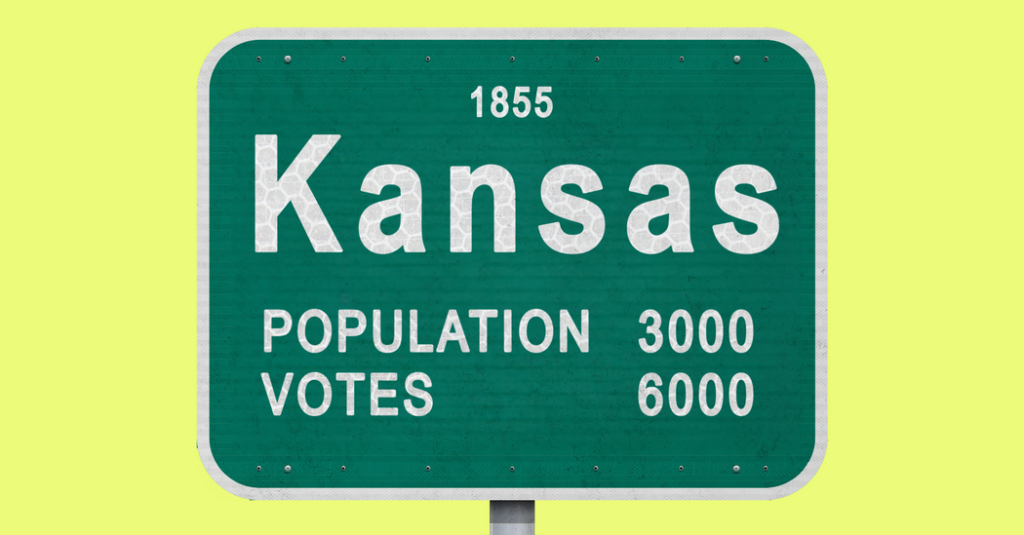
Western states, eager to attract residents, allowed recent arrivals (and sometimes noncitizens) to vote after spending a few days in town. Rural regions proved just as willing to trade voters as big cites. Bitter politics heated it all. Kansas elections became a sudden draw before the Civil War, as thousands of pro-slavery Missourians and antislavery New Englanders flooded in to decide whether the territory would allow slavery. Home to 3,000 eligible residents, Kansas saw 6,000 votes cast in the 1855 territory elections in March.
Years later, as Jim Crow squelched African Americans’ voting rights in the South, Republicans political bosses in the North cooked up a scheme to put “wheels on the suffrage” by relocating Black voters to places like Indiana and Connecticut to help their party win there.
But colonization worked best when it was hardly noticed, exploiting the tiny margins deciding the closest elections in U.S. history. James Garfield won the popular vote for president in 1880 by 1,898 votes. Just 1,149 ballots in New York made Grover Cleveland president in 1884. A few boardinghouses in Manhattan and Philadelphia could swing the nation’s most populous states and, with them, a fifth of the nation’s electoral votes. It would be like winning California, Texas and Florida today, all for the price of beds, beer and bologna.
Filling wards with temporary voters required incredible logistical power. Suppressing the vote took bigots and shotguns, but moving the vote meant housing, feeding and registering thousands. It took, in the words of an 1869 congressional inquiry into frauds in New York City, “a systematic plan of gigantic proportions, stealthily prearranged and boldly executed.” Boss Tweed won his power by orchestrating that systematic plan. A half dozen Bowery thugs actually registered to vote at Tweed’s Lower East Side address.
Political machines gathered colonized voters wherever they could. In Chicago, they slept on saloons’ sawdust floors. In Texas, they were fed barbecue. In Detroit, Congress found a Democratic leader providing his colonists with bouts of free whiskey “five or six times a day.” Voter registries show colonizers packing 152 men into a single New York address in 1868 and 230 voters in a small Greenwich Village hotel in 1902. The striking, six-foot-tall, Irish-born Katie Hicks ran a string of boardinghouses favored by African Americans in the West Village. In the early 1900s, authorities accused Hicks of marching her boarders to vote Republican en masse, waving a giant American flag.
The result blended political campaigning, social engineering and organized crime. In Coney Island, a Democratic political machine imported out-of-work Manhattan actors and housed them in off-season beachside hotels until the 1888 presidential election, feeding them cheap seafood. Think of the arithmetic that scam required of John Y. McKane, Coney Island’s party boss: combining a pool of bored men with vacant blocks of windswept November resorts, to swing an election and manufacture political power.
Around 1900, reformers realized that those boardinghouse bosses were colonization’s weakness. Cities had gained new regulatory controls over how people lived. Hygiene codes allowed inspectors to end what the Municipal Voters’ League denounced as the practice of colonized voters “sleeping like hogs on the filthy floors” of Chicago’s saloons. Shouting “Hobo rule must go,” Illinois legislators made it illegal to lodge more than six guests in a single room. Undercover investigators busted Manhattan landlords packing flophouses. New Jersey and other states stiffened registration laws, demanding that voters provide an exhaustive list of relatives and landlords in order to register.
To kill colonization, reformers tied voting rights to permanent addresses. In doing so, they also entrenched the political power of middle-class homeowners. It fit the more settled 20th-century electorate. Yet it has made registering to vote a challenge to this day, a holdover from the forgotten fight over a long-dead electoral scheme.
High mobility and close competition made colonization possible throughout the long Gilded Age. This dirty trick helps us understand what it meant to live in a developing democracy of rootless wanderers, cheap housing and enterprising bosses who knew their wards so intimately that they could say which brothel had extra beds. Colonization’s improvisatory chutzpah turned a weakness into a strength, seeing cities packed with homeless drifters as mobile political assets.
Modern gerrymandering fits our 21st-century problems, in many cases the opposite of those that gave rise to colonization in the 1800s. Falling geographic mobility, the sorting of the parties into easily mapped blocs and the shrinking number of competitive districts make it easier to move boundaries rather than people. If colonization exploited Gilded Age disruption, contemporary redistricting relies on America’s growing inertia.
But one thing is familiar from the 19th century: the dread that our democracy is becoming so permanently gamed that it leaves voters no role. Just as we worry about this “gerrymandering doom loop” today, deep in the Gilded Age the dour editor E.L. Godkin warned that there was “little prospect of escape” from America’s political “doom.” And where contemporary Americans feel a generalized hopelessness about reform, the British scholar James Bryce pointed to a “fatalism of the multitude” corroding Americans in the 1880s, certain that their democracy was beyond fixing.
And yet that doomed American electorate managed to rally against, reform and kill off a cartoonishly undemocratic practice. It would be facile to suggest that we could borrow their specific tricks today; but history tells us that it can be done, that it has been done.
It just wasn’t done once and for all. New bosses arose, dreaming up new schemes. America’s hazy political past is rich with frauds you never imagined, as well as solutions no one saw coming. Each political maneuver charted the contours of its society. Taken together, the development of our democracy looks less like a singular revolution 250 years ago and more like an endless challenge to its citizens, demanding vigilance and a deep historical memory.
Jon Grinspan is a curator of political history at the Smithsonian’s National Museum of American History and the author of “The Age of Acrimony: How Americans Fought to Fix Their Democracy, 1865-1915” and “Wide Awake: The Forgotten Force That Elected Lincoln and Spurred the Civil War.”
Source photograph by Thomas Pajot via Getty Images.
The Times is committed to publishing a diversity of letters to the editor. We’d like to hear what you think about this or any of our articles. Here are some tips. And here’s our email: [email protected].
Follow the New York Times Opinion section on Facebook, Instagram, TikTok, Bluesky, WhatsApp and Threads.
The post Why Manipulate the Lines When You Can Just Move People Around? appeared first on New York Times.