BROKEN ARROW, Okla. — Scott Belden drives 100 miles three times a week to check on his cows in the pasture farthest away.
The rancher finally made “good money” on cattle in May and June, for the first time in more than a decade, he said.
It was a different story by August. Lately he’s paying nearly $6 a gallon in diesel for those trips. In February, President Donald Trump announced that he would lower tariffs on beef imports from Argentina to lower meat costs in the United States, and in August, he expanded the relief to include Brazil and Paraguay. The move rattled U.S. beef markets, dropping the prices of cattle sold through auctions. Belden started losing $200 to $250 per calf.
“I’m not a huge political guy, but it’s probably the most gut punch I’ve ever felt,” Belden, 55, said.
Frustrations with Trump are spreading in deeply red territories home to agriculture. In some states where a Republican victory was once seemingly assured, the Democratic nominees are gaining a competitive edge. Oklahoma has emerged as one of the most surprising late election-cycle battlegrounds, as Democrat Cyndi Munson mounts a credible challenge to Republican Mike Mazzei in the open governor’s race, testing the faith of the most loyal GOP voters.
In mid-October, the nonpartisan Cook Political Report shifted its rating of the Oklahoma governor’s race from “Solid Republican” to “Likely Republican,” mirroring other shifts toward Democrats in the Kansas and Nebraska gubernatorial races. The Democratic Governors Association recently pledged $500,000 to Munson’s campaign, while the Republican Governors Association poured in $3 million to boost Mazzei. Trump rallied for Mazzei, a former state senator and budget director who won a bitterly contested primary with the president’s endorsement, on Oct. 1, at Mazzei’s request.
The national party involvement in the race reflects a worsening political environment for Republicans across the agriculture-heavy Midwest and Great Plains. Trump’s policies have dealt blow after blow to farmers and ranchers: A war in Iran driving up the cost of diesel needed to operate machinery. Trade wars that slashed sales abroad. Aggressive immigration enforcement that led to workers getting deported or too scared to work.
And Trump’s decision in August to pause tariffs on imports of beef from Brazil, Paraguay and Argentina beef landed hard on Oklahoma, the second highest beef-producing state behind Texas.
The Oklahoma Cattlemen’s Association issued a statement that called his order “extremely bad policy at exactly the wrong time for Oklahoma cattle producers.” The association also cited factors outside of the president’s control, including worsening drought conditions.
Seth C. McKee, a political science professor at Oklahoma State University, said cost of living and agriculture issues should help Democrats in Oklahoma by making the races more competitive. But a Democratic victory is still a long shot in a state Trump won by 34 percentage points in 2024.
“If Munson can hold the margin down quite a bit, it’s probably reflective of the greater climate we’re seeing,” McKee said.
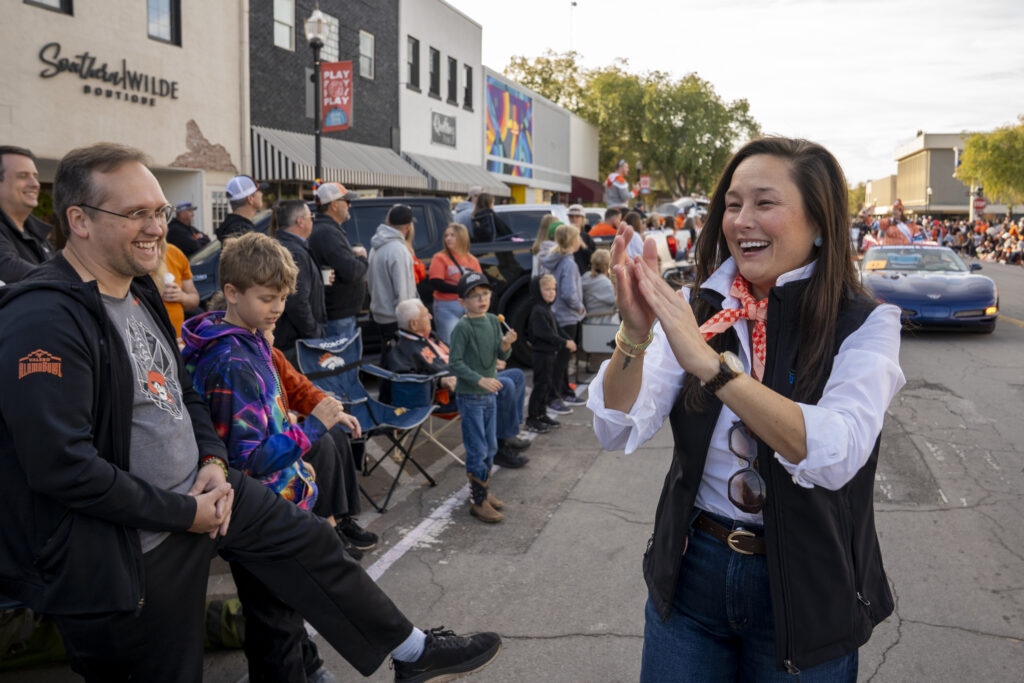
Munson’s hopes of an upset victory hinges on voters like Chastin Johnson-Leggett, a 36-year-old farmer from Jones, in central Oklahoma. He’s previously campaigned for Republicans and voted for Trump, but now he said he’s fed up with his party. He joined Munson as she recently marched in the Oklahoma State University homecoming parade.
Johnson-Leggett runs a farm with sheep, cattle, goats and rabbits and coaches youth livestock competitions. He blames Trump’s tariffs for the rising cost of feed, with prices increasing $4 to $5 a bag this year, Johnson-Leggett said.
“I have to start to wonder: How can I continue to support a party that’s not supporting us?” Johnson-Leggett said.
Johnson-Leggett voted for Mazzei’s opponent in the Republican primary, who was considered more moderate. He said he still supports some of Trump’s policies, but the combination of what he described as the president’s hateful rhetoric and harm to Johnson-Leggett’s industry has driven him away from Trump and the people he has endorsed.
Mazzei said in an interview that he is a strong supporter of Trump, but he’s not going to agree with every Trump administration policy, especially if it hurts the state’s ranchers.
“We so appreciate their hard work to feed Oklahoma and feed America with great American beef, and so, this particular matter, I support them and will always stand with Oklahoma farmers and ranchers,” Mazzei said in the interview.
Trump has tried to reduce costs for farmers by expanding access to tax-free red-dyed diesel and offering $8 billion in one-time payments during harvest season.
But some in agriculture say these steps are not enough and don’t heal the damage the president has wrought.
Munson, the Democratic minority leader in the state House, is trying to capitalize on the frustrations of Oklahoma’s farmers and ranchers.
She plans to appoint a secretary of agriculture to form policy and hire a director of forestry to combat wildfires that threaten the agricultural industry. But Munson has been vague on how she would specifically help ranchers and farmers affected by Trump administration policies.
During a forum hosted by the cattlemen’s association, Munson called the crowd the “stewards of the land.”
Munson said in an interview that Republican voters are feeling frustrated with GOP lawmakers and want these officials “regardless of what level of government they’re in, to respond to their needs and not just do what the president says.”
Munson’s greatest challenge, however, is whether those frustrations would translate to votes for a Democrat in a state that hasn’t elected a Democratic governor in two decades.
Belden, the cattleman in Broken Arrow, said he said he doesn’t vote based on party but rather his core values, including his Christian faith. He opposes Munson’s stances on issues such as “transgender surgery” for minors. Munson’s campaign website touts that she stood up to “attacks on trans kids” in the state legislature.
So Belden will set aside his frustrations as a rancher, and vote for Mazzei.
The post Ranchers’ anger at Trump is threatening GOP in deep red areas appeared first on Washington Post.