Little is clear about the power dynamics that will govern Israel and the United States in the coming months after pivotal elections in both countries. But Iran’s leaders are watching the contests closely, analysts said, and bracing for a renewed round of conflict whatever the outcome.
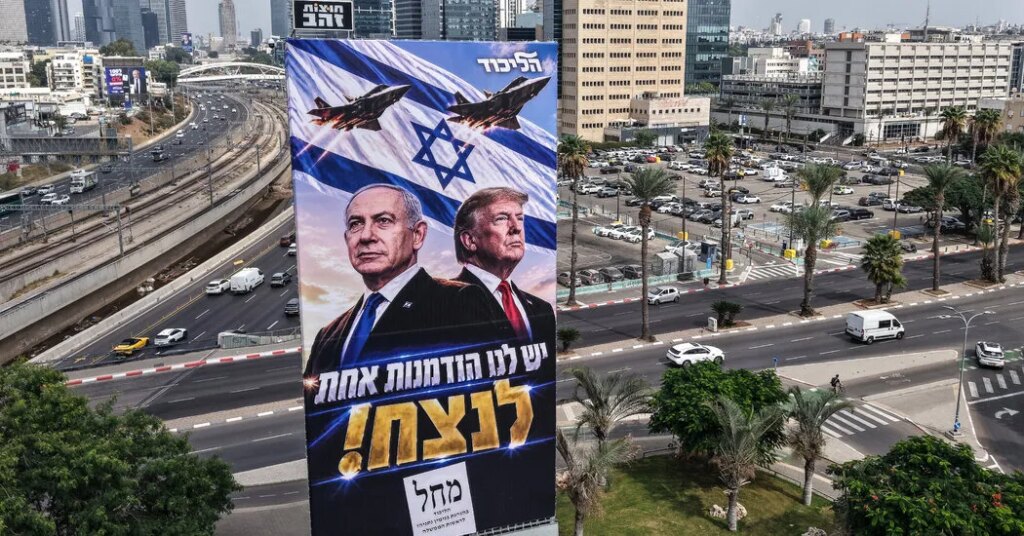
In Israel, this week’s national elections showed that neither Prime Minister Benjamin Netanyahu’s far-right alliance nor the main opposition bloc, led by Gadi Eisenkot, the country’s former top military official, won enough votes to form a government. That has set the stage for weeks of uncertainty.
In the United States, Democrats appear to be in a strong position to at least take control of the House in the midterm elections next week. But the exact size of their win, and whether they secure a majority in the Senate, will determine if they can actually put a brake on President Trump’s policies, including the war with Iran.
Tehran expects more attacks whoever takes control in Israel or of Congress, and has shown little willingness to make concessions demanded by the Trump administration to seal a peace deal.
“They have been expecting a new round of war already for a few weeks, and they’ve been preparing accordingly,” Hamidreza Azizi, senior Iran analyst at the International Crisis Group, said of the Iranian government.
In Israel, Iran would welcome the removal of Mr. Netanyahu from power, said Mohammad Saleh Sedghian, director of the Arab Center for Iranian Studies in Tehran. The Israeli leader helped persuade Mr. Trump to attack Iran this year and sought to orchestrate new airstrikes on Iran ahead of the election. But Iranian leaders believe that changing prime ministers would probably have an impact only in the short term rather than leading to a fundamental shift in Israeli policy, Mr. Sedghian said.
“Iranian and Israeli policies toward each other have remained consistent regardless of which government has been in power in Israel since the 1980s,” he said. “Any changes would likely be temporary rather than strategic.”
Mr. Azizi said there were several scenarios for how the Israeli election results could unfold, but that “we should not expect a fundamental change in the hostility between Israel and Iran.”
Even if Mr. Eisenkot or another opposition leader takes power and shifts Israel back into deploying covert tactics against Iran rather than all-out war, Iran’s response could still be escalatory.
“The Islamic Republic’s strategic thinking has undergone a significant shift, involving, first and foremost, a greater willingness to take risks and a move away from its long-established policy of strategic patience,” Mr. Azizi said. “As a result, Iran could still respond to indirect Israeli operations through direct military action.”
When it comes to the United States, Iran’s leaders are keenly aware of how the costs of the war, including higher gasoline prices for Americans, have affected Mr. Trump’s popularity and the Republican Party’s prospects in the midterms. Their assessment appears to be that a deal with Iran would benefit Mr. Trump politically, giving Tehran leverage in any negotiations to end the war. Iran, on the other hand, has already borne enormous costs including spiraling inflation, without its leaders changing their stance.
Mostafa Najafi, an analyst who is said to be close to Mr. Rezaei, wrote on social media on Wednesday that the Trump administration was pursuing a deal with Iran in the days leading up to the midterms as Republicans face a difficult fight to retain control of Congress.
“They want to leverage the agreement for the elections and insist that nuclear concessions also be part of the pre-election deal, which Tehran does not accept,” Mr. Najafi wrote. “If no agreement is reached in the next two days, the atmosphere will likely shift toward confrontation in the first week after the elections.”
Last week, Vice President JD Vance sent a letter to a top Iranian official to propose a new round of comprehensive peace talks, a senior U.S. official and an Iranian official with knowledge of the communication have said. Mr. Vance bypassed Iran’s elected government and President Masoud Pezeshkian and instead addressed the letter to Mohsen Rezaei, the top national security adviser and the former longtime commander of the powerful Islamic Revolutionary Guards Corps. The outreach to Mr. Rezaei reflected the Trump administration’s view that it needs to deal directly with an Iranian official with influence over hard-liners, who have opposed agreeing to a deal.
On Friday, a Qatari delegation arrived in Tehran for talks, Iran’s state news outlet reported. Qatar has been mediating discussions between Iran and the United States.
The burst of recent diplomacy comes at a significant moment. Mr. Trump has been weighing whether to renew attacks on Iran, potentially after the midterms, and the United States and Israel have drawn up specific plans for new strikes, U.S. officials and other people briefed on the deliberations have said. But there are major obstacles that would need to be overcome for the United States and Iran to reach a final agreement.
“The two sides remain far apart on several critical issues, including the Strait of Hormuz, sanctions relief, oversight by the International Atomic Energy Agency and the scope of Iran’s nuclear commitments,” said Mehrzad Boroujerdi, an Iran expert at Missouri University of Science and Technology. “My sense is that Tehran will pursue a dual-track strategy, engaging in intermittent diplomatic negotiations while simultaneously preparing, to the best of its ability, for a possible resumption of hostilities.”
Mr. Najafi, in his social media post on Wednesday, said that Iran “insists on the fulfillment of its seven conditions” before agreeing to any interim deal. Iranian officials have referred frequently to the conditions in the past month without fully explaining what they are, and framed them as a prerequisite for new talks or the reopening of the Strait of Hormuz, the critical shipping waterway on Iran’s southern coast.
Mr. Najafi said in a voice message to The New York Times that the conditions included lifting the U.S. naval blockade on Iran and sanctions on Iran’s oil sales; ending the war on all fronts, including in Lebanon, where Israel has been fighting with Hezbollah, the Iran-backed armed group; releasing frozen Iranian assets; and accepting Iran’s management of the Strait of Hormuz.
“Iran has put forth these to the American side as preconditions for the opening of the Strait of Hormuz,” Mr. Najafi said. “The American side must first fulfill these preconditions, and then the negotiations will enter the main phase.”
Mr. Najafi also expressed deep pessimism about the prospects of a lasting agreement between the two sides, saying that Iranian officials have no trust in American intentions or promises.
“Here, the messages exchanged with the United States are viewed with profound skepticism,” he said. “The issue of Iran-U.S. relations has become so complex that even if Iran were to agree to nuclear negotiations and make concessions, it is highly unlikely that this tangled web of conflict between the two nations will reach a meaningful resolution or result in a lasting agreement.”
Leily Nikounazar contributed reporting.
The post Iran Braces for More War, No Matter the Outcome of the U.S. and Israeli Elections appeared first on New York Times.