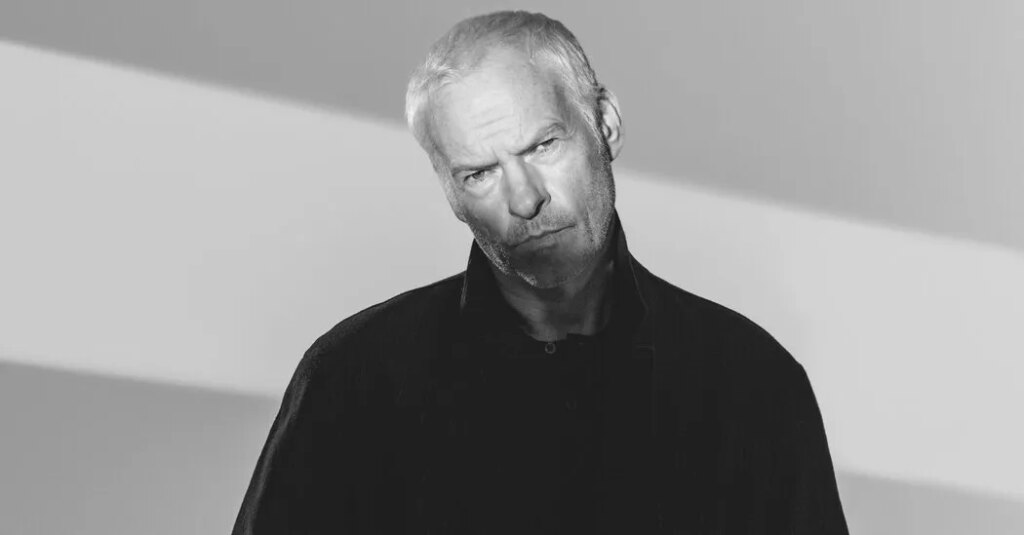
The writer-director Martin McDonagh has carved out a highly esteemed cinematic career as a chronicler of extreme, and often extremely bloody, behavior carried out on a relatively intimate scale. “The Banshees of Inisherin” (2022), to pick one of his films, was about two friends on a remote Irish island descending into a feud. “Three Billboards Outside Ebbing, Missouri” (2017), to pick another, looked at a mother’s attempt to get justice for her murdered daughter. That those movies, despite their dark setups, are often as vulgarly funny as they are emotionally affecting is evidence of McDonagh’s originality — and his skill too. (McDonagh was an enfant terrible of the British theatrical world before he turned to filmmaking.) The 56-year-old’s films have earned a cumulative 18 Academy Award nominations, and “Six Shooter” (2004) earned him an Oscar for best live-action short.
With the new “Wild Horse Nine,” his fifth feature, which is already earning major awards-season buzz, McDonagh has widened the aperture. The movie, in theaters Nov. 6, follows two C.I.A. agents, played by John Malkovich and Sam Rockwell, who have been deployed to Chile in 1973 to destabilize the country’s nascent democracy after President Allende was elected. That setup, which pivots on a fateful trip to Easter Island, allows McDonagh to explore big ideas about political power and America’s foreign misadventures, in addition to his more typical forays into male friendship, interpersonal ethical dilemmas and gleefully crass humor. As he explained to me when we spoke in New York this fall, those elements all add up to something that for McDonagh — however counterintuitive it may seem — are expressions of hope.
Subscribe: Apple Podcasts | Spotify | YouTube | Amazon | iHeart
“Wild Horse Nine” is coming out in the middle of a broader conversation — and argument — over America’s place in the world. That often comes down to a binary: Is America a force for good or bad? How do you see America’s place? Right now, I’m not sure. I guess we’re all a little bewildered about what it stands for. But the film explores a time when, seemingly, America’s place in the world was as the good guy, which is what most kids in the West — not just in the U.S. but in the U.K. and Ireland, Western Europe — are brought up to feel. The C.I.A. are the good guys and the K.G.B. are the bad guys; America is the good guy and Russia is the bad. But the more I read about what the C.I.A. were up to throughout the end of the last century, and particularly in Chile — to destabilize and help overthrow a democratically elected government, which ended up in fascist horrors for 15 years — it makes you think that you’re not being told the truth about the West and its moral outlook.
There’s a line in “Wild Horse Nine”: “Life is sad, everything is sad.” That line struck me as a melancholy iteration of a line from your play “The Pillowman,” which is: “The world’s a pile of [expletive].” There are moments of grace in your work, but is that your view? That’s not me. In both instances, it’s the setup to a joke, in a way. And both of those characters are quite nasty, tough cop characters. So I don’t know if that’s the way I feel about cops. I don’t think so. It’s weird because I guess my stuff comes out dark and sad in a lot of places, but I’m so the opposite. I never thought I’d be in a position to make a film, for instance. I never thought that would be open to me growing up as a working-class kid in London. So no, I definitely don’t feel that way about the world.
I do think of your work as generally pretty dark. Really?
Yeah. How could it be the case that the work doesn’t represent something about your innermost feelings about life? But questioning and disbelieving what you’re told isn’t dark, and making art is always hopeful, even if it’s dark art. I always think of Leonard Cohen and people saying that his stuff is depressing. I find it the total opposite. The tunes are beautiful. It’s poetic. I mean, I’m not disagreeing with people who say my stuff is on the dark side, but in the writing of it, I’m joyful. The performances are so wonderful, and the visual, cinematic parts of it are so wonderful, that darkness honestly doesn’t come into it from my perspective.
You said that making art is a hopeful act. Do you think the art that you make has the ability to change the people who see it? That’s a hard one. But if an audience has come out having laughed a lot and learned some stuff, particularly in this one about Chile, then that is what I’m after, and all of that is hopeful.
I used to agree with you, but now I don’t. I often think of a quote, from the British comedian Peter Cook, about the political efficacy of satire. He said, I’m paraphrasing, something like, Well, the greatest satire in the world was in Weimar Germany, and that stopped Hitler right in his tracks. [Laughs] It’s a very good line. Is hopeful work going to stop stuff? I don’t know. But is anything?
So I think of your work as —— Dark and bleak. [Laughs]
Dark and bleak, but also as the product of someone who likes to provoke a reaction, even if that’s a recoil. Um. …
Am I wrong about that? No, no. “Recoil” I might question. I often think about this. Yeah, it’s all quite provocative. It’s never intentionally offensive. It’s often outrageous. For instance, Malkovich’s character in this movie is outrageous. But I don’t think he, or even the film, or any of my stuff, is offensive. I always feel like my heart is in the right place morally. I have a predilection for being naughty. In this movie, there’s a scene about cheeses, for instance, that is quite naughty. But it never occurs to me to be offensive.
What’s the difference between being outrageous and being offensive? One is deliberately trying to hurt or attack an audience, whereas the other is to almost delight in something you haven’t heard before or you might not have thought of.
Do you want to say the thing about cheeses, or should I? You can go ahead.
So Malkovich’s character has a little disquisition about how what he calls the “gay countries” make the best cheeses. Yeah, Holland, France, the U.K. and Switzerland make great cheeses, and they are some of the “gay countries.” Russia is definitely not a gay country. I’m going to get in so much trouble.
It’s in the movie! It’s true. And Russia doesn’t have good cheese, and there’s a connection between the two, which is then connected to democracy, and democracy leads to gay, leads to good cheeses. Something I’ve thought about often and I think is true.
I’m sure there are people who will find that scene problematic or offensive. But when you’re watching it — and I’ve watched it with a whole lot of audiences, mostly pretty liberal audiences — the biggest laughs in the whole film are in that scene. And I think it’s because it’s outrageous, but there is some kind of weird something to it.
But going back 30 years, there have been people who have said your work is offensive. Do you feel as if the conversation about what causes offense — who can say what, and using what language — has evolved or changed in that time? It’s gotten worse, especially in the last 10 years. Only in the last 10 years have I been asked to change words in plays from 25, 30 years ago because of offense taken by certain words that wasn’t there 25 years ago. Those words were there to be either outrageous or to be truthful. If you’re writing a racist character, they’re going to use racist language. To try and cut those out 25 years later — for what reason? I’m never quite sure. If you don’t like that in a play, you should just not do the play. You shouldn’t try and change the play 25 years later.
Is it the N-word that people ask you to change? No, actually much softer, but words that could be seen as equally racist or offensive.
When I was preparing for this interview, I read a lot of essays about your work, and there were two that stood out to me on the topic of race. There was a piece by Hilton Als about your play “A Behanding in Spokane” where he equated a Black character in it to a Stepin Fetchit type. And my colleague at The Times, Wesley Morris, wrote a piece about “Three Billboards” where he said he thought the characters’ use of the N-word was glib. Those are two Pulitzer Prize-winning critics, both Black men, who saw something troubling in the work. Does that make you think, Maybe there is something I need to look at that I’m doing? Or do you think, No, they just don’t get it? After the play, the one that Hilton had the issue with, I did have a look back on it and wondered about the amount of offensive words. I felt my heart was in the right place when I wrote it, mostly about portraying the stupidity of the main guy who is racist. But you definitely take it on board. If you grew up completely antiracist, and that’s part of what your attempt at art is about, when that doesn’t go across to certain critics, you definitely have a think about it.
What do you think about it? Just to question the language a little bit in the next one, or maybe take a little more care about that subject. Less so about the film. I feel like the film was taken as redemption to a character that I didn’t feel was true. I don’t agree as much with that one.
Your work often generates questions about political correctness or the use of language. But there’s comparatively less writing about the violence. Why do you think one subject gets people agitated and the other — violence — seems to raise no questions for people? It’s weird, right? Well, I’d have to disagree.
You get it for violence, too? Yeah. That it’s gratuitous and always there and doesn’t need to be.
What do you make of that? I don’t think it’s always there, and I never make it gratuitous — never intentionally. Especially with the stage work, I was brought up having to watch English plays, which were, like, people drinking cups of tea for two and a half hours, and I always wanted to shoot them — onstage. [Laughs] So that naturally evolved into the plays I made. I’m being a bit glib, but I did think plays should be as exciting as the best films, and that meant you should be able to do anything onstage that you can do in a film, which led to a little violence now and then, but always with a moral dimension to it. Again, I would never want to be offensive with it. But I think they’ve been getting less and less violent. If you discount all the fingers in “Banshees,” there’s hardly any violence at all. I guess the donkey gets it, but offscreen!
“Wild Horse Nine” is a film, like “Banshees of Inisherin,” about characters who are thinking about their legacy — what they’re leaving behind and what their life will amount to. Is that a question that you think about? Oh, I knew you were going to go there. I think so. With every piece of work, you’re hoping to add to your canon of good stuff, and if you do enough of them or leave behind enough of them, that’s a route to happiness.
Why would leaving behind good work be a route to happiness? Well, you’ve got to have something. When you get a play right, it’s gone forever. It’s beautiful in the moment, but I can’t show you “The Beauty Queen of Leenane” from ’96, or “The Pillowman” from London. You put all your energy into those pieces of hopeful art and they’re gone. I think that’s probably why I’ve stuck with films lately, and why I’m happier artistically: They’re there and I can see them and I know that other people are going to be able to see them. In answer to the legacy bit of the question, it’s a pretty good thing if that’s what your role has been in the artistic world, just leaving some good films behind. I want them to be full of good acting and funny moments, and in this one a bit of truth about history that isn’t spoken about enough, and in “Banshees” a take on male friendship that’s not explored too much.
The new film is also about a male friendship. What ideas were you interested in exploring this time around? “Banshees” was the end of a loving male relationship. “Wild Horse Nine” is in the middle of a love affair, almost. I think of these two guys, Sam Rockwell and John Malkovich, as this old married couple who bicker and drive each other nuts, but there’s a love that’s fundamentally there in every scene. My male friendships are quite deep and sad and open and everything that a female friendship is acknowledged to be and is seen in the culture. I like the gentleness of my male friendships, and to show a bit more of that and not just have a buddy movie is what I was trying to get at with this film.
A lot of the male friends in your work are exploring ethical dilemmas. In your own life, have you and a friend had to work through an ethical problem? I don’t think so. Have you?
Of course. I think the great ethical dilemma of my life is, if it makes sense to say, a post-mortem ethical dilemma. I’m wasting your time talking about this. I’m loving it.
My best friend from growing up died from suicide. I had no idea he was hurting that much. And then trying to think through — this was a few years ago now — What were my ethical responsibilities there? How did I fail? What was I culpable for? And then also how much blame — or not — to apportion to him for what he did. I still think about it. And do you talk about that with your male friends?
Yeah. And do they have a similar feeling?
We have pretty different feelings. One of my good friends says this was an instance of mental illness and my friend had fallen through the care cracks, as it were, and how can you blame someone for that? But probably too harshly I can think, I don’t think he was mentally ill, and my friend who died does have some responsibility for what he did. I don’t think either of us are incontrovertibly right. Yeah, but even that right there is a fascinating discussion you’ve had with your close male friends, and that’s not necessarily something you ever really see in a Hollywood movie. And that, in a very different way, is what I’ve been trying to explore from “In Bruges” (2008) up to now.
I read a collection of academic essays about your work, and at the back of one there’s a biographical timeline. It says, at age 12, “Loses his Catholic faith and begins to listen to punk rock.” What was going on when you were 12? Were those things related? They totally were. I got into the Clash particularly around that age, 12 or 13. They were such a great band to help a kid question everything. I was a working-class kid who had no future apart from a dead-end job, and I left school very young, at 16. Bands like the Clash showed you that there was another way. You didn’t have to have a life that was dictated to you. You didn’t have to work in a factory or an office. There was hope. So, yeah, I grabbed onto that with both hands at the age of 12. And the Catholic thing, I think if you’re starting to question governments and people who force you to do things against your will, which is the punk-rock ethic, naturally the Catholic Church is going to be right in the firing line.
Have you ever regained your faith? No. There are parts of it that never fully go. I’m sure my moral sense is informed by the good stuff I took from the stories of Jesus or whatever. But I’m getting more and more entrenched in some kind of antireligious feeling in general. It is one of the worst things that’s happening in the world, and it seems to be getting worse.
What aspects of your current self would the Clash-loving teenage Martin McDonagh feel most proud of? And what are the aspects that would make him think, Oh, that’s who I turned out to be? Oh, god.
If any. I don’t want to assume you’ve betrayed any youthful ideals. Weirdly, the first time I learned about Chile and Allende and Victor Jara and all the things that this film talks about was from a Clash song called “Washington Bullets” on the album “Sandinista!” And again, I was like 12 or 13 when I first heard it, didn’t know any of these people or any of those situations, and started reading up about it. Joe Strummer was a god to me, and his passion and his morality was always an inspiration, and I always wanted to do something like that. I might have done it in one or two plays, but never in the films have I had a place of anger or wanting to help, I guess. So, for the first time, Joe might be proud of this one.
And what would make the teenage version of you roll your eyes at who you’ve become? That I probably don’t do enough to help in real life. That I have made too much money from it. I don’t have too much guilt about that, because it’s not like I’m killing anyone, I’m just making a film, but that complacency in real life is not what a proper punk rocker should be.
But you can change that now. I can change that this afternoon. What should I do?
Figure out what matters to you and find out how to help. But I think that would be making another film. You can get a viewpoint across to millions of people by making a film. If that’s going to help or not, we don’t know. But I would always come back to that.
So, I think of your dialogue as being stylistically identifiable. Are there things that you know you like to do? I couldn’t put my finger on exactly what it is, but it’s always just slightly overly theatrical and heightened in some way. Pinter and Mamet had a poetic heightening of how people really speak that I thought, This is the way to go.
I can hear Pinter and Mamet in your work — the attention to rhythm, the use of vulgarity, the interplay between a sophisticated wit and low comedy. But I also see your work as coming out of Tarantino — the shocking explosions of violence. [McDonagh bristles]
Was he not an influence early on? Early on. “Pulp Fiction” was around the time I was starting to write the plays. But I don’t really see it anymore. I remember in the early interviews I did, I name-checked him a bit, but I think my stuff has changed since then. That is the only reason I bristled, because I don’t quite see it anymore. And I don’t think our approach to violence is quite the same. The coolness of cinematic violence — I’m trying to walk away from that a little bit. I don’t think Quentin might be in the same place. We talked about gratuitousness, and it’s definitely something I’m trying to stay clear of these days.
You and Phoebe Waller-Bridge have been together for a decade. You’re both private about your relationship, but I read a quote that she gave about being inspired by your play “The Pillowman.” She said: “It was the first play I saw that made me think theater can be really exciting. Sometimes you need to see something like that — a piece of work that wakes you up, that makes you go, ‘Yes, of course that can be done,’ and gives your imagination permission to go 17 million other places.” What of her work has inspired you? “Fleabag” was game-changing and eye-opening and so insightful and funny. I learned so much about that woman, and women and feminism and storytelling. And then Season 2 took it to an even more beautiful place, and I think I learned a lot about love through Season 2.
What about love? Just about how important it is, and how lovely it is when you get there.
I want to return to the punk-rock informed portion of the interview. People are talking about “Wild Horse Nine” as an awards-season contender. You’ve been fortunate enough to be in that position a couple of times in your career. What’s the punk-rock part of Martin McDonagh’s soul that’s like, “I cannot believe I’m here doing this?” What makes you blanch? I knew you were going that way with the question. I knew it! What’s a punk-rock boy like you doing at the Oscars?
No, no. It’s not that. Good for you that you’re at the Oscars. I do ask myself that question.
I’m trying to understand where that part of you manifests in the world. I can see it in the work. It’s a good question. I’m not taking the piss.
You can take the piss. I’ve done it to you. You can do it back to me. That’s true! I think the young me would never give a damn about any kind of awards-y thing because it’s all irrelevant. But once you start getting nominated, I find it fascinating. I’m always googling, “Is John Malkovich still the leading contender?” Who’s coming up? Andrew Scott’s coming up. What can we do to destroy his race? [Laughs] Not really. But because even making films is so far away from anything I’d ever thought I’d be involved in, if you double that and think that an Oscar race is something you never thought you’d be involved in, I just find it fun and enjoy it. The work is the work. I would never change what the work is to get one, or make something Oscar-baity or any of that.
I would really like to see Martin McDonagh’s version of an “Oscar bait” movie. Jesus Christ, what would that be?
“The Orphan of Inisherin.” Who’s going to play it? Timothée Chalamet!
There you go. Hang on, he doesn’t win those, though. I’ve got to get it.
By the time he does your movie, he’ll be due. It’s all about the long game. True.
But earlier when you said you should be doing more to help, you then landed on making art as what you can do. That made me think about a scene in “Wild Horse Nine” where John Malkovich’s character is talking to a young left-wing student about going on a march, and he’s so cynically sarcastic. What do you expect to accomplish going on a march? I could imagine that the Malkovich character is even more cynical about the possibility of art changing the world. In your heart, who do you think is closer to the truth, you or him? [Long pause] I think art has changed things. But I think murder has probably changed a lot more. That’s a terribly bleak answer. But I ain’t going to murder anyone, so I’ve got to keep plowing on.
I was thinking about why I feel so pessimistic about the possibilities of art and I realized that a powerful counterargument to my feelings is already in your film: Victor Jara, the Chilean activist folk singer who was targeted and killed by the Pinochet regime. If the Pinochet regime didn’t think it mattered, they probably would have left him alone. And the Pinochet regime is gone and we still have his songs, so that’s something. But in terms of art changing the world, all of the art we’ve seen or the films we’ve loved or the paintings, they have changed the world, because they’re in it. They might not have changed things politically, but this world’s better because of the poems we love and the books we love and the films that we adore. So it’s not that it’s going to affect Trump or society necessarily, but it is a new piece of beautiful art that’s out there, and I think that is always hopeful.
This interview has been edited and condensed from two conversations. Listen to and follow “The Interview” on Apple Podcasts, Spotify, YouTube, iHeartRadio or Amazon Music. Follow us on Instagram and TikTok.
Director of photography (video): Tre Cassetta
The post Martin McDonagh Says Art Can Change the World. Just Not as Much as Murder. appeared first on New York Times.