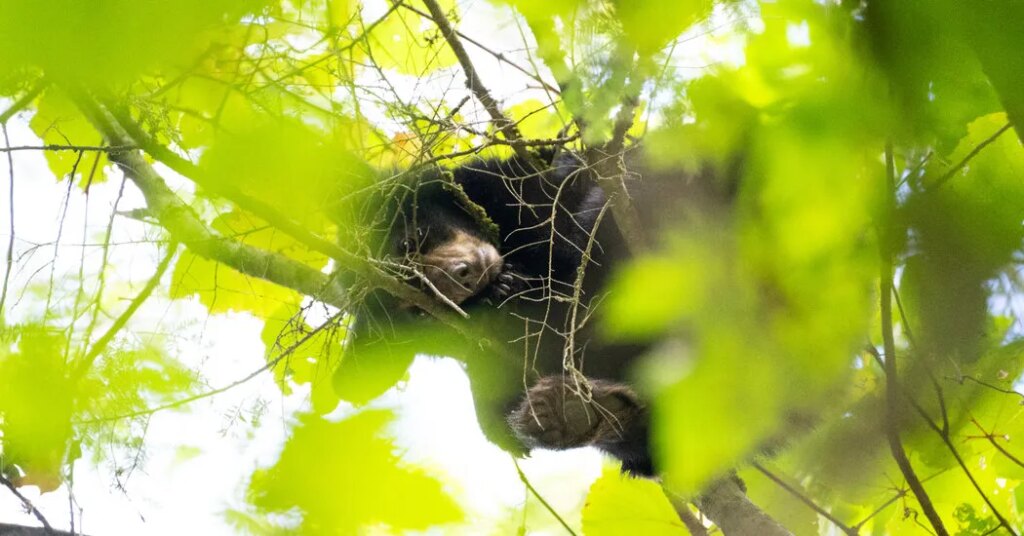
At a Connecticut vineyard where crops weave through rolling hills alongside a glistening stream, the tranquillity is intermittently broken by flashing lights and the piercing artificial noise of howling wolves, wailing police sirens, squealing pigs, exploding bombs and blaring car horns.
The commotion is just one part of the efforts that Jim Frey, the vineyard’s owner, has taken to protect his crop in Woodbury from black bears, whose encounters with Connecticut residents are increasing. Scientists suspect that the bear population has not only grown but also become more habituated to humans.
The number of human-bear conflicts has risen sharply from 531 in 2015 to 3,756 in 2025, according to a March report from the state’s Department of Energy and Environmental Protection. While a vast majority of reported conflicts involve the animals getting into trash cans or bird feeders, home entries by bears are more common in Connecticut compared with other states in the Northeast, the report said. So far this year, the agency has documented more than 60 home entries across 20 municipalities.
People were excited about the bears about 15 years ago, said Jason Hawley, a wildlife biologist at the agency, “but as the population has been allowed to grow uncontrolled, I’ve seen public sentiment change toward a very negative mind-set.”
Last year, four black bears destroyed Mr. Frey’s crop of red grapes, and he has been on a campaign to stop the animals ever since. Mr. Frey said he didn’t mind seeing the bears after harvest, “I just don’t want them eating my grapes.”
Black bears, a native species, were driven out of the state by the mid-1800s as forests were taken over by farmland. The bears returned in the 1980s, when the forests grew back because of land-use changes, which Mr. Hawley called a conservation success story.
“It’s important to remember bears aren’t bad, it’s the mistakes that humans make that create the problems with bears,” Mr. Hawley said.
It is not clear how many black bears are in the state, which is conducting its first black bear population study in over a decade. In 2012, researchers estimated there were between 1,000 and 1,200 bears in Connecticut.
Connecticut’s bears might choose to spend an entire autumn day beneath stands of white oak and black cherry trees, feasting on acorns that fall on the forest floor. Or they might find their food by scavenging roadkill or preying on small mammals or deer.
But when higher calorie, more plentiful human-provided food is accessible, like trash and agriculture, the state’s environmental agency has seen a rising number of bears seize the opportunity for an easy meal.
Bambi Gambino, the co-owner of Country Eatery in Woodbury, said that this year bears began making a mess of the restaurant’s trash more frequently, so the landlord put a metal chain on the dumpster. Brita Lombardi, of Washington, Conn., purchased a bear-resistant garbage can this year after the bears began visiting her home every week. “They’re fearless,” she said.
Mr. Hawley believes the problem isn’t being solved, in part, because Connecticut is the only state without a hunting season — other than Rhode Island, which doesn’t have many bears. He said neighboring states with hunting seasons like Massachusetts or New Jersey had larger black bear populations but experienced far less human conflicts. In those places, only a small number of bears are removed from the population.
“Bears don’t get a chance to get super habituated or friendly toward people because if they do, they’re removed,” he said.
In Connecticut, farmers can request permits to hunt bears that damage agriculture if they can show they’ve attempted nonlethal methods first. Last year, state lawmakers debated a bill to establish a bear hunting season, but rejected it. Instead, House members directed the state’s environmental agency to count the bear population and create a management plan.
For Mr. Frey, of Walker Road Vineyards in Woodbury, the solution to the bear problem appears to be noise. He turned to noise machines after other methods, including electric fencing, failed or proved unfeasible.
This year, he and his son also patrolled the vineyard with a 12-gauge shotgun, not to hunt the bears, but to shoot blanks and make noise when the animals were active. “The bears, I’m sorry, aren’t afraid of us anymore,” he said.
By the time Mr. Frey’s grape harvest arrived in mid-September, he hadn’t seen a bear in weeks.
On a wet, dewy morning last month, guitar chords could be heard across the property as Mr. Frey’s close friends and family members collected bundles of grapes from the vines.
After the harvest, volunteers enjoyed flowing wine and free lunch. Brian DuFord, Mr. Frey’s musician friend, led a group in singing a tongue-in-cheek ballad he had written called “A Bear in the Vineyard,” detailing Mr. Frey’s tumultuous relationship with the animal.
Though the harvest was only about a third as good as it typically is, Mr. Frey was glad to be back in his fields surrounded by those closest to him. Signs of last year’s disaster remained only in the hand-patched netting that the local bears had ripped through.
The post Black Bears in Connecticut Are Eating Grapes and Entering Homes appeared first on New York Times.