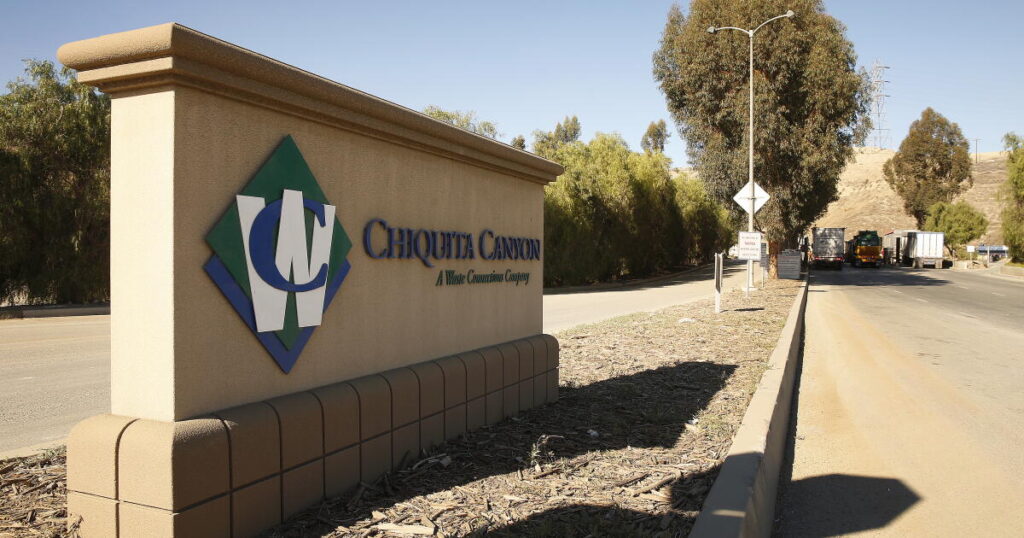
Castaic — A group of California lawmakers and state oversight officials have admonished Los Angeles County health authorities for failing to attend a public hearing on their response to a toxic chemical reaction within Chiquita Canyon Landfill.
The Joint Legislative Audit Committee held a public hearing Thursday evening in Santa Clarita Valley International School to discuss the findings of recent California State Auditor report that identified deficiencies in the Los Angeles County Department of Public Health’s response to health risks at the landfill. Since May 2022, garbage has been smoldering deep underground, releasing toxic fumes into nearby communities of Castaic and Valverde.
The hearing came days after the state Attorney General and the Department of Toxic Substances Control announced a lawsuit against the landfill‘s owner and operator, Waste Connections. The suit seeksg civil penalties and relief for repeated violations of state hazardous waste laws and environmental contamination.
Public health officials cited L.A. County’s ongoing litigation against Chiquita Canyon as the reason for not participating. Assemblymember John Harabedian (D-Pasadena), committee chair, said it was “unfortunate and disappointing” the agency did not appear.
The auditor’s report, published in late September, criticized county officials for taking almost two years to direct the landfill operators to temporarily relocate some area residents, and “could not provide a sufficient reason for why it did not act sooner.” It also said health officials failed to demonstrate that they consistently reviewed air quality data near the landfill, and neglected to notify residents when toxic pollution levels exceeded state benchmarks.
Notably, the landfill operator’s air quality monitors had repeatedly reported high levels of lung-irritating hydrogen sulfide in 2023 and 2024. However, the LADPH officials did not relay these results or explain what they meant to the public.
“We found no evidence of LADPH explaining the health risks to the public, or alternatively, reassuring residents that they shouldn’t be concerned,” California State Auditor Grant Parks said at the meeting. “And the LADPH analyst we spoke with, who was tasked with monitoring air quality data reported from the landfill, was actually unaware of the particularly high gas levels that we inquired about during our audit.”
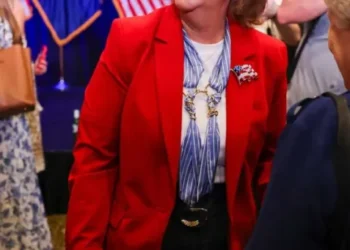
The legislative committee was joined by Assemblymember Pilar Schiavo (D-Santa Clarita), who called for the state audit and authored the recently passed Landfill Safety Act (Assembly Bill 28) in response to the crisis.
“The auditor’s findings … are scathing,” Schiavo said. “It is a clear failure of leadership that our community is not getting the support that they need, and it is the leadership that needs to fix that or get out of the way for someone else to do it.”
State Sen. Suzette Martinez Valladares acknowledged the report identified serious shortcomings. But she also urged the public and her colleagues to consider the full picture.
“Those findings deserve careful examination, and they deserve accountability,” she said. “But the audit also found that the county solid waste enforcement program acted with reasonable speed, and took appropriate steps to address the conditions at the landfill.”
“I believe that we have an obligation to examine this report in its entirety, recognizing what was done correctly, identifying where government fell short, and determining what has to change.”
For over four years, buried garbage has been smoldering inside a portion of Chiquita Canyon Landfill, releasing a toxic brew of gases and leachate that include the carcinogen benzene. The nearby communities of Val Verde and Castaichave also complained about nauseating odors, headaches and difficulty breathing.
Barbara Ferrer, director of the county health department, said in a statement that the state auditor’s report examines the health department’s actions “in isolation” rather than reviewing them in context with myriad of other government regulatory agencies.
The state auditor reviewed the health agency’s response to Chiquita Canyon stood in stark contrast to actions it has taken in past environmental disasters. After the 2015 Aliso Canyon gas leak, county health officials helped to temporarily relocate residents within a month, Parks said.
“The department officials who are in charge now had a sense that Aliso Canyon was more dangerous or potentially had bigger implications,” Parks said. “But the record shows that the conditions and the health assessments of the officials at the time had similar assessments to what is happening now currently.”
Among several recommendations, the state auditor urged the L.A. County Board of Supervisors direct the health department to regularly collect information about health symptoms near the landfill.
Chiquita Canyon closed at the end of 2024. Although the operator installed a cover and new equipment to better collect toxic gases and suppress fumes, the reaction has grown to 90 acres and could persist for several more years.
Jane Williams, executive director of California Communities Against Toxics, said Southern California has been rocked by numerous chemical disasters, including the Lineage warehouse fire and the Garden Grove hazardous materials emergency.
But underground landfill fires are much different. When garbage begins to smolder, it can release liquid waste and pollution for years.
“Usually a chemical disaster is short lived,” Williams said. “Something explodes or blows up. That’s not happening here.”
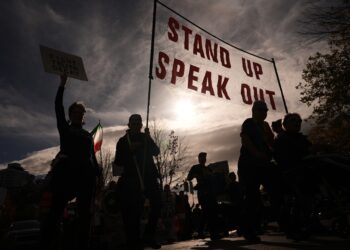
Several dozen disgruntled residents turned out for the hearing.
Jennifer Elkins, a Val Verde resident whose lives less than a mile from the landfill, said her family members have had nosebleeds, respiratory issues and headaches. She said she reported these symptoms to public health officials, but didn’t receive the answers she had hoped for.
“The only response I received was that the symptoms would be logged,” Elkins said. “No advice, no questions, no action was taken other than the logging of our symptoms. There is no policy or procedure, no standard practice. I don’t know if public health didn’t know how to respond or just didn’t want to, but we got absolutely nothing from their work.
At the end of the four-hour meeting, Schiavo lamented that public health officials were not there to hear stories from the community. But she vowed to explore options for state regulators to step in if the county public health officials
“If they don’t change it, the state has to change it,” she said. “We cannot keep waiting and crossing our fingers and begging and pleading for them to show up and do their job and protect our community. We need action and we need it now.”
The post As toxic chemical fire burns, L.A. County officials ghost Chiquita Canyon Landfill hearing appeared first on Los Angeles Times.