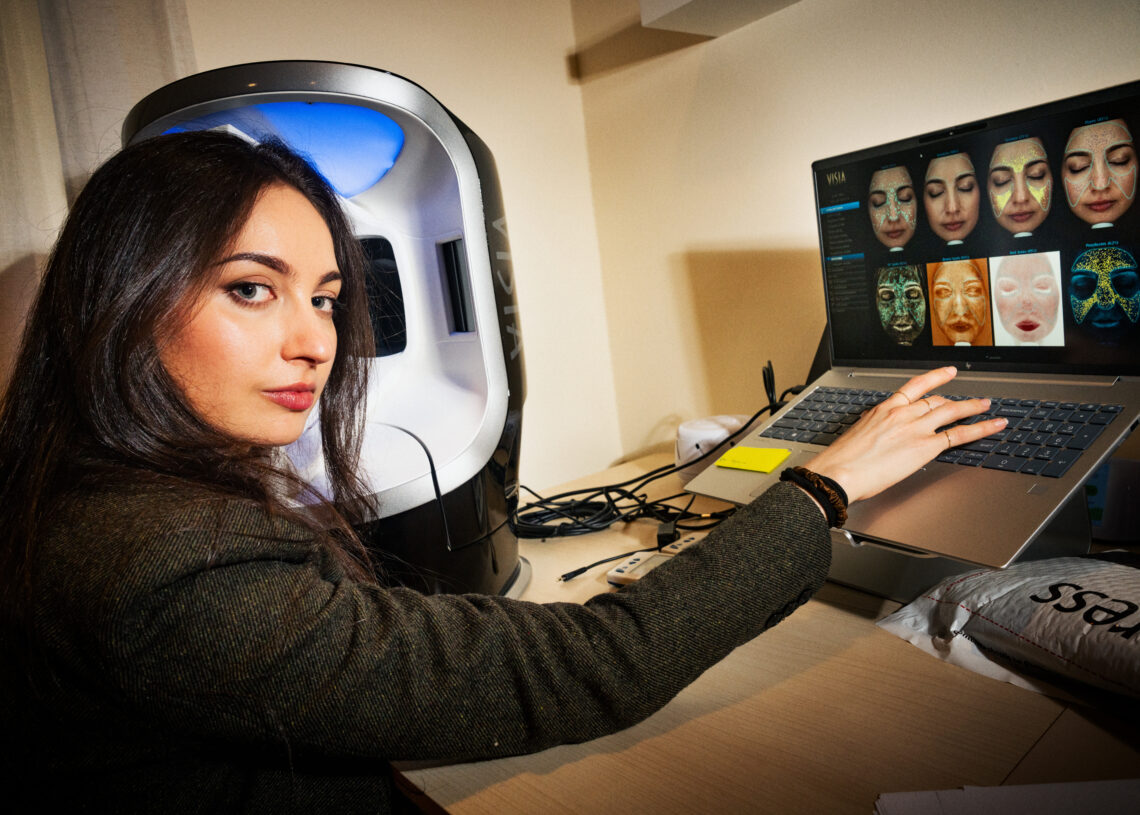
Kate Tolo has turned herself into a human experiment. The 31-year-old entrepreneur from Queensland, Australia, is tracking hundreds of biomarkers and millions of data points, hooking herself up to machines, laying beneath “artificial sun” and eating exactly 1,875 calories a day in her quest to become the world’s “most measured woman.” Everyone is invited to follow along.
“I agonized over it for probably the first six months leading up to making the decision, because I know what it’s like to trade your anonymity in for the spotlight,” Tolo says, beaming in by video from California. “It’s a huge sacrifice to make.” She’s referring to her decision to make those measurements public. Two months ago, Tolo announced she would spend roughly $2 million and hire a full-time medical team to build a “female protocol,” the processes and results of which she would share online. Her focus, so far, is women’s reproductive health.
“I’m not really one to be in front of the camera, and I don’t really enjoy the process,” Tolo says. But though she feels “very nervous” to bare it all, she feels a stronger pull to highlight the “female experience” in health and wellness. “Ultimately, it felt like something I just had to do to fulfill this dream that I’ve had since I was little: to help women,” she says.
It took some time for her to associate that goal with health optimization. In 2016, Tolo was in her early 20s, living in New York and pursuing a fashion career, when developments in artificial intelligence across the country captured her attention. The work and ethos of Bryan Johnson, the 49-year-old tech executive, resonated with her most. “I came across a quote in my inbox, in my email, that was attributed to Bryan,” she says, “and I thought: That person sees the world like I do.”
Tolo reached out to Johnson for years, trying to connect with him to “combine brainpower forces.” Eventually he responded, and the two paired up, with Tolo serving as his executive assistant at Kernel, Johnson’s neurotechnology company. Since then, they’ve co-founded companies and philosophies based on “longevity protocols.” They’ve also fallen in love.
Johnson has long captivated the internet with his personal investments into biohacking. He has publicly documented his efforts not merely to prolong his life but to reverse the aging process. (He aims to functionally be 18 again.) For most of that time, Tolo operated behind the scenes. That changed this summer, when she sought a diagnosis for endometriosis, a chronic condition in which tissue grows outside the uterus, often causing symptoms including painful periods, fatigue and infertility.
“I didn’t think that endometriosis would be part of my journey or my story, especially publicly,” she says. Tolo began experiencing symptoms when she was 21 but didn’t want to undergo the surgery to diagnose it. Ten years later, she recounts that “Bryan was on one of my team calls and overheard me talking about it as part of my intake questionnaire with some of my doctors. And he was like, ‘This is weird. We should look into it.’”
Tolo and Johnson moved fast, documenting the process for millions of followers online. Her first ultrasound came back “clear,” she says, but they followed up with more testing. “We went and got an endo-specific MRI, an endo-specific ultrasound, a blood test and a saliva test. And I came back positive on all four of those modalities.”
An estimated 10 percent of women worldwide have endometriosis, and yet they wait an average of seven to 10 years for a diagnosis, in part because a laparoscopy is required to get definitive confirmation. Noninvasive options such as saliva tests, which can detect “tiny biomarkers,” are becoming more widely available. Still, Tolo says, average wait times remain “ridiculous.”
Tolo tells me that her condition has reached stage 4, which the American Society for Reproductive Medicine classifies as “severe.” “Parts of my body are fused together internally, and I had no idea,” she adds. “I couldn’t not share that experience online and how raw and emotional it felt to get that diagnosis. … It’s just been this pocket of neglect in health care where women slip through the cracks.” How can the system improve? Tolo suggests that advancements in noninvasive testing will be key. “I’ve been thinking lately: There’s a world where endometriosis is a screening thing that happens in your early 20s,” she says. Doctors, in other words, wouldn’t wait for a woman’s body to scar before they caught and treated the underlying disease.
The online response to Tolo’s journey to become the most measured woman has been markedly different, and more supportive, than the response to Johnson’s. Perhaps that’s because, while he has referred to her as “a female Bryan Johnson,” their focuses aren’t the same. Johnson targets immortality, and Tolo longevity. “I’m choosing to not go after immortality,” she tells me. “My objective,” she says, “is to articulate the female experience.”
That evidently means the full experience. In the past four weeks, she has shared online every meal she is eating for 90 days, details of her menstrual cycle and her experience with a “techno tampon.” She doesn’t mind the world knowing her business. “I experience the same shame that everyone else experiences in this world,” Tolo says. “But I refuse to be silenced by that when it comes to simple biological things that affect so many women.”
What about her relationship with intimacy? Millions of people are following Tolo’s menstrual cycle. They know that she and Johnson don’t sleep in the same bed. They know the results of the vaginal microbiome test she took in April, which Johnson praised on social media. (It was a “100/100.”) For most people, these are details kept to themselves or shared only with partners and close family. Are there any red lines for the bionic pair?
What is public and private is decided on a “day-to-day basis,” she says, with “no hard rules” but constant communication. Still, she acknowledges that publicly measuring herself requires a kind of vulnerability that turns the idea of intimacy on its head. “In the process of signing up to put my life online, I had to say, ‘I’m going to be in a relationship with the public,’ which means I will have to be intimate with the public in some way.”
She concedes that it isn’t for everyone and “comes with a cost.” Tolo goes a step further, recommending that no one follow her and Johnson’s lead. “I think we are at the absolute fringe of what’s possible,” she says, laughing. “We’ve dedicated our lives to this. We have become memes, concepts, symbols that represent something. And people can react to that, and they can say, ‘I want that; I don’t want that.’”
What should they want? Rather than encourage people to focus on thousands of data points, Tolo points to one health change she thinks matters above all else: sleep. It is the “most powerful drug that a human can get access to,” she says. “I think there’s a lot of weight on doing these esoteric interventions, but ultimately, sleep, diet, exercise — it’s simple, but it works.”
Sleep may be a universal antidote, but the data from a single person can’t reliably be used to make assumptions about an entire sex. Given the sacrifices Tolo is making, what does she hope will come of the findings? “Our superpower in the world is to make topics viral and to get them into the zeitgeist.”
She doesn’t hesitate to release the “pretty hilarious” or “questionable” tweets, she says, because she’s excited by the attention being drawn to the issues. “It’s men talking to me about endometriosis for the first time, sometimes some of the most powerful men in the world, and they’re like, ‘I had no idea this thing existed and how severe it was.’ That’s change in society, and it has this trickle-down effect.”
If Tolo’s goal is accelerating conversation around women’s health, her experiment is already working.
The post She wants to become the world’s ‘most measured woman.’ Here’s why. appeared first on Washington Post.