Times Insider explains who we are and what we do and delivers behind-the-scenes insights into how our journalism comes together.
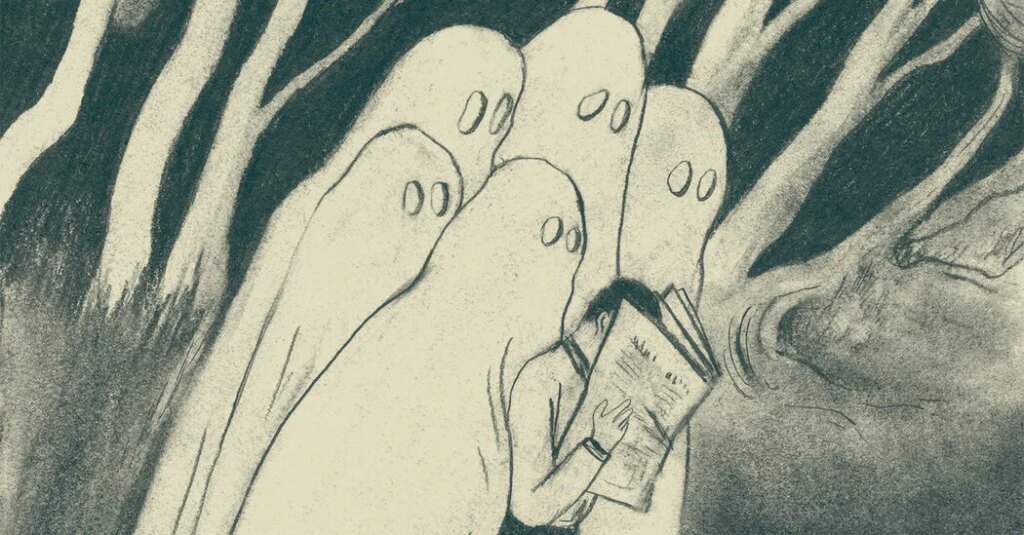
Before the advent of TV and shows like “Ghost Hunters” and “American Horror Story,” people often turned to newspapers to get their ghost stories.
Between the founding of The New York Times in 1851 and the early 20th century, hundreds of tales of goblins, screeching specters and even castle-like mirages appeared in its pages.
“In the 19th century, the newspaper had to serve all the media needs for the readers,” Paulette D. Kilmer, a culture historian and professor at the University of Toledo, told The Times in 2018. “They couldn’t turn on their TVs or computers. The newspaper was the center of their media existence.”
Some other accounts from The Times’s early years: a headless ghost haunting a Long Island cemetery; a phantom breaking crockery at a home in Hartford, Conn.; and ghostbusting at a boardinghouse in Brooklyn, where “demons” were said to startle guests at night.
During the 20th century, ghost stories evolved from quiet Victorian moral tales to visceral, psychological experiences.
The Times’s attitude toward the supernatural shifted as well, and reporters became more skeptical when it came to relaying reports of haunted hotels, bewitched bars and claims of demonic possession.
But why spoil the fun of a good ghost story? In honor of Halloween, here are five of our favorite spooky Times tales.
1909
Paladino Does Her Marvels
On Nov. 15, 1909, The Times delivered a front-page, first-person account of a séance conducted by a famous Italian medium, Eusapia Palladino (spelled “Paladino” in most Times articles during her rise to fame). In front of an audience of 17 that included six newspaper reporters in New York City, Ms. Palladino was said to have invoked a spirit and allegedly levitated a table three times, despite two men holding her feet and knees in place and her hands being “in plain view.”
The act, The Times wrote, “sent the reporters away believing, if not in spirits, at least in a mysterious personal force which contradicts all known laws of matter.”
After a Times reporter and the other newspaper writers left around 11:15 p.m. to make early deadlines, a physician still present described his account of the rest of the evening. He reported that Ms. Palladino moved items on a table without touching them; a “large hand that might have been carved out of alabaster” was said to be the culprit.
The medium’s talents later came under question after the newspaper invited her to perform a séance at its Manhattan headquarters. Ms. Palladino initially accepted the offer and then declined after refusing the conditions of the séance.
1912
Haunted Cage Ends Zoo Couple’s Bliss
You’ve heard of haunted houses, but a haunted wolf cage? That was the malady that afflicted the New York Zoological Park, now known as the Bronx Zoo, according to a 1912 report in The Times. Two wolves, Lobo and Palette, who had hitherto been “a rather mild-mannered pair” became so quarrelsome when they were moved to a new cage that “life together became impossible” and they had to be separated. An unknown, “creepy” force was said to have been responsible.
That wasn’t the first time such a transformation had occurred at the zoo, according to the park’s reptile keeper, Charles Snyder; a formerly “amiable” prairie wolf had previously become “surly and morose,” and an Eskimo dog had developed “a crustiness of temper.”
Through some intrepid sleuthing, the zoo’s wolf keeper, Alex Ferguson, soon got to the bottom of the mystery: An old gray timber wolf whose pen was next to the cursed cage liked to pace his den at all hours, dragging a claw along a board near the wall separating the cages as he turned, which made a scratching noise, followed by an asthmatic exhalation that sounded “like woomoop.”
The scratching, and the “woomoop,” had driven the neighboring cage’s occupants to madness, Mr. Ferguson concluded when Palette recovered soon after being moved to a different cage. (It was too late for poor Lobo, who was also moved but later died.)
“When I think of poor old Lobo,” Mr. Snyder told The Times, “I ponder upon how little it takes to shatter domestic happiness, even among the highest order of animals.”
1976
Diary of a Visit to a Haunted Hotel
In 1976, a Times reporter paid an overnight visit to the formerly upscale Bellevue Stratford Hotel in Philadelphia, which had experienced a rapid fall from grace after more than 150 attendees of an American Legion state convention held there the previous year came down with a mysterious form of pneumonia; the illness killed at least 29 people.
Her aim, said the writer, who readily acknowledged her skepticism (“I am not a fan of mystery tales”), was to investigate the site of one of the country’s most chilling medical enigmas.
She documented her experience over the course of a night, including talking to guests like a woman with a baby who had booked a room even though a cabdriver advised her against it, and weathering a false fire alarm that brought three fire trucks to the building.
The next morning, she reported, her stay had been decidedly fear-free. Maybe the most chilling things she encountered? The “soggy and expensive” scallops at one of the hotel’s restaurants.
The pneumonialike illness responsible for the outbreak the previous year is now known as Legionnaires’ disease.
1990
18 Rms. Riv Vu. Ghosts.
A deal is a deal, whether a house is haunted or not, a judge in New York ruled on March 15, 1990.
A Wall Street bond trader tried to get out of an agreement to purchase an 18-room Victorian house overlooking the Hudson River in Nyack, N.Y., for $650,000 (more than $1.7 million today), claiming the seller had neglected to tell him it was haunted. But a judge essentially told him: You’re stuck.
The seller, Helen V. Ackley, the judge said, was not required to disclose the presence of ghosts. The deal was subject to the same principles that governed buyers trying to get out of properties they later discovered to be undesirable, like those on landfills or with soon-to-be disconnected sewer outlets.
The buyer, Jeffrey M. Stambovsky, could at least take comfort in the fact that the spirits were apparently friendly: Ms. Ackley, who had written about the spirits in a 1977 Reader’s Digest article, described one of them as a “cheerful apple-cheeked man” who looked like Santa Claus. They were also, apparently, somewhat shy: Ms. Ackley had not seen any ghosts recently, she told The Times, though “her son-in-law had a few months ago.”
2014
Flickering Lights, Strange Music and a Ghost at a Brooklyn Bar. Maybe.
Modern readers still love a good ghost story, but the reporter on this one appeared to be skeptical from the start. Peppered with phrases like “for those who actually subscribe to the supernatural,” this Times article about a specter, allegedly Anna Smith, at a Brooklyn bar took great pains to present a decidedly worldly explanation at every turn. (Ms. Smith, who operated the bar during the 1960s and also lived above it, died in 2003.)
It opened with the testimony of a porter, Miguel Vargas, who said that, one morning in September 2006, he arrived for work to find a woman with gray hair in a long white dress walking across the dining room. She appeared corporeal, “normal,” Mr. Vargas told The Times, not translucent like on television.
Things soon got even spookier: After other employees reported music turning on without explanation, lights flickering and the feeling of being watched by an unseen presence, construction workers digging up the dining room floor unearthed a burial site. It contained a three-inch stone statue of the Madonna and child, a pair of children’s brown Mary Jane shoes, bone fragments said to originate from a small animal and a tiny gold ring.
Soon after, the employees began reporting broken glasses, sometimes as many as 20 a day.
“I thought the ghost was not happy about its possessions being taken from the floor,” the bar’s manager, Wesley Ham, said.
But the bar’s owner, Nina Brondmo, was dubious. She said vibrations from the drilling during construction had already made the glasses brittle, and added that, despite living in Ms. Smith’s former apartment, she had never seen anything to make her believe the building was haunted. The staff, she told The Times, was just superstitious.
The post A Terrifying Turn Through Ghost Stories of Times Past appeared first on New York Times.