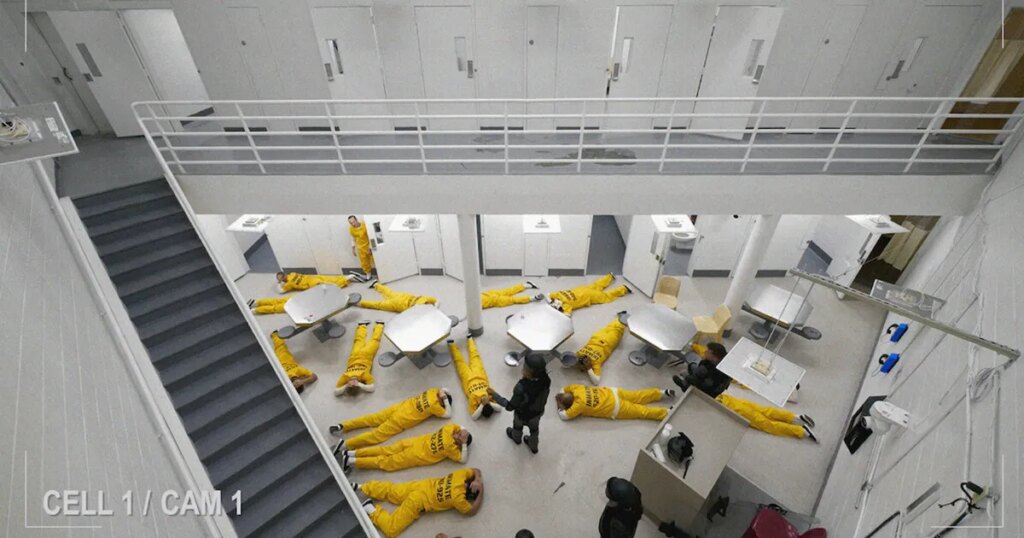
Netflix has recreated one of the most notorious and horrific social experiments in history: the Stanford prison experiment.
The 1971 study has left an indelible legacy in psychology for perhaps all the wrong reasons. In it, Stanford University psychologist Philip Zimbardo had 24 male college students randomly assigned to play guards or inmates in a mock prison to see how power structures could affect the behavior of ordinary people.
It was intended to last two weeks, but was shut down after just six days. From the very start, the students assigned as guards went on cruel power trips and repeatedly humiliated — if not psychologically tortured — the inmates, to the point that some of the prisoners suffered nervous breakdowns. The most infamous images show inmates forced to wear bags over their heads.
Needless to say, the Stanford experiment continues to be controversial for its dubious ethics and the equally dubious rigor of its methodology. Debates still rage over what conclusions, if any, to draw from such a deeply flawed but undeniably compelling study.
Netflix’s conclusion? That recreating the unsavory experiment would make for good television.
The resulting six-part series, “The New Stanford Prison Experiment,” is less abjectly horrifying but still a tough watch, according to the Washington Post. “Nobody ends up with a bag on his head,” writes its critic Monica Hesse, and there’s “no workplace sadism.” But “what there is, again and again, are a minority of people who have come to an experiment about power and authority with apparently no set definition of power and authority.”
Hesse described it as “maddening” to watch people choose to be punitive instead of judicious when there’s nothing forcing them to act that way. Her chagrin was deepened by the apparent pseudoscientific predilection of the experiment-runners, like the “psychologist who keeps introducing crazy variables and then murmuring, ‘Interesting!’ as if she stumbled upon the lunacy rather than planted it.”
It sounds, then, that Netflix’s riff on the Stanford prison experiment is faithful to the original in that it’s fatally flawed. Zimbardo admitted in his 2007 book “The Lucifer Effect” how he acted as the prison’s “superintendent” and even coached the guards how to behave — details that critics say clearly compromise the objectivity of the study and biased it towards certain outcomes. There’s probably little about human behavior that the Stanford experiment has left to tell us, but it still clearly captures our imaginations.
The post Netflix Turns Horrific Social Experiment Into Reality TV Show appeared first on Futurism.