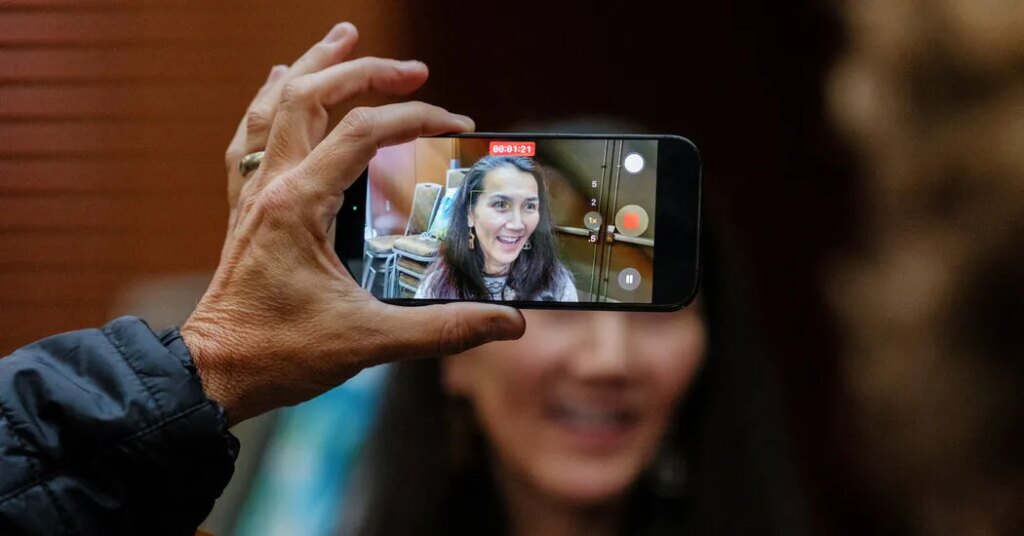
It was a shenanigan designed to give an Alaska Democrat, Mary Peltola, a leg up in her Senate race against Senator Dan Sullivan by stacking the ballot with spoilers.
And after my colleague Kellen Browning revealed yesterday that the extra Dan Sullivan running for Senate in Alaska was every bit the Democratic plant Republicans accused him of being, the fallout has been swift.
President Trump has called for Peltola — as well as the second Sullivan — to be kicked off the ballot. Vice President JD Vance accused Peltola of trying to “steal” a seat. Peltola says she’s not going anywhere.
Tonight, we’ll look at the major legal and political developments in the wake of Kellen’s reporting. Then we’ll answer a question I’ve heard from readers: How unusual are these ballot hijinks, anyway?
The investigations
Trump has long sought to stoke doubt in election results that don’t go his way, and he pre-emptively challenged the Alaska election result before The Times published our report. My colleague Glenn Thrush reported today that the Justice Department has begun sending out dozens of subpoenas as part of that investigation.
And Representative James Comer, a Kentucky Republican who leads the House Oversight Committee, requested testimony from two Democratic operatives named in our story: Elisa Rios, Peltola’s former campaign manager, and Jerid Kurtz, a strategist who Rios said had traveled all over Alaska trying to recruit would-be spoilers.
Some election law experts have cast doubt on the idea that there is a federal case to be made here, since elections are administered by states. In Alaska, Gov. Mike Dunleavy, a Republican, has ordered an investigation into whether Peltola’s campaign should face criminal charges or civil penalties for its role in recruiting spoiler candidates.
But proving it was a crime is likely to be difficult, Kellen and Anna Griffin wrote, particularly after the Alaska Supreme Court already rejected a Republican effort to get the extra Sullivan removed from the ballot.
The politics
It’s difficult to know what, if any, impact the revelations about Democrats’ tactics will have on the ballot box, but we do know this: Early voting in Alaska has been underway for almost two weeks.
Alaska Public Media interviewed voters about our report, and found little surprise.
“It does give — I think as some of the kids would describe it — icky vibes,” Adam Lees, an independent voter from Anchorage, told the outlet. But his support for Peltola, he said, was “mostly baked in.”
One person who has previously supported Peltola admonished her: Senator Lisa Murkowski. Murkowski had already endorsed Sullivan’s re-election, but she had supported Peltola’s earlier runs for the House.
“Alaskans deserve the honest truth from Mary and her campaign — what has been revealed is a pattern of lies and coverups and a culture of deception that belongs nowhere in our elections or among our elected officials,” she said.
Sneaky tactics everywhere
The maneuvers in Alaska follow a long tradition of both sides elevating or promoting spoiler candidates to siphon votes away from their opponents.
And, my colleague Reid Epstein wrote today, those tactics are playing out in several other races around the country right now.
In Ohio: Republicans have spent more than $2.2 million to promote Greg Levy, a member of the Party for Socialism and Liberation, in the Senate race, aiming to pull votes from the Democratic nominee, former Senator Sherrod Brown.
In New Jersey: Republicans have tried to elevate a mysterious candidate named Seamus O’Toole in a House district where polls show the Republican incumbent, Tom Kean Jr., in trouble. O’Toole, whose party is listed as “Stop Israel’s Genocide,” has not responded to efforts by The Times and local media to reach him.
In Nebraska: Both Democrats and Republicans are jockeying to help minor candidates peel votes away from Senator Pete Ricketts, the Republican incumbent, and his Democratic-backed independent challenger, Dan Osborn.
Trump’s allies even tried some mischief themselves in 2020, Reid recalls, when they encouraged Kanye West to run for president to shave off Black voters from Democrats. But the musician failed to get on the ballot in most battleground states.
Get Caught Up
-
Trump’s political operation is spending money on the Kansas Senate race for the first time, buying about $1.5 million in ads to boost Senator Roger Marshall. But Trump also canceled his plans to attend a rally in the state on Saturday.
-
The Trump administration, escalating its effort to prove California’s voting rolls are filled with noncitizens, has opened a criminal investigation and issued grand jury summonses to local officials.
-
Cabinet officials have fanned out across the country to help promote Republican candidates. Government ethics experts say the officials are flouting the Hatch Act.
-
Trump attacked Black and Jewish supporters of Dr. Abdul El-Sayed, the Democratic Senate candidate in Michigan, as “crazy.” He has used a similar strategy of pitting ethnic groups against each other in previous elections.
-
Last night’s New Hampshire Senate debate got tense. Here are my takeaways.
-
Democrats need to flip four Republican-held Senate seats to regain the majority. In the video below, Evan Reynolds, an election data reporter, explains just how difficult that might be.
A survey of this year’s ballot measures
More than 140 statewide ballot measures will go before voters on Tuesday. A new story from Maia Spoto and Leo Dominguez examines the trends in direct democracy this year.
-
Nearly 40 of this year’s measures are related to elections themselves — a record, experts say. In about a dozen states, voters will decide on citizenship or ID requirements for voting.
-
For the first time, voters will decide on transgender students’ participation in school sports. It’s on ballots in Washington, Colorado, Arizona and Nebraska.
-
And across dozens of local races, voters will weigh in on whether to allow the construction of data centers in their communities.
And in Idaho … voters will choose among six weapons — including a frontier-era revolver and a World War II rifle — that they think should be the official state gun.
Who’s really writing that?
A.I.-generated text isn’t just cropping up on one or two midterm candidates’ websites — it’s on hundreds of them.
Times reporters downloaded the text of nearly 700 campaign websites and ran them through A.I. detectors. They turned up evidence of bot-written language all across the midterms, including one telltale sign: a passage with the phrase “isn’t just,” followed by a phrase beginning with “it’s.” (Like in the first sentence of this item. Though we swear that one was written by a human.)
number of the Day
$1.5 million
That’s how much David Bensoussan, a major trader on Polymarket, has wagered on the outcomes of this year’s midterm elections.
Prediction markets like Polymarket and Kalshi have transformed politics into a new kind of casino. This year alone, bettors have wagered more than $221 million on elections, covering everything from individual races to control of Congress. Bensoussan stands to win more than $340,000 if his bets pay out — or lose far more if they don’t.
one last thing
Big portions and big feelings
It’s one of the strangest topics to take up prominent time at two presidents’ rallies in the waning days of the midterms.
Over the weekend, Obama described Trump’s Oval Office renovations as looking “like Saddam Hussein opened a Cheesecake Factory”; Trump retorted that the upscale-casual chain was “a very successful company,” and Republicans pounced on Obama’s quip as elitist. Obama returned to it last night, mocking Trump’s response: “They mobilized a whole-of-government response to that joke — not to inflation, but to that joke.”
How does the Cheesecake Factory feel about its status as a political punchline? Kim Severson, a food reporter, writes:
A writer for Vice once called it “the culinary embodiment of the Kardashians.” The Center for Science in the Public Interest has assailed its portion sizes, calling its food “heart attacks disguised as dinner.”
Kim spoke with Rick McCormack, the designer behind Cheesecake Factory’s postmodern-suburban-Versailles interior. “No design is universally loved,” he said. “I realize that. That is one thing I like about design. That makes the world of design go around.”
Taylor Robinson and Luke Caramanico contributed to this newsletter.
The post Fallout in the Last Frontier appeared first on New York Times.