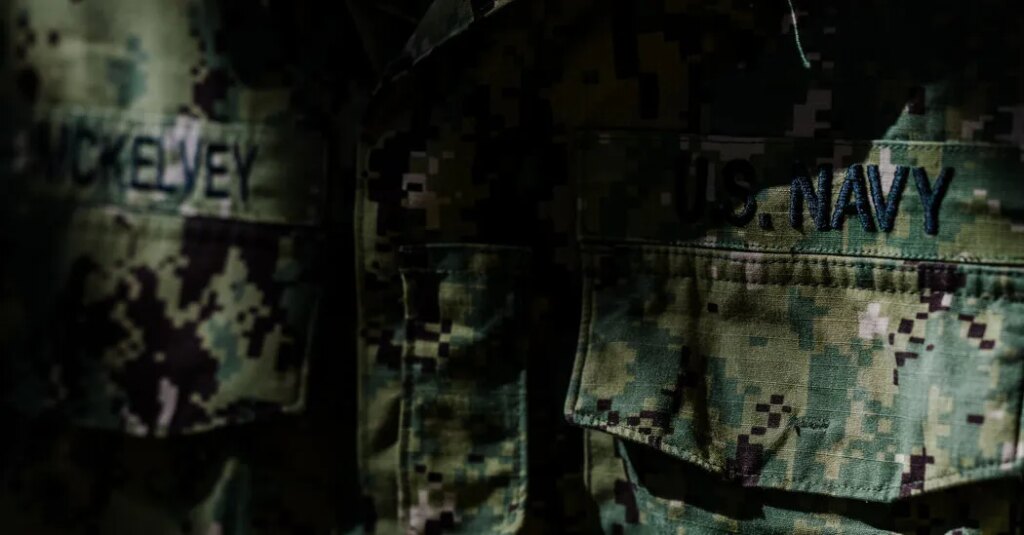
Nicholas McKelvey had been aboard the U.S.S. Abraham Lincoln for 255 grueling days.
As the war with Iran raged, the 19-year-old Navy airman — an aviation mechanic in a helicopter squadron — was working 12-hour shifts in the blazing sun, checking and guiding helicopters on the flight deck. He had missed the birth of his daughter. His in-laws were battling cancer. Food on the aircraft carrier was in short supply.
Then he reached his breaking point.
At about 10 a.m. on a Monday in early August, he sprinted along the flight deck then leaped from the ship’s edge and plunged 67 feet into the Arabian Sea, according to Navy records reviewed by The New York Times. He was rescued by a helicopter crew and returned to the ship 50 minutes later.
“I didn’t want to be there anymore,” Mr. McKelvey said in an interview, speaking publicly for the first time. “If I was going to die because of it, then that’s just how it is.”
On Thursday, the Navy effectively fired him — moving to discharge Mr. McKelvey after accusing him of “malingering,” or faking a mental health crisis to end his deployment, according to Mr. McKelvey’s wife, Samantha Larry. Under the terms of his removal — a general discharge under honorable conditions — he will become ineligible for education assistance under the G.I. Bill, cutting off a pathway to college that his family was counting on, Ms. Larry said.
The case offers a rare glimpse into how the Navy has handled mental health issues aboard ships under pressure from sustained deployments during the war with Iran. And it raises questions about whether officers treated Mr. McKelvey’s jump overboard as misconduct without sufficiently examining what led a sailor to take such an extreme, life-threatening step.
The Lincoln, which returned to San Diego this month after a near-record 322-day deployment, became a symbol of the food shortages and mental health challenges facing Navy ship crews after Iran destroyed a key supply hub in the region.
There were eight suicide attempts during the long deployment among sailors in the Lincoln strike group, according to a letter the Navy sent to lawmakers last month. The letter did not name Mr. McKelvey, but the description of a sailor who “went overboard from the ship” matches his story.
Aspects of the case were earlier reported by MS NOW, which did not identify Mr. McKelvey by name. Mr. McKelvey and his wife said they wanted to come forward publicly now to shed light on what they believed was inadequate mental health care before and after his jump and an unfair punishment.
“They don’t want to take accountability for what happened to him, and to what happened to multiple sailors on the boat,” said Ms. Larry, 19. “I don’t think that they care. They care more about how they’re pictured, how they’re viewed. They don’t want anyone to see the bad stuff.”
The Navy did not respond directly to specific questions about Mr. McKelvey. But a Navy spokesman said that aircraft carriers have “a multidisciplinary team of mental health resources” and that specialists “coordinate and provide care tailored to a wide range of conditions.”
Several former military lawyers and other experts interviewed by The Times agreed that Mr. McKelvey’s case presented complicated issues for the Navy. Some said the disciplinary response was legally justified and relatively lenient because malingering is sometimes treated as a criminal offense.
Others questioned whether the Navy’s response adequately addressed the distress that may have driven him to jump. The Navy, they said, could have focused on treating him, or seeking a medical discharge that would allow him to retain key benefits, rather than accusing him of wrongdoing.
“You’re going to have commanders that are willing to punish people who undertake action that risks their own lives in a moment of extreme mental trauma,” said Rachel VanLandingham, a former Air Force lawyer and a professor at Southwestern Law School. “But there’s so much more underneath it, and fundamentally you don’t need to punish it. You need to treat it.”
For Mr. McKelvey, the future beyond the Navy is uncertain.
He and his wife have been staying in Airbnb rentals and with relatives in San Diego as they prepare to return to their hometown, Jacksonville, Fla., with their two children, a 3-year-old boy and a 8-month-old girl.
After moving, they will try to figure out what Mr. McKelvey will do for work. They will help care for Ms. Larry’s mother, who was recently treated for lymphoma. And they will see if, without the education benefits lost due to his discharge, they can afford for him to one day go to college.
“We’re going to have to pull out student loans,” Ms. Larry said. “It is essentially setting us up for just putting us in debt.”
A Better Way of Life
Mr. McKelvey joined the Navy in 2024 as a path to a stable, good-paying job to support his family.
He and Ms. Larry met in middle school and had their first child when she was 15 and he was 16. They had dropped out of high school. The couple married last year.
In late November 2025, a week before Mr. McKelvey’s 19th birthday, the Lincoln departed from its home port in San Diego for a routine Pacific deployment.
The ship made a brief overnight stop in Guam for supplies roughly three weeks later — the last port of call for several months. By mid-January, the crew was told they would be redirected to the Middle East.
Mr. McKelvey was not alarmed by the change in course, he said. He welcomed the extra pay that would come with potentially heading to a war zone.
As the U.S. bombing campaign against Iran began in February, Mr. McKelvey spent his shifts on the ship’s flight deck helping to secure helicopters while also cleaning and inspecting aircraft for cracks and other damage, he said.
Clad in a long-sleeved cotton turtleneck, heavyweight flame-resistant trousers, a helmet, thick leather gloves and steel-toed leather boots, he worked in extreme heat. The conditions were intensified by the exhaust from fighter jets and the constant hunger he felt as meal portions shrank from dwindling food supplies.
His mind was back home, he said. His wife had given birth to their daughter four days before combat operations began.
Staying connected was a challenge as the ship’s Wi-Fi was disconnected for a month for security reasons at the beginning of the war, according to Ms. Larry. Wi-Fi service eventually returned, but calls would not always go through, and text messages took hours to send if they were sent at all.
In late June, Mr. McKelvey visited the ship’s medical unit seeking mental health care and was directed to speak with a chaplain, he said. But he declined, he said, because the chaplain was not a mental health professional.
The Lincoln, with more than 5,000 service members aboard, had five chaplains and six mental health specialists, including a psychologist and a clinical social worker, according to the letter the Navy sent lawmakers.
The Navy increased funding for mental health care after a spate of suicides in 2022. Nonetheless, a report last year by the Defense Department’s inspector general flagged continued issues, such as some commanders failing to have a proper response plan for sailors who appear at risk of suicide.
Mr. McKelvey said one of his commanders had told him the Navy would try to fly him off the ship. It never happened. Instead, the Lincoln’s deployment was repeatedly extended, deepening Mr. McKelvey’s hopelessness, he said.
“I think the boat is finally getting to me,” he wrote to Ms. Larry in a July text message, adding that he was unsure he could “finish this deployment.”
Man Overboard
A report filed by the officer of the deck — the person responsible for running the Lincoln’s operations from the ship’s pilothouse — described in detail the elaborate response that consumed the ship and its crew for nearly an hour after Mr. McKelvey’s Aug. 3 jump.
As the current carried Mr. McKelvey away, the captain ordered the massive vessel to be turned around. The ship’s navigator kept his eyes on the sailor. An officer initiated a procedure known as “River City,” in which Wi-Fi and other external communications were shut off.
A Navy helicopter flying nearby dropped a floating smoke flare into the water to mark his location.
Mr. McKelvey was about a mile away when a swimmer for the rescue helicopter jumped into the ocean, and 10 minutes later, they were hoisted back up into the aircraft.
In the report, the officer struck a note of skepticism about what might have led Mr. McKelvey to jump. While his “motives are undetermined,” the officer wrote, “the conditions in which he jumped appear suspect.”
He jumped in broad daylight when the ship was moving slowly for maintenance, the report noted. With five-foot waves, and a water temperature of 76 degrees, the ocean was relatively calm. He wore his “float coat,” a special vest used by crew members on the carrier deck that can function as a flotation device.
The officer also wrote that the sailor “almost immediately waved for help” — a point that Mr. McKelvey disputes. He said that he was not waving, but swimming away from the ship.
In the report, the officer acknowledged that the stresses of life on the Lincoln might have played a role. “This has been a difficult deployment,” the report said, “and it is unsurprising that we might have a jumper.”
Mr. McKelvey was immediately taken to the medical unit, Ms. Larry said. He was given Tylenol for back pain.
He met briefly with a psychiatrist, who asked him why he had jumped from the ship, Ms. Larry said. Mr. McKelvey said simply, “I wanted to get home,” Ms. Larry said her husband told her.
He was placed on suicide watch and held in an open room that included several small beds, Ms. Larry said. The next day he was ordered to clean and sweep floors, Ms. Larry said.
Mr. McKelvey was flown off the Lincoln on a cargo plane to Djibouti in East Africa on Aug. 10, where he stayed overnight in a bunker due to bombing in the area, Ms. Larry said. He was flown to Ethiopia the next day and then to Washington State before returning to San Diego on Aug. 13.
He saw his wife and children briefly at the airport before he was taken to the hospital where he was kept for four days, Ms. Larry said.
The day after Mr. McKelvey was discharged from the hospital, he reported to work at the naval base at 8 a.m., Ms. Larry said. He was tasked with sweeping, painting and cleaning before the Lincoln returned to San Diego.
He had his first follow-up appointment several days later, and a doctor prescribed anxiety medication. He declined it, saying he did not want to be on medication.
On Aug. 25, Mr. McKelvey learned that the Navy was charging him with malingering as well as “absence without leave” for abandoning his post when he jumped, according to charging papers reviewed by The Times. As an administrative charge, the process would be handled by a commander who also determines guilt. Such charges are typically less severe than those that trigger a court-martial and potential jail time.
The next day, Mr. McKelvey met with a Navy therapist. Mr. McKelvey said he was ready to provide a fuller explanation for his actions.
“Obviously, I was trying to get home,” he told The Times, describing what he intended to tell the therapist. “I kept my float coat on because if I wasn’t supposed to die then I was going to get saved, but it didn’t matter, and if I was supposed to die then I would have just been dead. It’s that simple.”
But before he could say that, he said, the therapist cut him off and pointed to a record showing what he had told the ship psychiatrist — that he had just wanted to go home.
“‘Don’t try to change anything now,’” Mr. McKelvey recalled the therapist saying.
The Navy soon replaced the absence charge with a new charge — jumping from a vessel, according to Ms. Larry.
During a hearing last month, his commanding officer announced the charges against him, noting that when he jumped he endangered the entire ship, Ms. Larry said.
The officer found him guilty.
Ms. Larry said the Navy punished her husband for having a mental break.
“What they did was wrong,” she said. “They’d rather blame the victim.”
John Ismay contributed reporting.
The post A Sailor Jumped From the U.S.S. Lincoln. The Navy Punished Him. appeared first on New York Times.