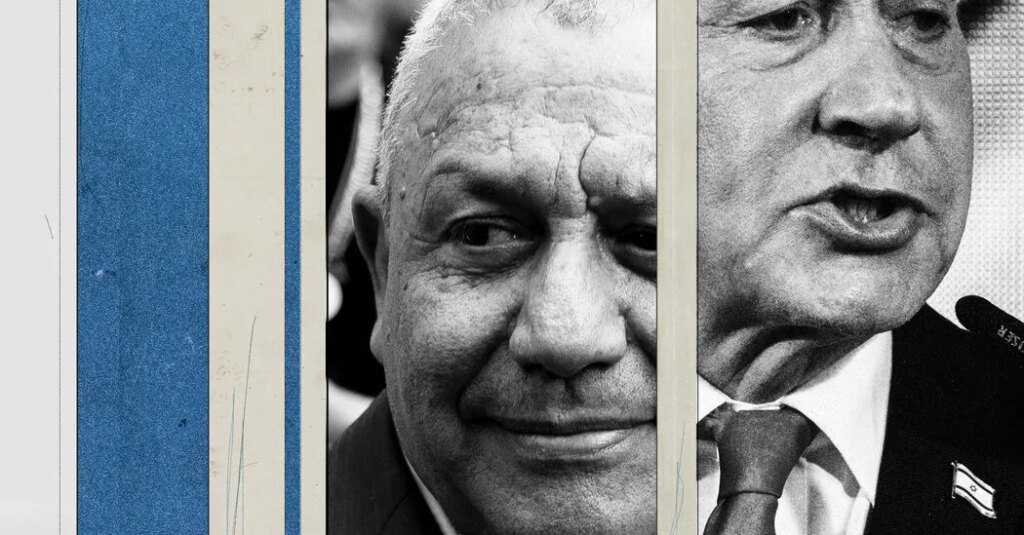
Tuesday’s historic elections in Israel ended in deadlock, setting the stage for negotiations and machinations to create a majority in the Knesset that could form a government. Two blocs are now at loggerheads: Prime Minister Benjamin Netanyahu’s far-right governing coalition and an opposition grouping led by Gadi Eisenkot, a former Israel Defense Forces chief of staff.
In a written online conversation, Daniel J. Wakin, Times Opinion’s deputy international editor, discussed the election with Diana Buttu, Yossi Klein Halevi, Dahlia Scheindlin and Bret Stephens. The text has been edited for length and clarity.
Daniel J. Wakin: It’s been two days since Israelis went to the polls. It was the highest voter turnout in more than 25 years, but neither of the two main blocs will be able to form a government on its own. What do you think is the most likely solution to this logjam?
Bret Stephens: Likeliest? Mr. Netanyahu fails to form a government but continues to govern and hopes events — like another military confrontation with Iran — turn in his favor when another election is called sometime next year.
Dahlia Scheindlin: It’s hard to keep the permutations straight: political stalemate and new elections? A minority government? A unity government? Bloc defections? The biggest question is whether any bloc will do the obvious and include an Arab party in the coalition — those two parties hold 19 seats combined, a record.
Diana Buttu: Israel uses the claim that Palestinians who hold Israeli citizenship can vote as somehow being a defense against the charge of apartheid. But here we see clearly that despite the fact that Palestinians, who make up about 20 percent of the population, showed they wanted an end to this government, our votes are being discounted. The opposition, despite being given an opportunity to seize power from Mr. Netanyahu by forming a coalition with the Palestinian-led parties, cannot seem to get over their racism to finally oust him.
Yossi Klein Halevi: The opposition has three options, none of them good. The first is to go for new elections, in which Mr. Netanyahu is likely to either maintain his support or even increase it. For example, the many thousands of Israelis living abroad who came in just to vote against Mr. Netanyahu will not come a second time. The second option is to depend on the outside support of the two Arab parties and create a minority government. The third option is to enter a so-called unity government with Mr. Netanyahu, but no one trusts him to uphold a rotation agreement — and in any case the main goal of the opposition has been to unseat him.
Scheindlin: Personally, I think Yossi’s second option is a great one. And why only from the outside? Arab parties should join a coalition directly.
Stephens: I don’t think Mr. Eisenkot’s bloc is going to be eager to team up with an Arab opposition that refuses to describe Hamas as a terrorist organization. The problem is that there are so many poison pills on every side of this vote: The Eisenkot bloc won’t sit with Mr. Netanyahu out of personal suspicion, or with the Haredi — ultra-Orthodox — parties allied with the prime minister because the issue of exempting the Haredi from conscription is at the top of that bloc’s concerns. Mr. Netanyahu isn’t eager to form a power-sharing agreement with Mr. Eisenkot if he sees a path to a full term in office. So deadlock is what I suspect we’re going to get until a new election is called.
Halevi: After Oct. 7, no party can sit in an Israeli government whose members don’t recognize Hamas as an enemy. The Israeli Jewish public will not accept it. This is not about racism, though certainly anti-Arab sentiment has spread since the Hamas massacre.
Scheindlin: All of the Arab party leaders have condemned everything about Oct. 7 — they have condemned terror in all possible ways except signing a metaphorical declaration that Israel’s Zionist political leaders are demanding, mostly to exclude them. Don’t worry — when they want the Arab parties in, they’ll find a way. If they want to keep Arab Palestinian parties in Israel out, nothing will satisfy them.
Buttu: Palestinians do not want to be part of a government that carries out genocide, ethnic cleansing and which supports the occupation, and with it the settler terrorism. The Palestinian-led parties are parties that are calling for equality and justice for all. All Israeli governments have sought to maintain Jewish supremacy.
Stephens: Well, for an “apartheid regime,” as Israel is so inaccurately accused of being, it’s remarkable that Israeli Arabs turned out to vote in record numbers.
Wakin: What do you think the exclusion of Palestinian-led parties from a coalition would say about the nature of Israeli democracy?
Scheindlin: Democracy in Israel has been partial and ambiguous from the start. That’s partly due to a reluctance to clarify religion and state relations or final borders, but very much due to resistance to equality for Palestinians — either as citizens, or later, those under occupation. The effort to delegitimize their vote (via Likud claims of “stop the steal”) or exclude them from coalition-building is the latest manifestation of efforts to claim democracy via elections alone, while eroding the meaning of that process.
Buttu: The exclusion of Palestinian-led parties says that Israel is a racist state founded on apartheid. Can you imagine any other place that claims to be a democracy saying to 20 percent of the population, “Your vote does not count”? But this is Israel.
The Palestinian-led parties are seeking simple things: (1) a halt to the demolition of our homes; (2) finally the addressing of the issue of organized crime rings to which the government has turned a blind eye; (3) an end to the race-baiting that Netanyahu and his government have engaged in as well as the scores of racist pieces of legislation that have been introduced and passed.
Halevi: And yet we have the precedent of Raam, the United Arab List party, participating in the government headed by Naftali Bennett in 2021. Oct. 7 has set the bar higher: Israeli Jews need basic reassurance that their potential Arab partners in governing Israel accept the premise that the country has the right to defend itself against radical Islamism.
Wakin: While this is an election involving many parties, in some ways it came down to a referendum on two men. Yossi, Bret — was Gadi Eisenkot a compelling alternative to Benjamin Netanyahu? Why did he fall short?
Halevi: On paper, he was an ideal alternative to Netanyahu: The first serious Mizrahi — a Jew with family roots in the Arab world — candidate for prime minister, a former chief of staff of the armed forces, a bereaved father who lost a son in Gaza. But he lacks political experience, and Israelis tend to be wary of ex-generals who enter the political system too soon after leaving the army. Mr. Netanyahu succeeded in portraying him — falsely, I believe — as an unsuccessful military commander who would be irresolute against Israel’s enemies.
Stephens: It’s a truism in politics that you can’t run on biography alone. It’s also a truism in Israeli politics never to count Bibi out. He’s an exceptionally skilled politician who, for all of the disasters over which he’s presided — Oct. 7 above all — has also presided over some notable successes. Israel has largely re-established its regional reputation for military fearsomeness. Israel’s economic growth, despite three years of war, is one of the strongest in the world. He has a close personal relationship with Donald Trump, which, distasteful as it may be to many people, is vital to Israel’s security, at least for the next two years.
Wakin: What specifically are you watching in the coming days and weeks as the parties search for a way to form a coalition?
Halevi: I’m hoping that Mansour Abbas, the leader of Raam, who has already gone so far in reaching out to the Jewish public, will make the essential statement labeling Hamas as a terrorist regime. If he does so, my sense is that the opposition parties will accept him once again as a coalition partner. If that doesn’t happen, Mr. Eisenkot may have no choice but to negotiate a joint government with Mr. Netanyahu, in which the opposition will demand a bill to draft the ultra-Orthodox into the military and end the vast subsidies for the ultra-Orthodox community that are threatening the long-term stability of the Israeli economy.
Scheindlin: Those of us who are committed to liberal democratic principles are longing for the leading politicians of the opposition bloc to invite an Arab party into the coalition or, second best, support it from the outside. There were demonstrations — albeit small — on Wednesday demanding this, and petitions. But we know it’s a long shot. More likely, I’ll look for defections from the known blocs or options for a minority government. But first, President Isaac Herzog has to tap someone to form a government, and it could well be Mr. Netanyahu.
Stephens: The best Israeli governments have been national unity governments: in 1967 during the Six-Day War, in the mid-1980s during the economic crisis, at the beginning of this century during the second intifada. I don’t envision that happening this time, except perhaps for one reason: President Herzog extends a full pardon to Mr. Netanyahu in exchange for a power-sharing deal with Mr. Eisenkot.
Buttu: I will be watching to see just how far this anti-Palestinian campaign of trying to discredit the vote goes and who is supporting it, and who is not. As a Palestinian living in Haifa, I face racism on a daily basis. I have grown used to having my very existence and identity challenged. In a recent poll, roughly a third of Jewish Israelis said that Arabs with Israeli citizenship should not have the right to vote. What’s shocking isn’t just the figure: It’s that the question was asked in the first place.
Wakin: Yossi mentioned earlier that new elections would benefit the Netanyahu camp because the out-of-country voters would not be making another trip back. How else would Mr. Netanyahu — or the opposition — benefit from new elections, if at all?
Halevi: The opposition generated tremendous energy. We haven’t seen this level of optimism for many years. The fact that Netanyahu has proved that he can’t be dislodged will be deeply demoralizing, and will likely affect the ability of the opposition to mobilize its public.
Scheindlin: We don’t know how many returnees actually voted or which side they supported. If we have new elections, Arab turnout will surely be lower.
Stephens: “Events, my dear boy, events.” The line, widely attributed to Harold Macmillan, the midcentury British prime minister, was supposed to describe what politicians most fear. For Mr. Netanyahu it’s what he most wants — crises that give him a chance to change the conversation in his favor. He thinks his life’s mission is to bring about the fall of the regime in Tehran, and he is going to do everything in his power over the next few months to make that happen, probably with the broad backing of the Israeli public. If he succeeds, he could win another mandate by a wide margin.
Wakin: Dahlia, Yossi, Diana — what do you think of the situation with Iran? There are indications that the United States and Israel might already be making preparations for further attacks on Iran after the U.S. midterms. How — if at all — would that action impact negotiations if they are still underway?
Scheindlin: Mr. Netanyahu prefers to cling to every possible day in office, and if there’s a chance that a war would distract or delay coalition negotiations, he would gain. I don’t want to claim that’s the reason he would start a war, though many Israelis would certainly believe this.
Halevi: Mr. Netanyahu has corrupted the political system, divided our society and taken no responsibility for the greatest disaster in the country’s history. But this much needs to be acknowledged: He has consistently led the international campaign to stop Iran from going nuclear. No matter who becomes prime minister, the confrontation with Iran will continue. What began on Oct. 7 was the Iranian-Israeli war. That war is not over.
Stephens: There isn’t much that Tehran, Jerusalem and Washington (under Trump) agree on, except maybe for this: War and diplomacy aren’t opposites. They are complements. What the Trump administration now seems to envisage is a short campaign of intense strikes intended to change Iran’s approach to negotiations. So far that hasn’t succeeded, and I’m not sure how effective it will be going forward. Israel, I think, is prepared for a longer military campaign if there’s a reasonable chance of doing lasting, possibly irreversible damage to the Tehran regime.
Buttu: Mr. Netanyahu’s political career (and in particular this election) is premised on the idea of forever wars. Forever wars keep him in power even though it is abundantly clear that he is the instigator of these wars. In short, he starts the fire and sells Israelis the water needed to put out the fire. So he will try to start another war to make it more difficult to get rid of him. We’ve seen this movie; we know the ending.
Halevi: Diana’s dismissal of Israel’s need to militarily confront Iran, a nuclearizing regime that has declared war against our existence, is itself an indication of why many Israeli Jews are wary of including Arab parties in the coalition. In conversations I’ve had with Arab Israeli political leaders, it was clear that there is no military action on Israel’s part that would be acceptable to them.
Buttu: We have existential concerns, too. Ours are real and being played out in real time before our very eyes as you watch. Our land has been eaten up, we are hearing daily promises about ethnic cleansing, settlers are terrorizing our lives and members of the Knesset are calling for our erasure. This isn’t theoretical; it is real.
Halevi: Absolutely. But alienating even Israeli Jewish liberals by convincing us that the goal of the Palestinian national movement remains the destruction of a Jewish state in any borders is not going to change Jewish attitudes.
Buttu: It isn’t my job to convince Jewish Israelis. The choice is theirs: Mr. Netanyahu or getting over their racism. I suspect they will choose Mr. Netanyahu.
Halevi: Much of the Jewish public voted against Mr. Netanyahu. Portraying us all as racists doesn’t advance the cause of coexistence within Israeli society or peace between Israelis and Palestinians.
Scheindlin: Why are we even distinguishing between Jewish and Arab votes in Israel? That shouldn’t be acceptable in any country striving for democracy.
I think Bret’s comment about Israelis being prepared for a longer-term war with Iran leaves out the precipitous decline in public trust that the war could achieve its goals this spring and the massive disruption to life over just five weeks — not to mention damage and loss of life — that were deeply traumatic for every Israeli citizen, in addition to ongoing war in Gaza and imminent war in the West Bank if conditions don’t change. Jewish Israelis will certainly support it at the start, I guess, but not with a blank check.
Wakin: What will this whole political process mean for Israel’s place in the world?
Scheindlin: Israel enjoyed kind words from international observers in the moment after its high-turnout election. But Israel’s position among Western allies and even the United States will continue to decline — like the sharp decline in U.S. opinion surveys over recent years — without a change of policy.
Buttu: I hope that people truly examine the positions that are being espoused by all of the political parties, including the two Palestinian-led parties. When they do, they will see that with the exception of those two parties (now with 19 seats), Israeli politicians, reflecting Israeli society, believe in the idea of Jewish supremacy; they support genocide, ethnic cleansing, occupation, land theft and a two-tiered system. This is something that needs to be confronted — and it can.
Halevi: A unity government between the opposition and Mr. Netanyahu is a compelling way to help forestall the isolation of Israel. That would mean a government committed to reining in settler violence, forgoing the current government’s goal of annexing the West Bank and ending the assault on Israel’s democratic institutions. My concern is shoring up the resolve of our friends around the world to continue to defend us. They need us to be morally credible.
Stephens: There’s a myth that Israel used to have standing in the world but it somehow dissipated in the last several decades. The truth is that Israel has been fighting for its life, against formidable odds since 1948 by doing what it thought was right irrespective of whether it was popular. The ultimate truth about this election is that Israelis of all backgrounds, including its Arab citizens, voted in record numbers because they care about the future of their state. That’s something to admire, even if the result is nothing anyone on this panel — or, for that matter, most of Israel itself — seems to like.
Diana Buttu is a lawyer and former adviser to P.L.O. negotiators. Yossi Klein Halevi is a senior fellow of the Shalom Hartman Institute and author of “Letters to My Palestinian Neighbor.” Dahlia Scheindlin is a public opinion expert, political strategist and senior analyst at the Haaretz newspaper. Bret Stephens is an Opinion columnist. Daniel J. Wakin is deputy international editor of Times Opinion.
Source photographs by Amir Levy and Chris McGrath and Keystone/Hulton Archive, via Getty Images.
The Times is committed to publishing a diversity of letters to the editor. We’d like to hear what you think about this or any of our articles. Here are some tips. And here’s our email: [email protected].
Follow the New York Times Opinion section on Facebook, Instagram, TikTok, Bluesky, WhatsApp and Threads.
The post What’s Next for Israel? Four Writers Decode the Election Results. appeared first on New York Times.