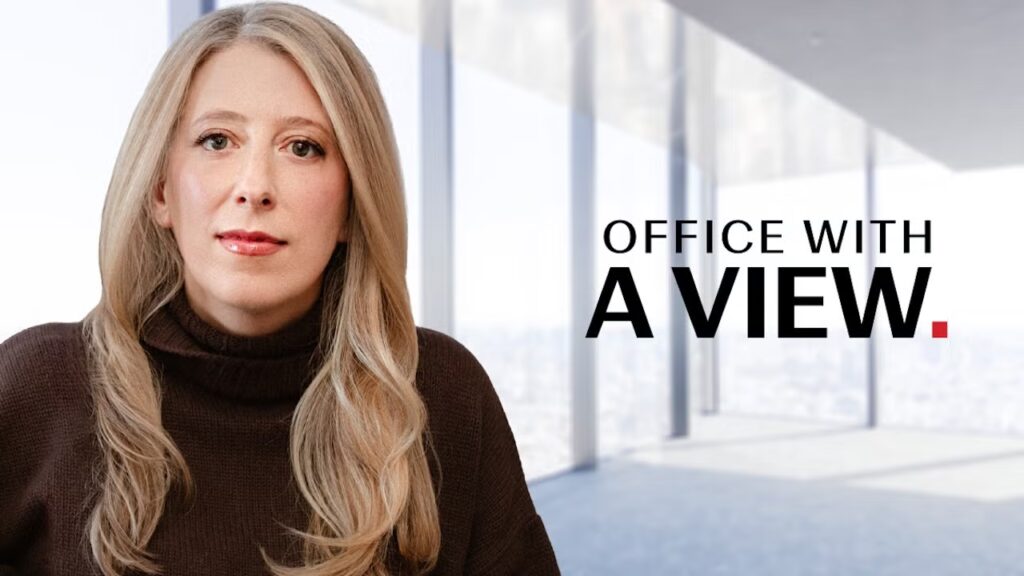
In the four years since Mary Robertson founded Sony Pictures’ TV Maxine Productions, she and the company have spearheaded crucial conversations about Hollywood through boundary-pushing documentaries like “Quiet on Set,” “The Fall of Diddy” and, most recently, “The One About Matthew Perry.”
But Robertson is well aware the projects wouldn’t have reached the same audience if they didn’t lean into stigmatized topics.
“We do want to create work that reaches an audience, and when we create work that reaches an audience, then we are able to move culture,” Robertson told TheWrap for this week’s Office With a View. “It’s hard to move culture if you’re not engaging with culture … We want to shift and effectuate change in perception and reframing when it’s warranted.”
“Quiet on Set” is the best example of that mission coming to fruition. The documentary series prompted shockwaves across the industry, leading to the greenlight for an additional fifth episode featuring “Drake & Josh” star Drake Bell. But beyond the cultural reckoning, Robertson revealed that within the bipartisan legislation aiming to create federal protections for child actors, “Quiet on Set” is quoted in the accompanying write-up, a discovery that Robertson said “was a moment of great pride.”
But even with “The One About Matthew Perry,” which Robertson had first pitched amid the success of Perry’s 2022 memoir, the director felt no need to shy away from discussing the addiction that Perry struggled with for nearly all of his adult life, and eventually led to his 2023 death.
“Matthew would have wanted us to make a film that didn’t shy away from talking about addiction — part of his legacy is that he spoke in such a fulsome manner about addiction, so we didn’t feel as though there was any reason to avoid telling the stories that related to Matthew carrying this enormous beast on his shoulder,” Robertson said. “There shouldn’t be stigma associated with relaying the fact that Matthew was grappling with what we understand to be a disease or chronic illness.”
TheWrap: Why it was the right time to pursue the Matthew Perry doc and what was your general approach to the project?
I did start watching “Friends” when it premiered, and I’m of the age where I watched it as appointment viewing on NBC Thursday nights in my living room. I connected with it as hundreds of millions around the world have through many many years. I connected especially with Chandler’s character and with Matthew’s performance of Chandler. He brought this incredible sense of warmth and comfort to this character, who also, of course, was relentlessly funny, deeply riotously funny. But there was a vulnerability in his character that I think was deeply human and in a way comforting. I read Matthew Perry’s memoir when he published it years later … and I don’t think I’d ever read a memoir that was quite like it. I wrote people who were affiliated with the publication after that — I’m sure they were inundated with people, filmmakers who were interested in making something of Matthew’s story that was inspired by the book, and I didn’t hear anything back at that time.
But then I kept thinking about it and kept thinking about it. And when Matthew passed away, I was deeply saddened. And I think, if anything, in the months afterwards, it renewed my sense that we should be, to some extent, looking at understanding Matthew beyond his death, which is to say that I wanted the focus to shift away from the circumstances or conditions of his death, which deserve to be reported and understood, but they shouldn’t eclipse the totality of his life.
Over a year after he died, I started writing letters, sending DMs along with some of my colleagues to people that we understood had a relationship with Matthew. And this time was different. We did receive some responses … I started some conversation with our friends at Netflix, and we really quickly came to understand that we wanted to make the same type of project together — one that was tender and unflinching, and as complete and complex as it could be. And on the basis of Netflix’s commitment, we renewed our effort to find others who were close to Matthew. We wrote a letter to Mia Perry Bowick, who is Matthew’s sister … I screamed when she wrote back. We jumped on a Zoom with Mia and her wonderful husband David, and that began this sort of beautiful relationship.
For a project like this, getting somebody like Mia is essential. How do you go about figuring out who are the voices that really are essential to make it happen?
Whatever the project is that we’re working on at Maxine, our goal is to be as close as possible to the story itself, to the people and events at the center of it. Proximity matters … firsthand accounts matter. We want to hear directly from those who were impacted by the person or events, rather than through mediated sources — people who heard about it from a friend or read about it or watched it on TV.
In the case of telling Matthew’s story, our goal was to get as close to as many people as possible who were close to Matthew, and we have many interviews in the film from those who knew Matthew through all eras of his life, and most of the folks in the film have never shared their accounts before. Not only do we feature the account of Mia, but we feature the account of his two of his lifelong best friends, David and Roger, who met Matthew when he was around 17, and they were friends until he died at 54 … We featured folks who worked with him on “Friends” and folks who worked with him on a play that he wrote later and on sitcoms that he efforted to create throughout the years, and ex-girlfriends, and friends that he worked with as an advocate, and even the account of one man who says that Matthew saved his life. I’m really proud of the sort of totality of voices and primary sources that we were able to bring into the film.
How have you seen the landscape more broadly for nonfiction work and documentaries?
There’s wonderful work being made. We see that there’s talent that’s been nurtured and developed over the last few years and decades. We work with wonderful clients at Netflix and beyond who are committed to supporting artists and filmmakers and journalists. I think undeniably the market is smaller than it was five years ago — that’s just an empirical fact — but the market exists, and the interests of the part of our clients and our filmmaking partners and our journalist partners that exist too. So there’s absolutely opportunity to create powerful work.
You work with Netflix, Peacock and a bunch of the streamers. What are you seeing a hunger for right now in the documentary space?
There’s always a hunger for that which feels as though it is of the moment and needs to be told in this moment. You have to be able to answer the question of why now with authority, if you can’t answer the question of why now, I think I think it’s hard to move that project forward. And that doesn’t mean that all projects have to be derived from yesterday’s headlines. That’s definitely not what I think we want to always be making as filmmakers, or what the audience or the clients and buyers and platforms necessarily want, but it does mean that you need to feel as though your story is infused not only with a sense of complexity but purpose.
What’s your vision for where the studio is heading in this next chapter?
We’re positioned to continue to make work that we’re enormously proud of. At Maxine, we’ve spent the last almost five years building a remarkable group of collaborators. We have incredible filmmakers on staff. We have incredible journalists on staff, production wizards, and we’ve all, I think, learned a certain type of practice together over these years, and so feel sort of stronger, more focused in that effort than we ever have. We’ve done a lot of work that is investigative in nature. We’ve done a lot of work that could be classified as pop culture investigation, which some people say there’s a genre [of] pop culture investigation, and that that is a lot of what we’ve done.
I think it’s really wonderful to be at this moment where we’re able to show our range by introducing “The One about Matthew Perry” to audiences around the world. This is a project that is committed to accuracy, but not strictly or definitionally investigative in nature — this is an accurate, loving, tender, unflinching account of a man who touched many, many lives and will continue to do so over generations to come.
There’s been chatter about how “You Can See Everything” has pushed the convention of documentary. When something like that rocks the space what do you think and how does it prompt you to re-consider the space?
I haven’t seen “You Can See Everything” yet, so I can’t really comment upon it. I’m eager to see it, and certainly there’s a lot of talk about it. I think part of what we’re seeing with the interest in that film and response to that film is in an interest in projects about the public figures that shape our times, but [also] an interest in projects about those figures that are not shaped by those figures and that’s part of what we see in this one about Matthew Perry as well. This is not a project that was controlled by any contributor. This is a project where the editorial control did not reside with the the people who were the focus of the project. And I think the audience’s hunger is for that type of trust in the author and that confidence in the editorial vision.
What advice would you give to a young person aiming to enter into the industry?
It’s important to pick your early jobs with real purpose because I think you end up learning a lot by osmosis, and I almost think that it’s more important to pick the environment that you’re working in rather than the specific responsibilities or the description of that entry-level job, because the real benefit of those early career jobs are the skills that you learn ambiently and the relationships that you’re forming. It makes a lot of sense, I think, to do that in an environment that’s creating the type of work that you really admire.
This story has been edited for length and clarity.
The post Matthew Perry Doc Director on Not Shying Away From Stigma: ‘It’s Hard to Move Culture if You’re Not Engaging With Culture’ appeared first on TheWrap.