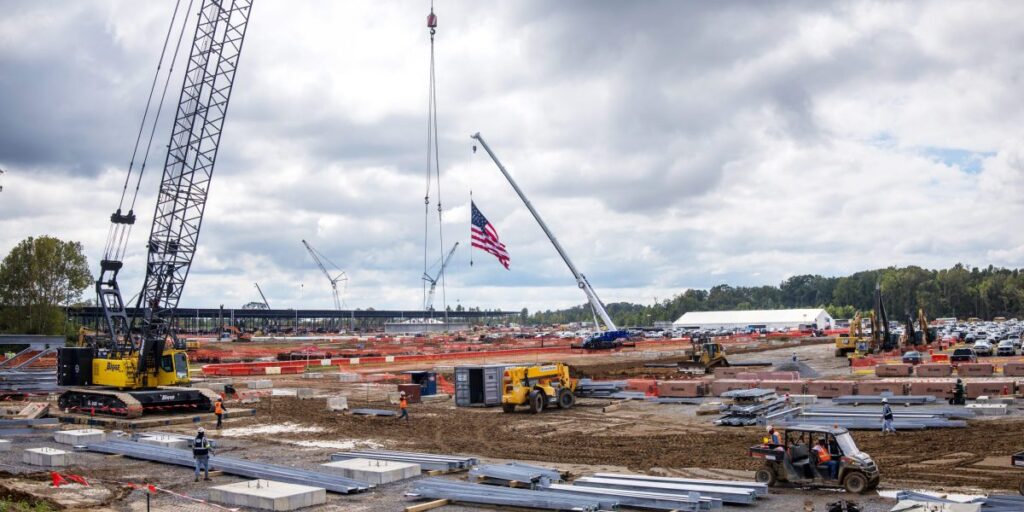
Across the country, massive new factories, semiconductor plants, and football-field-sized AI data centers are reshaping America’s landscape. More than 1,500 data centers are under development nationwide. Construction spending has surged to nearly two-and-a-half times what it was five years ago, and this year the United States is on pace to spend roughly $2.2 trillion—almost the GDP of Canada—on construction.
Ironically, America is building more at the exact moment the world is becoming far more dangerous to build in. In each of the past six years, natural catastrophes such as wildfires, hurricanes, and floods have caused at least $100 billion in insured losses globally, and the U.S. often bears the brunt.
And yet the concrete keeps pouring.
Why?
Because behind nearly every major project in America is a resilient financial infrastructure that helps manage risk and sustain investment. Yet because this financial infrastructure operates largely behind the scenes, its contributions to America’s economic growth and resilience often go unnoticed by policymakers or the public.
When Americans think about the growing role of financial services in today’s economy, they tend to be skeptical. After all, events like the 2008 financial crisis seemingly demonstrated the risks of relying too heavily on complex financial mechanisms.
But failures in finance are memorable precisely because they are rare. By contrast, the successes of financialization—including the countless projects and transactions that proceed smoothly every day—go largely unnoticed.
A prime example is reinsurance—insurance for insurers—which plays an indispensable role in managing risk so that investments can happen at scale.
Consider this hypothetical example. A developer wants to build a new apartment complex in a region exposed to hurricanes, and needs insurance coverage. The insurer knows that providing coverage requires setting aside significant capital in case a major storm hits. This makes it harder to provide needed insurance coverage for other projects.
Reinsurance is the solution. By transferring part of its risk to a reinsurer, the insurer limits its exposure and caps the amount it would pay after a major disaster, freeing more resources to protect other projects. In effect, reinsurance serves as a shock absorber: it helps insurers offer coverage at a viable price, which in turn gives investors the confidence they need to commit capital.
Meanwhile, the reinsurer keeps the system stable by spreading potential losses out—often across borders. The company I lead, Swiss Re, is a reinsurer headquartered in Switzerland that does much of its business in the U.S. When companies like Swiss Re underwrite risk here, capital from abroad is effectively helping support American investment and growth.
After Hurricane Katrina, international insurers and reinsurers covered more than half the damage. After the September 11 attacks, they covered 64% of the damage.
Insurers and reinsurers have underpinned America’s growth for more than a century. After the 1906 San Francisco earthquake, insurers paid more than 100,000 claims, wiping out almost a half-century of U.S. insurance market profits.
Today, the need for this sort of protection has only grown. Economic growth is concentrating more people and assets in high-risk areas, such as coastal regions prone to hurricanes and flooding, while increasingly severe weather patterns are raising the threat of natural disasters.
But the impact of reinsurance extends far beyond disaster protection. It underpins nearly every aspect of economic growth.
Reinsurance allows businesses to hire new workers while managing risks like workplace injuries or liability claims. It enables companies to deploy new technologies at scale despite risks such as system failures or cyberattacks. Even rocket launches are routinely insured and reinsured before they leave the ground.
Systems like reinsurance also strengthen America’s global competitiveness by helping businesses recover quickly from supply-chain shocks and invest boldly, rather than holding back capital for worst-case scenarios.
Of course, reinsurance is only one part of the solution. When underlying risks—such as the threat of natural disasters—increase, it becomes even more important to take a holistic approach to managing risk. That means investing proactively in stronger infrastructure, prioritizing mitigation and adaptation, fostering public-private partnerships, and complementing reinsurance with other financial tools, such as catastrophe bonds that redistribute risk to outside investors.
But as American companies build more housing, expand energy infrastructure, and invest in advanced manufacturing, they will undoubtedly rely on reinsurers to play a central role in protecting their investments.
The world is inherently unpredictable. Financial structures like reinsurance may seem complex, but they’re essential to ensure the economy operates smoothly despite that uncertainty.
That essential function deserves greater recognition from policymakers and the public alike. The benefits of financialization may not always be visible—but they are constantly working to enable progress, support resilience, and promote America’s economic dynamism.
The opinions expressed in Fortune.com commentary pieces are solely the views of their authors and do not necessarily reflect the opinions and beliefs of Fortune.
The post The hidden financial engine behind America’s building boom appeared first on Fortune.