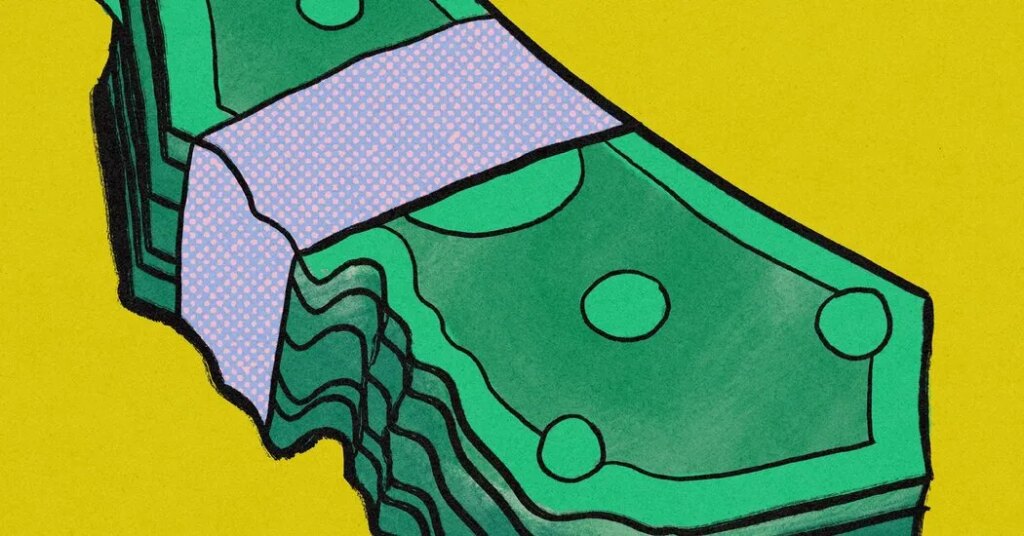
Californians next week will vote on Prop 40, a one-time 5 percent wealth tax on the state’s 250 or so billionaires. Often owners of public companies in the tech sector, these fortunate few have greatly benefited from a system that taxes their income at lower rates than those paid by many of their employees.
Like everyone else, billionaires should pay their fair share. Prop 40, however, addresses only a sliver of the unfairness in our tax system. Fixating on this tiny group of people misses the forest of wealth in the Golden State for a few redwoods in Silicon Valley.
We see two major problems with the Prop 40 approach to tax reform. The first is arithmetic. The second is psychology.
At the end of 2025, California’s billionaires were worth around $2 trillion. That’s a big number, but it withers when compared to the other pools of great wealth in the state.
We estimate that the state is home to about 450,000 households that own a private business and have at least $5 million in wealth. We call them “everywhere millionaires” because they live all over, running ordinary businesses woven into the fabric of everyday life. They own and run car dealerships, construction companies, medical practices and trucking firms somewhere near you.
The Californians in this group are collectively worth about $9 trillion, nearly five times as much as the billionaires. They generally are subject to higher tax rates than the tech billionaires, but everywhere millionaires still benefit from loopholes that favor their income over that of a highly paid salary earner.
As extraordinarily wealthy as some of these people are, they figure little in the public debate over how to tax wealth. That’s for a few reasons. Their stories are relatable and often inspiring, making them more sympathetic and familiar than the extraterrestrial tech lords and titans of finance. Everywhere millionaires live in every community, running businesses that provide services many of us rely on, employing people we all know. They sponsor Little League teams and may hold local elected office.
Unlike many of the billionaires running public companies, everywhere millionaires attract little media attention. And by clinging to the venerated mantle of “small business,” regardless of their businesses’ actual size or value, they avoid being seen as large founts for collecting additional tax revenue.
That brings us to the second problem with the debate: When it comes to taxes, everyone thinks someone else should pay.
Policymakers keep adding groups to the list of loophole beneficiaries: incumbent homeowners, venture capital and private equity partners, everywhere millionaires, heirs and, in the case of Prop 40, everyone worth less than $1 billion. At the other end of the spectrum, tipped workers, contractors, overtime workers and older people now benefit from additional tax exclusions. If everyone feels that someone else is getting a better tax deal, it undermines faith in the entire system and makes everyone more resentful about participating.
For both these reasons and more, if California voters are looking for large reservoirs of undertaxed wealth, a much better, bigger target lies right beneath their feet.
The original sin underlying California’s tax structure is Prop 13, the 1978 law that rewrote the rules of property ownership. Getting rid of it would be a more efficient and durable way to make the rich pay their fair share.
Prop 13 capped property taxes at just one percent of assessed value, limited the rate of increase to 2 percent per year, and allowed assessments to be revised to a property’s real market value only when the property undergoes substantial renovations or is sold.
Combined with tight limits on new construction, these restrictions on property tax rates helped make California’s housing market one of the most expensive in the country. By 2024, the state was home to 12 percent of the country’s population, but nearly 40 percent of all owner-occupied homes worth at least $2 million. There are around 100,000 homes there worth at least $5 million, including some in the Bay Area that are considered “starter homes.” Billionaires own only a small fraction of them.
In addition to making house prices rise, Prop 13 resulted in crazy disparities. Today, on a given block you can find wildly divergent property tax bills, with recent buyers on the hook for several times more than their longer situated neighbors, regardless of anyone’s means.
Because home values have risen faster than property taxes, California homeowners now pay an average of just 0.8 percent tax on their property. In the fiscal year ending June 2025, that helped generate about $100 billion in revenues. Texas homeowners, by contrast, pay 2 percent. According to recent estimates, if California were to raise its rate to match Texas’, the overall residential property tax revenue would more than double — and those sky-high housing prices would ease by around 13 percent.
The most optimistic forecasts have Prop 40 raising $100 billion. Because some billionaires might move to avoid paying it, however, the real number would likely be a good bit lower. And because it’s meant to be a one-time tax, after that it’s back to the same old wild inequities and the same huge amounts of money left on the table.
California’s government will spend about $540 billion this year. It is simply not possible to fund the state’s needs by leaning on a few hundred people, as politically appealing as that may be. For California to tax wealth in a progressive fashion and meaningfully improve its fiscal position, it needs to broaden the aperture beyond billionaires, to the hundreds of thousands of other very wealthy people who could easily afford to contribute more by paying a real estate tax that finally works.
It is telling, then, that a broader, progressive tax reform is nowhere near politically feasible in the current environment.
Taxes should not be reserved exclusively for punishment, even if one can occasionally justify their use on such grounds. The tax policy debate needs to return to the notion of taxes as paying for important things we’ve chosen to provide collectively, such as education, infrastructure and national defense. These public goods require funding from a broader base. As the Supreme Court justice Oliver Wendell Holmes said, “Taxes are what we pay for civilized society.”
Like many homes in California, the tax system has gone decades without a reassessment. If voters want a more equitable tax system, they should think bigger than one-off embellishments. The gut renovation is long overdue.
Owen Zidar is a professor of economics and public affairs at Princeton University. Eric Zwick is a professor of economics and finance at the University of Chicago Booth School of Business. They are the authors of “The Everywhere Millionaire: Who Is Really Rich in America and How They Got There.”
The Times is committed to publishing a diversity of letters to the editor. We’d like to hear what you think about this or any of our articles. Here are some tips. And here’s our email: [email protected].
Follow the New York Times Opinion section on Facebook, Instagram, TikTok, Bluesky, WhatsApp and Threads.
The post California Is Voting on the Wrong Wealth Tax appeared first on New York Times.