Zombies have taken many forms in popular culture. In Michael Jackson’s “Thriller” music video, corpses climb out of their graves and perform an impressively coordinated dance. In HBO’s “The Last of Us,” a fungus infects humans, takes over their bodies and turns them into hosts that help spread the infection. Even Plankton tried his hand at taking control of another organism in “SpongeBob SquarePants.”
These examples are fictional, but they all play with the same unsettling idea: Can one organism take control of another, even after they’re dead? In nature, the answer is not quite as dramatic, but some parasites and fungi come surprisingly close.
I spend much of my time as a biomedical engineer and synthetic biologist thinking about how biological systems sense signals, process information and change their behavior. That is part of what makes the idea of one organism taking control of another so fascinating to me.
Some parasites and fungi can alter the behavior of a living host in ways that benefit the parasite. They do not bring the dead back to life. Instead, they interfere with biological systems that control movement, motivation and decision-making.
Creating ‘zombie ants’
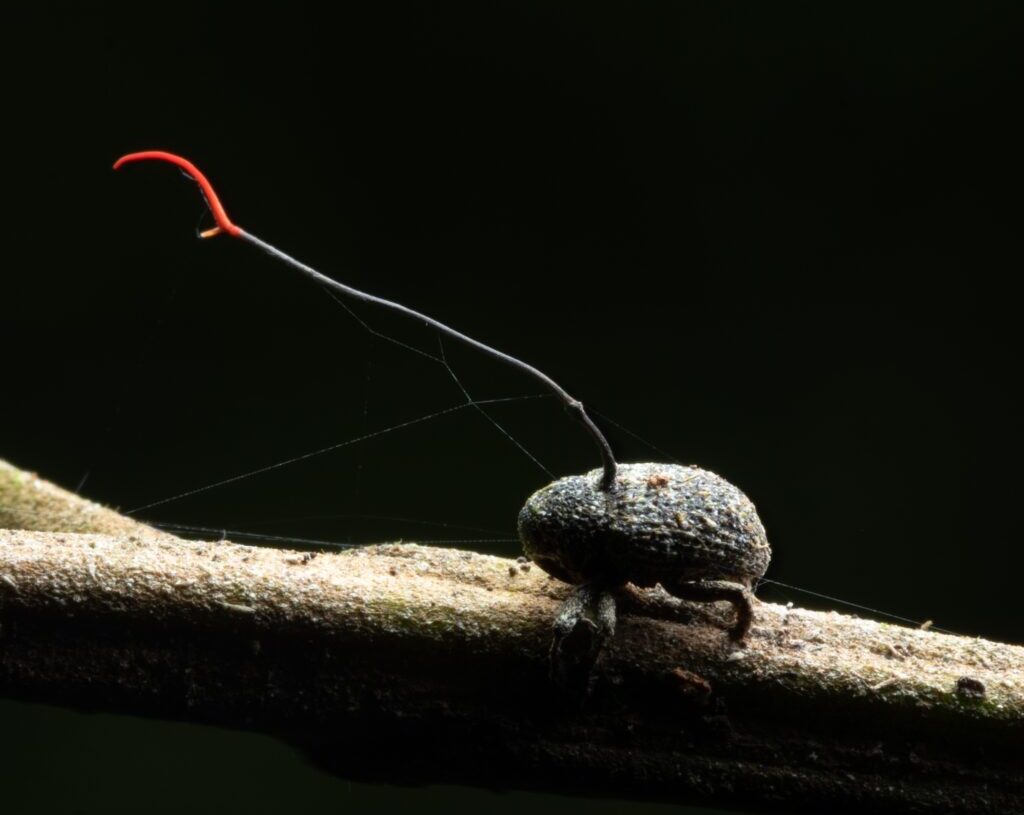
The best-known example of a parasite changing its host’s behavior is the “zombie ant” fungus, Ophiocordyceps, which helped inspire “The Last of Us.”
The life cycle of the zombie ant fungus begins when fungal spores land on an ant. The spores stick to the ant’s outer surface and eventually break through it, allowing the fungus to enter the body. Once inside, the fungus grows and spreads while the ant is still alive. The infection can develop over several weeks before the most dramatic changes in the ant’s behavior begin.
Eventually, the infected ant leaves the colony and begins wandering and climbing vegetation. This behavior moves the ant away from its normal habitat and into a location that favors fungal reproduction and dispersal. Near the end of the infection, the ant bites tightly onto a leaf, twig or other plant surface and remains attached in what researchers call a death grip. After the ant dies, the fungus consumes the remaining tissues and produces a stalk from the ant’s body. This structure releases spores that can fall on other ants below and begin the cycle again.
How does the fungus make the ant do this? You might imagine fungal cells invading the ant’s brain and taking control. Surprisingly, researchers examining infected ants before death found extensive fungal growth throughout the body and around muscle fibers, but not inside the brain. Fungal cells can form networks around the ant’s muscles, suggesting that the ability to manipulate behavior may involve communication between the fungus and multiple host tissues rather than direct control of the brain.
The death grip provides an especially striking example of how the fungus can manipulate its host’s muscles. The jaw muscles of infected ants are heavily colonized by the fungus, showing signs of extreme contraction. There are also signs that the fungus may be releasing molecules near these tissues. Yet motor neurons and connections between nerves and muscles can remain intact. Together, these findings suggest that the fungus may alter the machinery controlling muscle contraction rather than simply destroying it.
Scientists still do not know exactly what causes ants to undergo the entire sequence of wandering, climbing and biting. While researchers have identified fungal genes associated with proteins, toxins and other compounds that could affect chemical signaling in the host, many of these possible mechanisms have not yet been proved.
That uncertainty is part of what makes the system so fascinating. The fungus does not appear to flip a single “zombie switch.” Instead, it may change several biological systems at once until the ant behaves in a way that benefits the fungus.
Parasites in charge
Ophiocordyceps is not the only organism capable of changing a host’s behavior.
The emerald jewel wasp, Ampulex compressa, uses a very different strategy: It injects venom into a cockroach’s nervous system. The cockroach is not paralyzed, but it becomes much less likely to start moving on its own or to escape. The wasp can then lead it to a burrow and lay an egg on it.
Researchers have shown that the venom reduces activity in parts of the nervous system involved in starting movement. In other words, the cockroach can still walk, but its drive to do so has been changed.
Hairworms take behavioral manipulation one step further by leading their hosts toward their own demise. Some species infect praying mantises or crickets and grow inside them while the insect is alive. When the worm is ready to reproduce, the infected host becomes unusually attracted to light, which may draw it toward the shiny surface of water. The host enters the water, where the worm escapes from its body and begins the next stage of its life cycle. For the host that cannot swim, that behavior can be fatal.
Researchers are still working out exactly how the parasite causes this change, but studies have found changes in proteins in the host’s brain as the parasite manipulates it. In effect, the parasite appears to hijack the host’s sensory and behavioral machinery to guide it somewhere it would not normally go.
Behavioral manipulation also occurs in mammals. Toxoplasma gondii can infect many warm-blooded animals, but it reproduces in cats.
While rodents normally avoid cat odors, those infected with the parasite can lose some of that natural aversion and even become attracted to cat odors. This change could increase the chance that an infected rodent is eaten by a cat, allowing the parasite to complete its life cycle.
More than mind control
These examples show why “mind control” is an imperfect description of how parasites manipulate their hosts. Parasites do not need to control every action that their host makes. They may need to change only one key behavior: whether to climb, whether to walk away, whether to enter water or whether to avoid a predator.
There is no single “zombie switch.” Behavior emerges from communication between the nervous system, muscles and other tissues throughout the body. Different parasites have evolved different ways to interfere with those systems.
So biology cannot create the dancing dead of “Thriller” or the infected humans of “The Last of Us.” But if a zombie is a living organism whose normal behavior has been redirected by another organism, nature has already created plenty of them.
Studying these real-life zombies may help scientists understand not only how parasites manipulate their hosts, but also how normal behavior is generated and controlled in the first place.
Tara Deans is an associate professor of biomedical engineering at the Georgia Institute of Technology.
This article was produced in collaboration with The Conversation, a nonprofit news organization.
The post How parasites and fungi create nature’s real-life zombies appeared first on Washington Post.