The allure of the new documentary “Everest: The Other Side” is, unsurprisingly, its title attraction, the highest mountain in the world and a seductive temple of rock, snow, ice and human desire. It’s the latest from the filmmaking team of Elizabeth Chai Vasarhelyi and Jimmy Chin, who have carved out a singular niche in the movieverse with fiction and nonfiction stories about intrepid risk-takers. The pair are best known for their glossily produced, high-altitude documentaries, including “Meru” (2015, about a group of mountaineers) and especially “Free Solo” (2018, about the free climber Alex Honnold).
In “Everest,” Vasarhelyi and Chin largely stick to the basic template they have successfully used before, in which they combine human interest stories of differing appeal with nature photography that often steals the show. Their protagonists are adventurers, some with a thing for great heights, rarefied skill sets and a tolerance for life-threatening risks. In “Meru,” a group of mountaineers — Chin included — struggle to successfully summit Meru Peak in India via a treacherous route; in “Free Solo,” Honnold scales El Capitan in California’s Yosemite National Park without ropes or protective equipment.
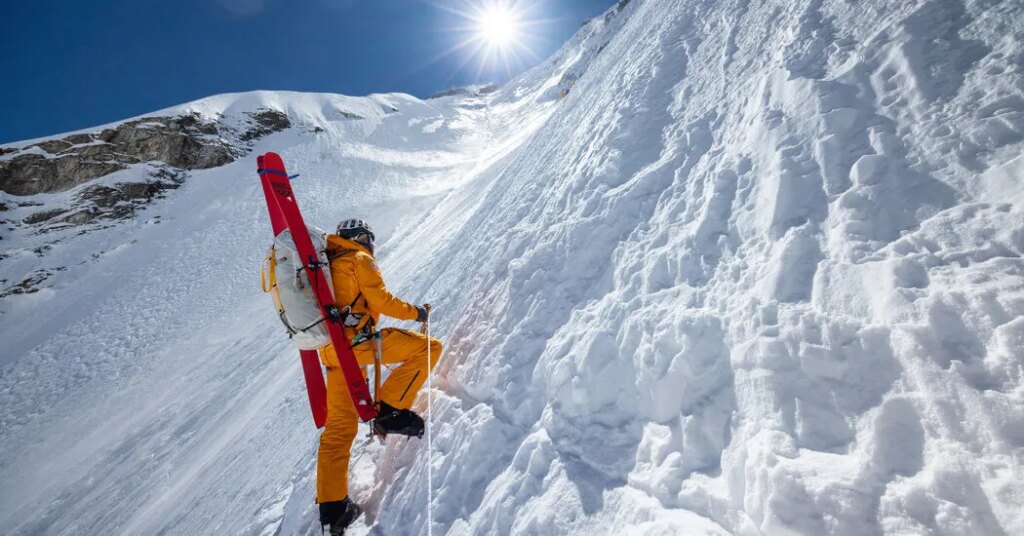
“Everest” primarily centers on Jim Morrison, a ski mountaineer with a weathered face and a staggeringly tragic personal life. The details of his biography emerge gradually in the documentary, which tracks Morrison on his quest to ascend the north face of Everest and then ski down it. If that sounds nuts, there’s a reason. Thousands have climbed the mountain (Chin among them), but only a handful have managed that feat on its northern aspect. In 2024, Chin helped discover the partial remains of one who tried, Andrew Irvine, a climber who vanished in 1924 alongside George Mallory, whose body had been recovered 25 years earlier.
It’s no surprise that death hangs over “Everest”; the shock is how it descends. First, though, the filmmakers set the scene by sketching in Morrison’s background as he prepares for his climbing and skiing quest. With brisk familiarity, they introduce him along with Hilaree Nelson, Morrison’s partner in life and adventure, as they bustle around their home. (Chin and Nelson worked together on a 2011 ad for the North Face.) Her older son, Quinn, sulks around with a baseball cap pulled down over his face and understandably doesn’t seem all that thrilled to be on camera. The sweet-faced younger boy, Graydon, seems more open to living life in front of a documentary crew. The family’s ridiculously cute Labradoodle seems oblivious.
Once the scene shifts to Everest, in Chinese-controlled Tibet, the filmmakers get their dazzle on. Working with a battery of camera operators, and using images taken from the ground and the air, they capture the mountain’s foreboding beauty. Cameras swoop and clouds swirl, snow ominously falls and Everest beckons but also threatens. The visuals are crisp (you can see every rocky crag and facial pore) but overly polished; it’s handsome in the manner of a slick advertisement. Morrison and his companions do help warm things up, as they strategize their climb, discuss hazards and meet with the Sherpas who will do some of the toughest, most dangerous expedition work.
Process movies are often seductive, and this one has its obvious attractions. This is familiar terrain for Vasarhelyi and Chin, geographically and narratively. They know how to grab your attention and hold it with images of the natural world, and they understand the tug of daring human adventures. There is also much that they glide over, to predictable and, occasionally, distracting effect. “Everest” features scenes with Tibetan monks and music, but the impacts of China’s control over Tibet are discreetly elided. The movie was produced with what the credits term “assistance” from the state-owned China Film Co-Production Corporation. Per the credits, it was also “filmed in association and with expedition funding by the North Face.”
Corporate sponsorship is par for the sports-documentary course, though the repeated image of the North Face logo in this case proves off-putting. That becomes all the truer when, about a quarter way into the movie, Morrison and some companions head off to another mountain in advance of the Everest climb. During that 2022 trip, one participant was fatally swept off the mountain, a genuinely horrifying calamity that was caught on camera and which the filmmakers have wrongly included here. Images of real death have become so commonplace in our lives that I imagine Vasarhelyi and Chin assumed their audience would be fine watching the fatal fall of one of their subjects. I wasn’t. Clearly, they thought it was crucial to their movie and to conveying why some people chance death. It was not; it’s exploitation.
Everest: The Other Side Rated PG-13 for scenes of an accident and the recovery of a body. Running time: 1 hour 50 minutes. In theaters.
The post ‘Everest: The Other Side’ Review: Chancing Death appeared first on New York Times.