Israel’s high-stakes parliamentary election on Tuesday produced no clear winner after most of the votes were counted.
That in itself was not unexpected — but there were nevertheless some surprises.
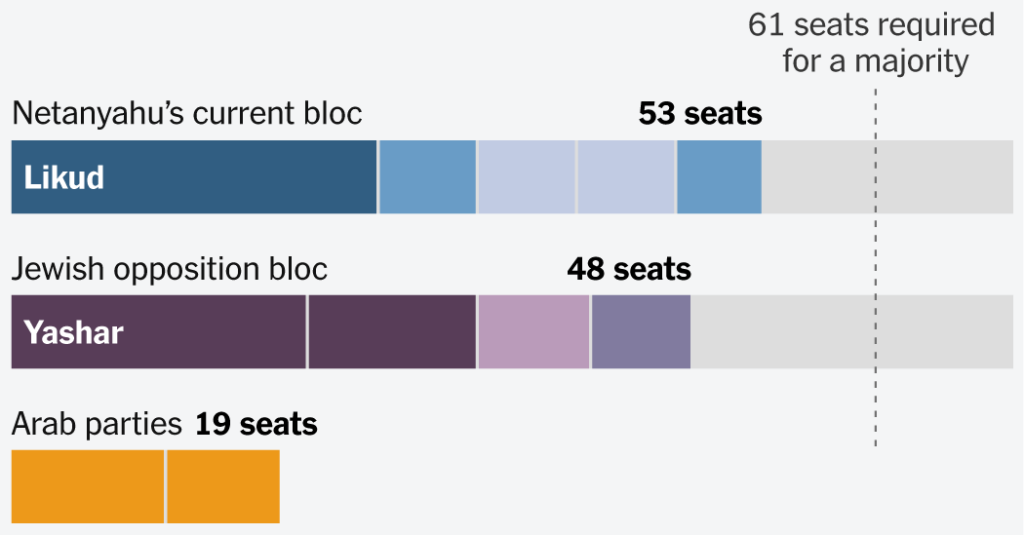
Mr. Netanyahu’s right-wing, populist party, Likud, outperformed many pre-election polls to become the largest party in Parliament, preliminary results show. It won fewer seats than in 2022, though, when the last national election was held.
More noteworthy was the turnout by supporters of Israel’s Arab parties, which ended Election Day with a historic boost.
Israel’s parliamentary system as a rule requires parties to find enough common ground to assemble a 61-seat majority bloc in Israel’s 120-seat Parliament. Over the years, that has produced some unlikely alliances — but also shaky, short-lived governments.
In less than four years, from 2019 to 2022, Israelis were sent to the polls five times as parties failed to hold a majority together, or to form one in the first place.
In the coming days, party leaders will be back at it again. With the provisional election results showing no bloc with a straightforward path to a coalition, it could mean bitter negotiations — or deadlock, with the very real possibility of another election.
Here’s how parties may align for Israelis to get a government and avoid another trip to the polls.
Scenario
A historic Jewish-Arab alliance
For Mr. Netanyahu’s opponents, securing a majority increasingly appears to depend on support from at least some Arab lawmakers.
If the opposition leader Gadi Eisenkot’s coalition were to include both Arab parties — the Joint List, an ideologically diverse alliance, and Raam, a pragmatic Islamist party — he would have a significant majority in Parliament.
Such a coalition would carry political risks.
Mr. Eisenkot has rejected alliances with parties that do not support Israel’s Jewish character or the defeat of militant group Hamas in the Gaza Strip. Many of his voters could see an alliance with Arab parties as a broken campaign promise, a liability for Mr. Eisenkot in a political landscape in which another election could be imminent.
Another possibility for the Eisenkot bloc is to leave Arab lawmakers out of the coalition but secure their agreement to support a minority government. Such a government can take office as long as more lawmakers vote for it than against it, even if the parties that make it up hold fewer than 61 seats.
For the Jewish anti-Netanyahu bloc, based on provisional results, that would mean support from at least six lawmakers from the Arab parties in the initial confidence vote. But it is unclear whether those parties would agree to support a government from which they would be excluded, or how sustainable such an arrangement would be.
Scenario
A unity government
A unity government led by Mr. Netanyahu and Mr. Eisenkot could offer a different path to a clear majority.
But such an alliance could prove uneasy for both leaders.
Mr. Eisenkot’s entire campaign focused on the urgent need to unseat Mr. Netanyahu, whom he called unfit to serve as prime minister. Mr. Netanyahu may not be keen to share power, or delegate significant authority, to his fierce rivals, potentially at the expense of longtime allies.
One possible unity government could bring together Mr. Netanyahu’s Likud party; Mr. Eisenkot’s Yashar party; Together, an alliance between the right-wing Naftali Bennett and the centrist Yair Lapid; and Yisrael Beiteinu, a right-wing party whose leader, Avigdor Liberman, broke with Mr. Netanyahu and has long been his rival on the right.
Preliminary results give such a bloc 66 seats, a clear governing majority, if a shaky one.
Scenario
Defections
The coming weeks of political wrangling could open other paths to a government. Defections — not uncommon in Israeli politics — could allow one bloc to prevail at the expense of the other, a risk that exists in both political camps.
Parties that allied with Mr. Eisenkot during the campaign, or even individual lawmakers, could be coaxed into supporting a government led by Mr. Netanyahu.
For his part, Mr. Eisenkot could seek the support of the two ultra-Orthodox parties, which are longtime allies of Mr. Netanyahu but not without grievances against him. That might prove difficult, given that the opposition has long opposed military draft exemptions for ultra-Orthodox men.
Only one thing appears clear: However much Israelis may have regarded this election as a turning point for their country, neither Mr. Netanyahu nor his chief rival got the mandate they sought.
Now, any path to power will require ideological compromises, uncomfortable alliances or both. Otherwise, it’s back to the voting booth.
Additional work by Josh Holder.
The post With No Clear Winner, How Could Israel Get a Prime Minister? appeared first on New York Times.