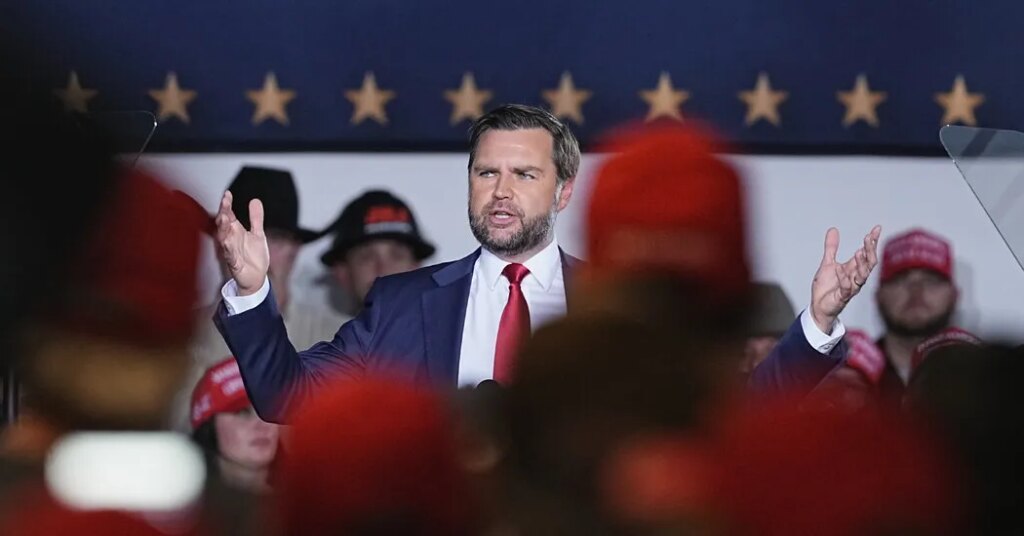
Vice President JD Vance’s message on Israel last week was as blunt as anything coming from Democratic politicians.
For Republicans to win elections after the midterm wipeout, Mr. Vance wrote on Wednesday, they must end the war against Iran, which President Trump and Israel started, and also “change our relationship with Israel.”
Coming from a leading Republican who is considering a presidential run in 2028, it was an extraordinary volley against U.S. policy on Israel, which over decades has received robust military, diplomatic and economic support.
That backing had long been a bipartisan pillar of U.S. foreign policy. But it has eroded in recent years, first among Democrats angry about Israel’s war in Gaza and the treatment of Palestinians in the occupied West Bank, and more recently among some Republicans who blame Israel’s government for encouraging Mr. Trump to launch the war in Iran.
The war has led to soaring gas prices and higher inflation. Many of Mr. Trump’s supporters also view it as a betrayal of his pledge to avoid “forever wars.”
Israel still has strong support among many politicians in Washington, including Senator Chuck Schumer of New York, the top Democrat in the Senate. They argue that the United States must continue its traditional backing for a democratic, Jewish nation that has been attacked by armed groups for decades and whose powerful military serves as a partner force.
In separate remarks on Friday and on Sunday, Secretary of State Marco Rubio strongly defended the U.S.-Israeli war against Iran war. “Presidents are elected to do the hard things, sometimes difficult things, but necessary things,” he said before flying to Paris on Sunday.
The debate over U.S. policy has been complicated by accusations of antisemitism against some conservative and liberal political figures who take a critical stand on Israel. But many prominent American politicians are interpreting the midterm election results as a mandate from voters to rethink the U.S.-Israel relationship.
Senator Chris Van Hollen, Democrat of Maryland, said in an interview that his top priority in the new Congress would be to “end the ‘blank check’ of American taxpayer support for the government of Israel.”
In September, all but one Senate Democrat voted for a bill Mr. Van Hollen had sponsored that would require the State Department to produce a human rights report on violence by Israel in the West Bank, including in the deaths of Palestinian Americans. The effort failed, but it was a sign that many Democratic politicians were ready to pursue sanctions against Israel.
“This is a transformative moment in the U.S.-Israel-Palestine relationship,” said Hady Amr, a former State Department political appointee who worked on Palestinian issues and is a fellow at the Brookings Institution and Chatham House.
“The U.S.-Israel relationship is going to be dramatically different,” he said, “and it’s going to be a much more normal relationship where ordinary Americans assess Israel’s behavior in the way that they assess the behavior of any other country. ”
Even Mr. Trump, who has approved large arms packages to Israel, appears to sense the change.
In a surprising Election-Day announcement, the president told Fox News that he planned to cut off most military aid to Israel before the end of this year. That would remove a “bad talking point” from “lunatics” critical of aid, he said.
It is unclear whether Mr. Trump intends to follow through, or whether he was speaking merely to send a last-minute signal to voters critical of Israel. He still supports pending legislation enshrining other military support for Israel, and he could veto any congressional measures imposing limits.
An Obama-era agreement that expires in 2028 promises Israel each year $3.3 billion in financial aid that the country then uses to buy U.S. arms, and an additional $500 million for missile defense.
Until recently, the notion of ending U.S. military aid to Israel was almost unheard-of in Washington. But Prime Minister Benjamin Netanyahu of Israel has himself said his country should gradually move toward “armaments independence.”
He has spoken of a decade-long process. Mr. Trump’s short time frame of a few months shocked Israeli officials.
After Hamas attacked Israel in October 2023, killing about 1,200 people, the United States surged additional military aid to the country with congressional approval. With the regular annual allotment, total U.S. military aid was nearly $22 billion from October 2023 to September 2025, according to a Brown University study.
Israel responded to the Hamas attacks by pummeling Gaza with American-made bombs and missiles, killing tens of thousands of Palestinians and reducing much of the Palestinian territory to rubble.
Over that period, many Democratic lawmakers and some Republicans pressed the Biden and Trump administrations to end or limit military support for Israel. But both administrations continued to push through expedited arms packages to Israel — and bypassed congressional approval.
Now, Democrats are planning new efforts to end or restrict aid to Israel as they prepare to control both houses of Congress.
Some Democrats, including Jon Ossoff, a Jewish American senator who won re-election, have voted for banning certain arms sales to Israel. And several incoming Democrats want to go further. Abdul El-Sayed of Michigan, the first Muslim elected to the Senate, told National Public Radio on Wednesday that he agreed with Mr. Trump’s call for ending aid to Israel.
“I’d also like to see us stop selling weaponry that gets used to do the worst things, including genocide and apartheid, to Israel,” he said. The super PAC of a lobbying group, the American Israel Public Affairs Committee, or AIPAC, spent $32 million in Michigan’s Senate Democratic primary in a failed effort to defeat Mr. El-Sayed.
At least one former top aide to President Joseph R. Biden Jr., criticized by many liberals for his Israel-Gaza policy, is pushing for a new approach.
Jon Finer, principal deputy national security adviser in the Biden White House, publicly says that Democrats should use American aid as leverage to change Israel’s behavior.
That could include placing conditions on arms sales; ending the U.S. practice of vetoing United Nations resolutions critical of Israeli; and imposing financial sanctions and travel bans on individuals and groups that support Israeli settlements in the West Bank, Mr. Finer wrote in a New York Times opinion essay last month.
But in a new book, Brett McGurk, Mr. Biden’s top Middle East adviser, wrote that public disputes between the United States and Israel could jeopardize their common interests. Mr. McGurk asserted that public signs of discord between Mr. Biden and Mr. Netanyahu over Israel’s conduct of the war in Gaza had led Hamas to harden its negotiating position on the release of Israeli hostages.
Danny Danon, Israel’s ambassador to the United Nations, acknowledged in an interview Wednesday with an Israeli TV channel that the political environment was more difficult.
“We have to pay attention to the voices — by the way not only in the Democratic Party, also in the Republican Party — real voices that are blaming Israel and criticizing Israel,” he said. “It will be harder for us, but we also have friends across the aisle.”
He said the critics were a “vocal minority” that included “radicals who don’t care about the facts.”
On the Republican side, the arguments focus less on the well-being of Palestinians and more on whether the United States is pulled into costly Middle East wars because of Israel.
“In practice, I suspect this debate will actually center on the future of the war in Iran going forward,” said Emma Ashford, a senior fellow on U.S. foreign policy at the Stimson Center.
As for arms aid to Israel, even if Mr. Trump ends that, proposed legislation that the American president supports could blunt the impact, she said. The House version of an annual U.S. defense funding bill would lead to the American and Israeli militaries and intelligence agencies working even more closely together. (Mr. Van Hollen said he would work to strip out such provisions before any final bill.)
The conservative restraint crowd has vowed to continue to pressure Mr. Trump and other Republicans. It has champions with devoted followings, including Tucker Carlson, a critic of Israel who has been accused of being antisemitic, which he denies. Some in the movement say they still have faith in Mr. Vance, despite his allegiance to Mr. Trump’s foreign policy.
“The future of the country is one where we drastically reform the relationship with Israel,” said Curt Mills, executive director of The American Conservative magazine, which advocates anti-interventionist and nativist policies. “I don’t think we should sell them arms. We should oppose intelligence sharing.”
He said that Mr. Trump, by embracing what some Israeli leaders have long sought as their “holy grail foreign policy item” — the Iran war — had betrayed his voters.
The post Bipartisan Support for Israel Erodes as Both Sides Push for New Limits appeared first on New York Times.