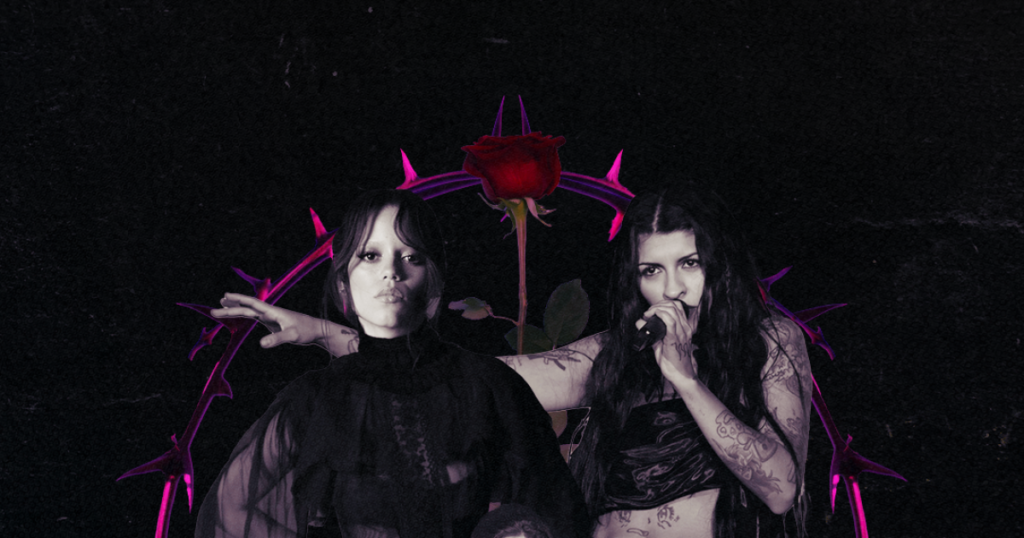
’Tis the season of the bruja. Every October, societal outcasts and weirdos relegated to the underground are permitted passage back into the mainstream. What was once fodder for their ostracization now captivates the imagination of millions — and has been popularized in movies and TV shows, from “Interview With the Vampire” to “Wednesday.”
But long before dark lip liner and “corporate goth” viral looks splashed across our social media feeds, the macabre was woven into the cultural histories of Latine people. And among Latinas in particular, tracing the threads of this visual lineage reveals how gothic subcultures became a kind of cultural armor.
Neither historical atrocities nor the racialized violence that persists today have been abstract concepts for Latine communities; the violent legacy of European colonialism, the widespread reach of the Catholic Church and land seizure by settlers have given Latine people an all-too intimate relationship with death.
At the same time, existing Indigenous and Afro-diasporic cosmologies were either erased or absorbed, hiding in plain sight.
Women’s bodies have long served as a site of colonial violence, along with theft of resources and land itself. Conquering forces wielded sexual violence and the subjugation of Indigenous and Afro-descendant women as a tool to establish dominance, break community structures, and enforce racial hierarchies. Indigenous and Black women were stripped of the protections or statuses afforded to white European women, positioning them as exploitable labor and objects of violence.
Yet Indigenous and enslaved African populations did not simply take on these symbols of subjugation; they absorbed and subverted them. By weaving Indigenous ancestor veneration and West African spiritual traditions into Catholic iconology, the macabre became a covert dialect; a secret language used to preserve identity, critique imperial power and mourn ongoing loss, while asserting spiritual survival under threat of erasure.
From this wreckage, a uniquely Latina vision of gothic aesthetics emerged as a form of cultural double-vision.
By the mid-20th century, this inherited relationship with the macabre migrated from home altars and rural folk traditions into the pavement of urban youth cultures. Post-punk, darkwave and gothic rock crossed borders from Europe into the Americas during the 1970s and 1980s.
For young Latinas navigating the restrictive forces of patriarchy, racial marginalization and political unrest, the goth movement offered a canvas for rebellion. Rather than adopting the appearance of British or white American goths, Latinas playing with goth aesthetics forged an identity rooted directly in their own homes and neighborhoods, crafting a subculture all their own. (So sang punk singer Alicia Armendariz, a.k.a. Alice Bag in 1979: “We don’t need the English!”)
In doing so, they declared their bodies sovereign space. The objects of traditional Catholic practice were recontextualized; the heavy silver crucifixes, rosaries and black funeral lace instead became a stylized armor. They merged these elements with more legible Chicana and Latina looks: razor-sharp eyeliner and structured hair was paired with fishnets and heavy combat boots. Black lip liner bordered on neutral lipstick.
It was a reclamation of beauty standards, in which icons like the Brat singer Teresa Covarrubias adopted the visual markers of shadow and decay, refusing to render themselves more easily readable or palatable. Meanwhile, Latina artists like Patssi Valdez painted and photographed her contemporaries — who were, as Leticia Alvarado writes, “bearers of an edgy beauty and indescribable talent who existed as art themselves.”
In the new millennium, the scene has given way to countless subcommunities — Chicana Goth, TropiGoth and Gothic Vaquera, to name a few — and has risen out from underground clubs and local DIY scenes, directly onto the global stage.
Here, a new generation of Latinas is embodying this living art form. In the roles of Wednesday Addams (“Wednesday”) and Astrid Deetz (“Beetlejuice Beetlejuice”), Jenna Ortega has helped make dark romanticism a defining force in popular beauty trends. Likewise, elusive it-girl Alexa Demie often uses rare red carpet appearances to present the shadowy, soft glamour of gothic cinema.
In the music scene, the tattooed Argentine MC Cazzu bridges Latin trap with goth visuals, channeling the shadows of South American political history into an unfiltered, dynamic persona. And in the high-fashion world, model Gabbriette Bechtel embodies the edginess of contemporary Latina Goth looks, one that upends vintage Chicana beauty conventions by pushing them into a more avant-garde space.
The Latina expression of the gothic through self-styling is not a passing algorithmic trend — nor is it a passive imitation of white subcultures. It is an enduring, living archive of survival, forged over centuries of displacement, structural violence and cultural resilience.
By honoring death as a companion to life through beauty practices, Latina women continue to transform historical (and present-day) trauma into artistic expression. After all: in a sociopolitical climate that too often demands our silence and assimilation, to remain untamable, wild and dark, is to remain free.
The post Latina Gothic: How anti-colonial struggle informed our signature dark glamour appeared first on Los Angeles Times.