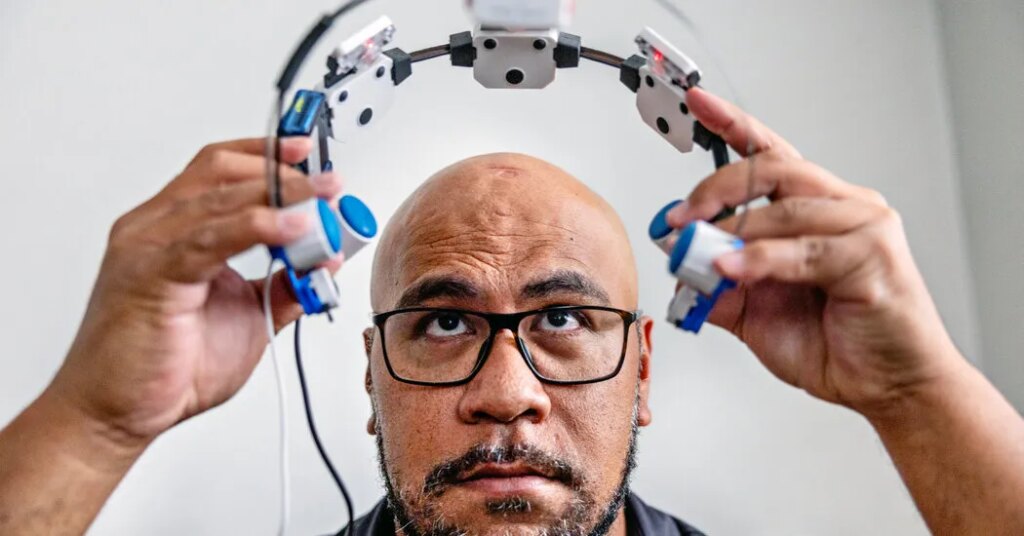
A college football team in Utah is donning some curious caps this season. As part of their regular recovery routine, many Brigham Young University players are wearing headsets that shine near-infrared light onto their scalps — and up their noses.
Emerging science suggests that the devices may help the brain be more resilient to damage, potentially reducing the risk of chronic traumatic encephalopathy, a degenerative disease associated with repeated head trauma.
Researchers first introduced the headsets to B.Y.U. football as part of a small, randomized trial in 2021. Based on that study’s results — signs of reduced brain inflammation among users over the season — the team ordered more.
Near-infrared light is just one of a number of surprising therapeutic approaches for C.T.E. that scientists are investigating. Some see promise in manipulating the gut microbiome; others are exploring the potential of stimulating the vagus nerve, eliciting a psychedelic experience or repurposing drugs that might quiet inflammation in the brain.
All the research is driven by mounting concerns over the long-term brain health of contact-sport athletes. A study published on Wednesday used a statistical model to estimate that three in four former National Football League players who died between 2008 and 2023 most likely had signs of C.T.E. in their brains at death.
Chris Nowinski, a neuroscientist and chief executive of the Concussion & CTE Foundation, and a coauthor of the study, described C.T.E. as a “massive public health issue.”
Dr. Allen Sills, the N.F.L.’s chief medical officer, said he is closely watching research developments.
“All clinicians hope that we will soon have better diagnostic and therapeutic options for patients,” he said. “We just have so much more to learn about the pathophysiology of many neurodegenerative diseases and which parts of the cascade are most robust for intervention.”
It’s not only a problem in sports. The Coast Guard acknowledged for the first time in July that rough seas can cause repeated brain trauma to small-boat crews.
And by some estimates, the number of intimate partner violence survivors living with long-term effects from brain injury dwarfs that of football players.
At the moment, there is no widely recognized treatment for C.T.E., and it can only be definitively diagnosed after death. But worried athletes and former athletes are not waiting for the research to arrive.
Marcus Mailei began playing football at age 7. After a brief injury-riddled stint in the N.F.L., the fullback hung up his cleats at age 24.
Disturbing changes slowly surfaced over the next several years. Mr. Mailei became increasingly irritable. He grew more socially anxious, even paranoid, about the intentions of family and friends, or about planes flying overhead.
His wife, Kristen Mailei, began to fear for his safety, as well as their family’s. One day, she stumbled across an article about another former player whose similar symptoms subsided after using a near-infrared light headset.
“It was a Hail Mary,” she said.
In 2020, Marcus began wearing a headset a few days a week, 20 minutes at a time. “After about a year, I felt like my feet were back on the ground,” said Mr. Mailei, now 39 and a community college teacher and coach in Utah.
Unexpected Results
The treatment, called photobiomodulation, or PBM, emerged in the 1960s after Hungarian scientists accidentally discovered that low-level red light stimulated hair growth in rodents.
Decades later, researchers began to investigate whether longer wavelengths of near-infrared light — which are invisible to the human eye and penetrate more deeply than visible red wavelengths — could affect brain tissue.
Studies in animals and humans showed that, depending on the device, a small fraction of near-infrared photons targeted at the scalp can reach the brain. That appears to be enough to trigger shifts in blood flow, communication between brain regions, and how cells produce and use energy.
PBM is widely available in clinics as a treatment for wounds, inflammation and more. But much of the science regarding its effects on both the brain and body remains unsettled, including optimal wavelengths, intensities and durations.
The headsets used in the B.Y.U. studies include a component that sends photons up the nose, which preliminary research suggests may be a more efficient route for getting photons to certain parts of the brain.
After PBM studies continued to show improvements in people with lingering head injury symptoms, researchers at the University of Utah decided to see if it could also be used to intervene earlier.
“If we can prevent damage from happening, that’s even better,” said Hannah Lindsay, a neurologist at the University of Utah School of Medicine and coauthor of the study of the B.Y.U. football team.
During the 2021 football season, dozens of B.Y.U. players used a near-infrared light headset three times a week. Half of the players were randomized to receive active light therapy and the other half to use identical headsets that did not produce light.
Based on a final analysis of 26 players, researchers saw that the brains of athletes who received PBM did not accumulate the same widespread inflammation and wiring damage as those in the placebo group.
What’s more, the neuroinflammatory changes in this group were concentrated in brain regions known to be the most vulnerable to the rotational twisting and sheering forces common in football.
Other research adds support. John Mitrofanis, a neuroscientist at the University of Grenoble Alpes in France, has helped demonstrate that pretreating an animal with near-infrared light makes its brain, he said, “more likely to stave off whatever insult it’s going to be hit with.”
A small, randomized study at Massachusetts General Hospital also showed improved markers of early recovery for patients treated with PBM within three days of a traumatic brain injury.
“More and more data comes out showing that this is real,” said the study coauthor Eva Ratai, a neuroradiologist at Mass General Research Institute.
Not all trials have shown significant benefits, however. Some experts caution that PBM needs much more research before it can be recommended to athletes at risk.
“The idea that red-light therapy could stop brain damage acutely is a massive claim that lacks significant evidence,” said Dr. Nowinski. “It’s also a risky claim if we’re actually trying to convince people to change their behaviors.”
Larger and more rigorous trials are in the works. The Utah research team recently received a $4.6 million grant from the Department of Defense to study PBM for persistent symptoms of mild traumatic brain injury in 300 service members, veterans and first responders.
Dr. Jean-François Chermann, a neurologist in Paris who specializes in sports-related concussions, is planning one of at least two separate clinical trials in France of PBM for rugby players.
Dr. Chermann recently treated 60 elite players whose concussion symptoms had lingered for at least three months. After eight or more sessions, according to his not-yet-published results, about 80 percent had significant improvement.
“But some people didn’t respond at all,” he said.
An Experimental Playbook
Near-infrared light is far from the only C.T.E. treatment that scientists are evaluating.
Daniel Carcillo played 10 years in the National Hockey League, winning two Stanley Cups and engaging in 164 fights. He subsequently developed symptoms associated with C.T.E.
Mr. Carcillo, now 41, said he made himself a “guinea pig” to all kinds of treatments — hyperbaric chamber therapy, craniosacral massage. Nothing seemed to work.
Finally, after reading promising research on psychedelics, he participated in a guided psilocybin session. (Psilocybin is the psychedelic compound in “magic mushrooms.”)
“I’ve now been symptom free for seven years,” he said. “I’ve never been happier or healthier.”
Frederick Barrett, director of the Center for Psychedelic and Consciousness Research at Johns Hopkins University, said he hears similar stories from former athletes.
The “plural of anecdote is not data,” he said. Yet Dr. Barrett suggests the emerging evidence is sufficient to justify investigating psychedelics as a treatment for T.B.I. and C.T.E.
One study published in September, for example, showed that doses of psilocybin after repeated mild head impacts helped protect rats’ brains by rebuilding networks and boosting cell repair, as well as by reducing swelling and the toxic buildup of tau protein. The N.H.L. declined to comment on this and other experimental treatments.
Drugs already on the market might also be repurposed to protect against brain injury. Baricitinib, a high potency anti-inflammatory medication used to treat rheumatoid arthritis and other conditions, is under investigation in a new open-label trial of depressed football players.
Depression can be a “precursor to full blown C.T.E.”, as well as to Alzheimer’s and Parkinson’s diseases, said Andrew Miller, a psychiatrist at Emory University and trial investigator. “Inflammation is playing a major role in all these diseases.”
The trial will explore if, by blocking inflammation, the drug can arrest disease “before cognitive calamity,” he said.
The influence of the gut microbiome on inflammation is among reasons that it, too, is on the radar. A recent small study linked mild, non-concussive blows to the head during football with changes in the microbiome.
Mounting research suggests it’s a two-way street: Manipulating the microbiome also appears to affect inflammation and tissue damage in the brain.
The N.F.L. Players Association is supporting microbiome trials. One is collecting blood and stool samples while tracking head injuries among 120 male and female college athletes in Houston.
A separate trial has been looking at veterans and people coming into the emergency room after a T.B.I. Those findings, currently under review, suggest that the microbiome might dictate recovery or be a target for interventions, said Lisa Brenner, director of the VA Brain Health Coordinating Center at the University of Colorado Anschutz and trial investigator.
Much more work is needed, scientists say, but specific probiotic strains or fecal transplants could one day be a plausible treatment for the brain.
“We think about recovery from a brain injury happening in the brain, but it could be happening in the body, too,” said Dr. Brenner.
New animal research even hints that tapping into the bone-brain connection — by compressing the shin bone — could promote recovery after brain injury.
Some of these novel strategies may overlap. Researchers have applied PBM to the abdomen, targeting the gut microbiome. Others have found possible synergy between PBM and vagus nerve stimulation; at least one headset now incorporates both treatments.
More standard psychiatric treatments — from neurofeedback to noninvasive brain stimulation — could make the treatments more effective. One of the three arms in the Utah team’s new clinical trial will combine PBM with computerized cognitive rehabilitation.
Scientists agree that the very best solution is to prevent head injuries in the first place. In the case of football, more advanced helmets and protective rules, such as limits on full-contact practices and changes to kickoffs, help.
Dr. Sills said the N.F.L. is continuing to look for further opportunities to “get rid of avoidable head impacts.”
But such efforts still don’t eliminate the risks. And as Dr. Nowinski points out, abstinence is “a difficult sell to young people and to their parents.”
The Maileis’ oldest son plays football and recently suffered a concussion. “I strapped the light on his head the next day,” said Ms. Mailei. “I’m terrified of him playing, but he loves it so much.”
The post Can Scientists Make Football Safer? appeared first on New York Times.