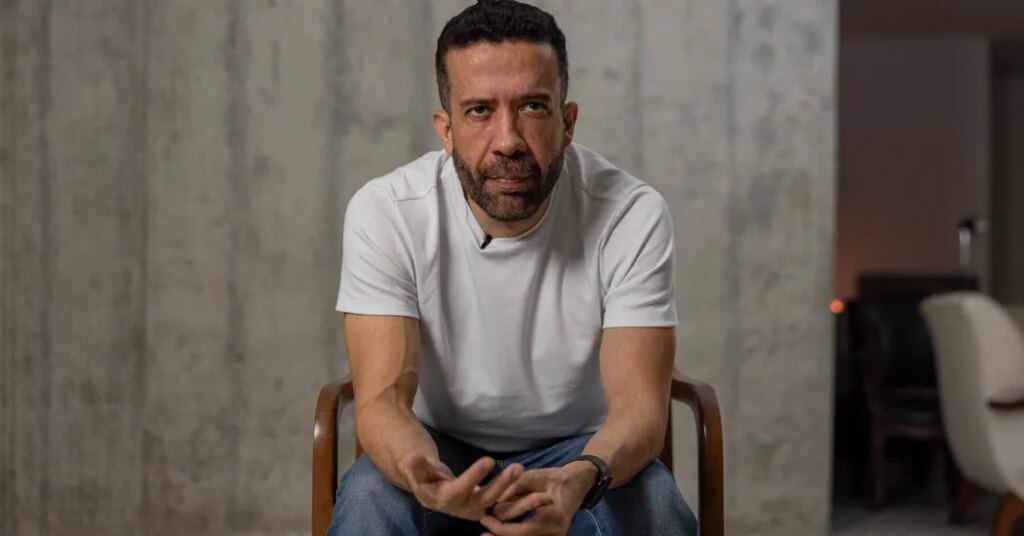
André Janones would have had plenty of reasons to be fast asleep. It was less than 24 hours after President Luiz Inácio Lula de Silva’s stunning comeback in Brazil’s fiercely contested presidential election, and Mr. Janones had played the role of a key architect in the candidate’s 11th-hour victory.
He had led an impromptu, nonstop digital campaign to mobilize Lula supporters to the polls on Sunday, helping Mr. Lula overcome his second-place finish to his right-wing rival, Flávio Bolsonaro, in the first round of voting.
But on Monday night, Mr. Janones, 42, who said he had been averaging about four hours of sleep a night during the final three-week sprint, was pacing around a São Paulo living room, drinking coffee and animatedly dissecting his role in Mr. Lula’s win.
“No matter what happens in my life from now on, my existence has been worth it,” he said during a two-hour interview on Monday night. “I was able to contribute to the survival of democracy in my country.”
As Mr. Lula claimed victory on Sunday, the leftist president explicitly thanked Mr. Janones for his role.
The election has taken a head-spinning twist since Sunday, with Mr. Bolsonaro fleeing Brazil for the United States after the Brazilian authorities ordered him to submit his passports because he was under investigation for money laundering.
In some ways, Mr. Janones’s role in the election seemed unlikely. He is a leftist congressman from a small city in the state of Minas Gerais, he never had an official role in Mr. Lula’s campaign, and he didn’t even belong to Mr. Lula’s party.
But unlike Mr. Lula, who until recently didn’t even own a smartphone, Mr. Janones is no stranger to digital politicking. He has hosted Facebook videos since 2018, including ones supporting the poor and striking truck drivers that went viral and became part of his successful congressional campaign.
After Mr. Lula finished 2 percentage points behind Mr. Bolsonaro in the first round, on Oct. 4, many political analysts and data experts started writing off the president.
But Mr. Janones, who comes across as an eternal optimist, had other ideas. He decided he would turbocharge a slow-growing WhatsApp channel called Lula’s Army that he had created in April. On Oct. 5, he issued an initial call to action after the first round.
“Prepare to be shocked,” he said. “Hold your head high, because we are going to win this election, and I’ll tell you how: We are going to win this election, first, by speaking the language of the people.”
He shared Mr. Lula’s belief that the election was essentially a fight on behalf of the nation’s poorest people. Like Mr. Lula, Mr. Janones said he was born into poverty, faced hunger as a child and was raised by a single mother.
But the channel also leaned into a simple resonant message — that Brazil could ill afford another Bolsonaro as president.
Mr. Bolsonaro’s father, Jair Bolsonaro, was convicted of plotting a coup after losing to Mr. Lula in 2022. The plot, prosecutors said, included plans to assassinate Mr. Lula.
Seeking to marshal support for Mr. Lula, Mr. Janones began using the language of armed conflict, calling himself “general” and his followers “soldiers,” to whom he issued tasks that he called “missions.”
He said he felt uncomfortable adopting a militaristic approach to try to defeat a candidate he believe threatened Brazil’s democracy.
But, he said, “It’s wartime. The time we’re living through today is not the time for us to do what we’d like to do. It’s the moment for us to do what needs to be done.”
With internet algorithms in mind, he told his followers not to respond to online attacks against Mr. Lula as engagement would further boost reach. He implored them to watch pro-Lula videos to the end, post comments and share widely.
He told followers to post selfies at the same time wearing the same yellow Brazilian soccer jersey, long a symbol of the right, and making an “L” with one hand, a pro-Lula gesture. “We’re going to take back our symbols,” he said on the channel. The fad was soon trending.
At the exact time that Mr. Bolsonaro was scheduled to appear on the nation’s largest TV network, Mr. Janones called for a “panelaço,” a Latin American form of protesting involving the banging of pots and pans. His video, urging followers to “keep banging until you dent it, then replace it, buy another pot,” drew 20 million views in hours.
Mr. Janones also drew from what he viewed as the digital toolbox of the right wing — including using emphatic and colorful language — that he said has generally been more adept at using social media to help achieve political success. He has also admitted to lobbing half-truths in his messages.
“The right lies shamelessly,” he said. “They hit below the belt. Ideally you’d hit above. I hit exactly at the belt line.”
In many messages and videos Mr. Janones often swore and frequently typed in capital letters. Messages urged followers to make posts “EXPLODE!” online. “This video needs to reach millions of views in MINUTES,” he said in one post.
The WhatsApp group quickly snowballed. Within five days of the first round of voting it had topped 3 million followers — after staring with 53,000. (By Election Day the number had reached 10 million.)
Mr. Bolsonaro started taking notice and in mid-October asked Brazil’s electoral court to suspend the account, his campaign accusing Mr. Janones of running “a channel to spread lies on a massive scale.”
Right-wing social media accounts also raised suspicions that he paid subscribers to his channel, but they provided no evidence.
A judge politically aligned with Mr. Bolsonaro briefly suspended the channel, twice. But those rulings were quickly overturned.
Several million additional followers soon joined the group.
One of those followers ended up being Mr. Lula himself, who up until then was widely known not to have a cellphone.
The WhatsApp channel also translated its digital muscle to the real world, helping mobilize mass rallies, especially among younger Brazilians.
One follower, Marcella Marconi, 43, shuttled voters to a polling station on Election Day in her city in Bahia State.
Afterward, she posted videos of her efforts, saying she had been “Janonized.”
David Nemer, an associate professor at the University of Virginia who researches the role of social media in Brazilian politics, said the WhatsApp group mobilized left-leaning voters who may not have otherwise gone to the polls.
“That’s the thing that the left always lacked in Brazil, the centralized organization,” he said.
Mr. Lula, in his victory speech on Sunday, lauded Mr. Janones, who was standing by his side, as “our general” and thanked him for playing “an exponential role in boosting the morale of our troops every single day.”
Mr. Lula then pledged that in his fourth term, his administration would embrace all the digital tools at its disposal to speak more directly to the people.
The president’s praise has ignited speculation that a job may await Mr. Janones in Mr. Lula’s government. But Mr. Janones said he’s not interested.
Despite his efforts on Mr. Lula’s behalf, he is not only critical of the right but also of what Brazilians call the “caviar Left,” which he accuses of “intellectual arrogance and elitism” that he feels alienates the working class.
“The Left completely lost the smell of the people,” he said.
Throughout the three-week campaign between the two rounds of voting, Mr. Janones not only forestalled sleep but also halted his fitness routines, he said, and was constantly on his phone, as online as he had ever been, which was saying a lot.
As the interview ended, he paused for a moment and said, “This is the longest I’ve gone without looking at my phone in the past two months.
Reporting was contributed by Thayz Guimarães from Brasília, Seth Kugel from São Paulo, Leonardo Coelho from Rio de Janeiro and Zane Irwin from New York City.
The post The Digital Provocateur Who Helped Turbocharge Lula’s Comeback appeared first on New York Times.