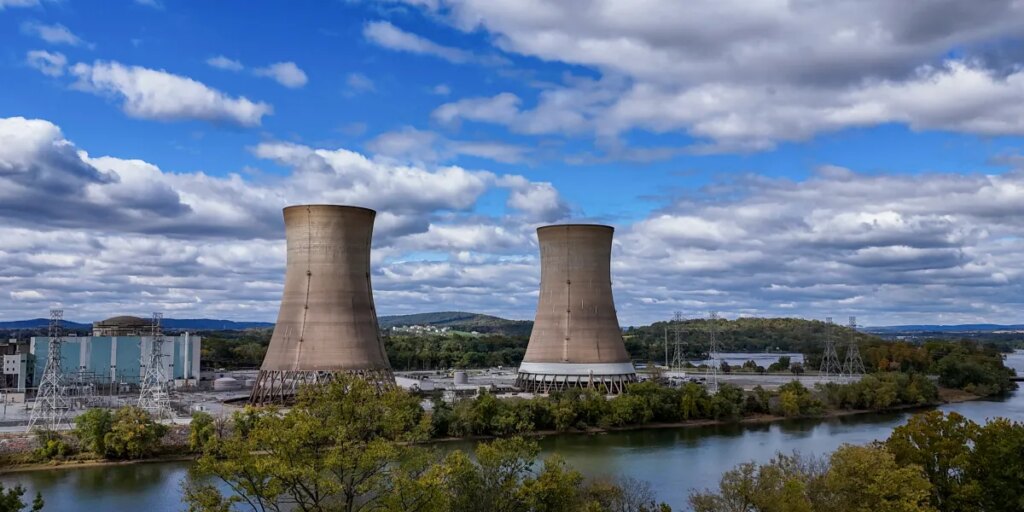
In 2019, the owners of the Three Mile Island nuclear power plant shut down its Unit 1 reactor. The reactor was still running. It just couldn’t compete economically.
Five years later, Microsoft signed a 20-year agreement to buy its power, and the plant is being restarted as the Crane Clean Energy Center.
Nothing about the reactor changed. The buyer did. Data centers need enormous amounts of reliable, around-the-clock electricity, and many of their operators have ambitious carbon-free energy commitments. To that customer, a plant the market had written off was suddenly worth bringing back.
Three Mile Island is a preview of something bigger. Climate-specialist venture funds are on track to raise less than $1 billion this year, according to PitchBook, their weakest showing since 2015 and down from more than $10 billion in 2021. That’s money flowing into funds with “climate” on the door.
Money flowing into the companies themselves tells a different story. Venture and growth investment in clean energy startups hit a three-year high in 2025, per Sightline Climate. Geothermal developer Fervo Energy raised $2.2 billion in its May IPO, then signed a new power deal with Google. Increasingly, the checks come from generalist investors, public markets, and corporate buyers. Dawn Lippert of Earthshot Ventures told Fortune that 90 percent of the companies it backs have generalist tech investors as co-investors. Gigascale Capital’s Mike Schroepfer calls it “a tale of two cities.”
The capital is following the technology and leaving the label behind.
Better. faster. cheaper. stronger. safer.
Five words that explain how technologies win markets. A technology only has to win on the ones its customers value most. In more than 15 years of working with companies across energy, climate, and infrastructure, I’ve seen firsthand how compelling economics and superior performance accelerate adoption. The idea is old. It bears repeating now, as AI captures the world’s capital and talent.
The urgency trap
For decades, climate advocacy has rested on a reasonable assumption: if people grasped the scale of the crisis, they would act.
Except people are very good at ignoring problems that feel distant, gradual, or politically loaded. I don’t believe we’ll ever generate the universal sense of urgency climate advocates seek, and we don’t have to.
Look at AI. Companies are racing to adopt it to cut costs and beat competitors. No moral consensus was required, and much of the promised value remains unproven. The sociologist Everett Rogers defined “relative advantage” as the degree to which an innovation is perceived as better than the idea it replaces. With AI, perception has been enough.
AI is defined by the value it promises to create. Climate tech is still too often defined by the problems it promises to solve.
That’s backwards, because many climate technologies don’t have to promise. They can prove it.
The five-word test
Utility-scale solar’s global average cost fell roughly 90 percent between 2010 and 2023, according to the International Renewable Energy Agency. The pitch shifted from “pay a premium to do good” to cheaper power and long-term price certainty. In 2024, U.S. heat pump shipments outpaced gas furnaces by 32 percent, the widest margin on record.
The environmental benefits are real. They just don’t have to be the reason someone writes the check.
Some climate technologies can’t pass the test yet. Early-stage companies chasing breakthroughs feel the funding squeeze most, and many still need policy support. That is where the work remains.
Meanwhile, Microsoft and Google are signing long-term deals for nuclear and geothermal power. AI competes with clean energy for capital, but it has also become one of clean energy’s most important customers. And whoever is buying decides which of the five words matters most.
The category trap
We’ve also made climate tech its own category, complete with climate startups, climate funds, and climate conferences. These labels organize capital and talent, but they lump together technologies that share little beyond their environmental benefits, and obscure the far larger markets they serve. The buyers aren’t looking for climate solutions. They are looking for things like more efficient HVAC, cheaper process heat, and lower electric bills.
Investors are already looking past the label. Dawn Lippert of Earthshot Ventures told Fortune that 90 percent of the companies it backs have generalist tech investors as co-investors.
Consider a manufacturer that cuts its energy bill with industrial heat pumps, or a data center developer that gets online sooner with on-site batteries. Neither would call itself a climate company, and neither should.
In the 1990s, being an “internet company” meant something. Today, virtually every business is one, and the label means little.
Electricity followed the same arc a century earlier. Generating stations were running by the early 1880s, yet as economist Paul David showed, the big productivity gains didn’t arrive until the 1920s, once factories stopped simply swapping steam engines for electric motors and redesigned themselves around electricity. Today, nobody calls a factory “electric.” It’s just a factory.
Climate is headed down the same road. Every company will become climate-enabled, and executives won’t have to become environmentalists for it to happen. These technologies will become inseparable from how businesses compete.
From movement to market
Policy and public investment have helped create these markets, and they still matter. Lasting adoption, though, depends on delivering value.
A movement asks people to believe. A market gives them a reason to buy. Three Mile Island got its second life from a customer who needed what it could deliver.
The future of climate is the entire economy. The real goal is climate innovation so much better, faster, cheaper, stronger, and safer that we no longer need a separate category to describe it.
The end of climate tech wouldn’t be a failure. It would be the ultimate victory.
The opinions expressed in Fortune.com commentary pieces are solely the views of their authors and do not necessarily reflect the opinions and beliefs of Fortune.
The post Climate VC fundraising is on track for its worst year since 2015. That’s the best thing that could happen to climate tech appeared first on Fortune.