There’s something tantalizingly Christmassy about Mona Pirnot’s elegant “I Became We” at the Atlantic Theater in Manhattan. It’s odd, that faint sensation, because the show (more a concert than a musical) displays no shiny star, no tinsel, no hint of a tree. In fact nothing could be more secular than Pirnot’s scrupulously unspectacular script, which starts drolly with an account of male cluelessness.
“I saw a segment on ‘Jimmy Kimmel Live!’ called, ‘What Do You Know About the Female Body?’” the production begins, describing a reporter-on-the-street bit in which men were asked to identify organs on a chart. “One man points to the cervix and calls it a uterus. One man points to the bladder and calls it a vagina. One man points to the rectum and says he’s pretty sure that it’s a baby.” (Guys!)
This anecdote does not, in and of itself, scream “holiday.” Yet there’s the way that Pirnot conveys it. Because “I Became We,” directed by Sarah Benson, is actually a beautifully composed classical song-cycle by Jack D. Coen, who wrote the libretto with Pirnot.
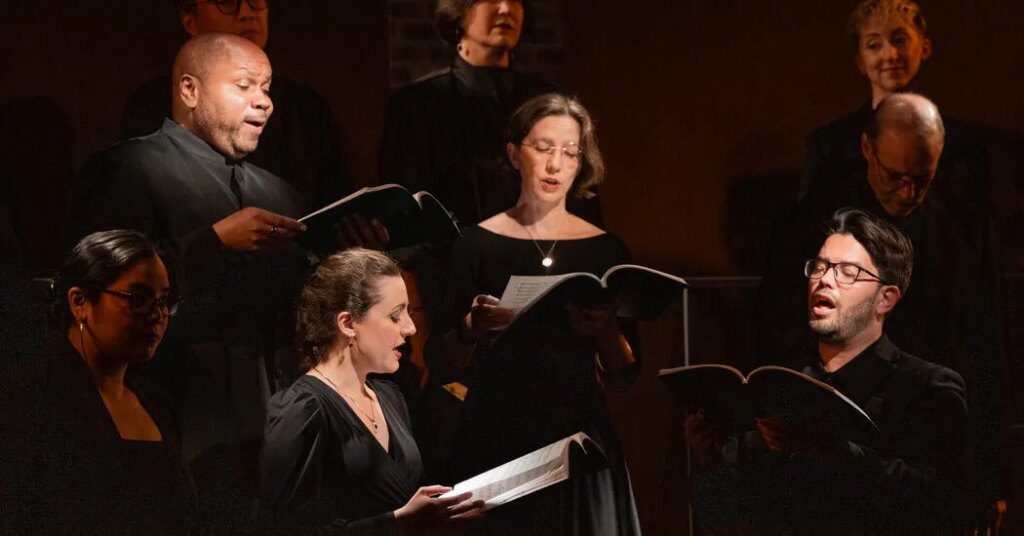
The pianist Blair McMillen sits at a grand piano; a world-class choir stands on performance risers, wearing their finest concert black. Suddenly, as a gust of smoke swirls overhead, we notice that the Atlantic Theater is a converted church: We’re in the sensorial world of madrigal recitals, “Messiah” sings, sacred carols.
Pirnot never appears onstage; instead, the entire choir plays her. Together more than a dozen voices sing, “I’m smiling and nodding,” and thus a lone biographical identity can be multiplied and atomized at once.
Coen’s first song, reminiscent of one of the jollier Schubert chorales, bounces along to begin with, though the notes flatten when we sense the “speaker” cringing. The syllables of “Jim-my Kim-mel Live!” run up a scale, like a woman jogging up the stairs. But when the sopranos hit the two syllables of “ba-by” while sliding off E-flat and onto D-natural, that collapsed tonal interval kind of winces.
Coen, who also conducts, has called “I Became We” a “play for choir,” and the collaborators have ensured that the lyrics are never overtly lyrical. The music can soar with operatic grandeur, but events, such as they are, seem resolutely set in ordinary time. The “I” of the title describes meetings with agents and producers because a play has done well (“What’s next?”); she gossips with a friend about a third friend getting pregnant (“Thank god it won’t be us!”); she attends a child-packed barbecue with a noise-averse husband. Is something missing from her calm contentment? We think suddenly of the way that pregnant friends and shouting kids might rhyme.
Benson’s direction is restrained, and often amusing. The supertitles time their appearance to land certain words as punchlines, emphasizing the humor of exquisitely shaped classical voices singing words like “Zoloft.” The production is also consistently, ecstatically gorgeous. Occasionally the performers will turn and listen to one another — when McMillen lets it rip on the keys, for instance. Their expression of polite ravishment was just what I was feeling myself.
This show is the third of the playwright’s autobiographical productions. Each one has fragmented or displaced the writer’s own identity in some way. For the one-woman play “I Love You So Much I Could Die” (2024), Pirnot did appear, but a computerized voice read her lines about a family tragedy; in “I’m Assuming You Know David Greenspan” (2025), she had the downtown actor David Greenspan play a kind of quasi-Pirnot, while explaining the artistic and financial life of the downtown actor David Greenspan.
In both of these earlier cases, the show’s real subject was too difficult to handle directly: grief and then money. But in “I Became We,” she concludes the trilogy by pivoting to glad tidings, or at least to the decision to consider them.
Pirnot’s seemingly autobiographical “I” may be full of anxiety about her dawning wishes, which run counter to everything she has believed about herself, including a childlessness she had long since chosen. Yet epiphany is epiphany. And when revelation comes, you want it to sound like all of heaven is breaking open.
The figure in “I Became We” stands in a kitchen, holding, reluctantly, a friend’s baby. “Her hand curls / Around my finger. My smallest finger / Her whole hand,” the choir sings, and a new future opens in the doubting mind that is speaking to us. It’s not Handel. It’s not “for unto us a child is given.” Still, it’s 2026. You never know where your annunciating angel might find you. It could be Brooklyn. Hallelujah!
I Became We Through Nov. 15 at the Atlantic Theater, Manhattan; atlantictheater.org. Running time: 1 hour 10 minutes.
The post In ‘I Became We,’ Many Voices Exalt One Very Personal Decision appeared first on New York Times.