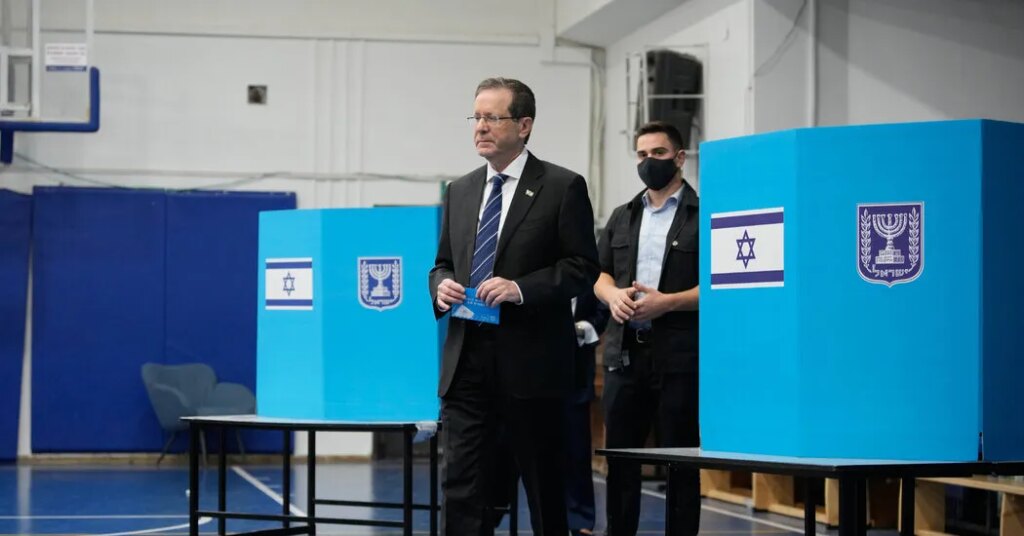
Isaac Herzog, Israel’s president, has a largely ceremonial role — except after national elections, when it is his responsibility to choose a potential prime minister and then tasks that person with trying to form a government.
Since Israelis vote for a party or parties rather than an individual, the person who might lead the country is selected after the ballots are counted and parliamentary seats are allocated to parties according to their proportion of the vote. The president — who is separately elected by the Knesset, Israel’s single-chamber legislature — then convenes party leaders to hear their recommendations for prime minister before choosing someone to form a government.
While the president can choose the leader of the party that won the most votes, he can also select another leader who seems more likely to assemble a coalition that can secure a vote of confidence in the Knesset.
In 2009, President Shimon Peres chose Benjamin Netanyahu — the current prime minister — even though his right-wing Likud party had won fewer votes than the centrist Kadima party.
Early exit polls on Wednesday suggest a tight race between the far-right coalition led by Mr. Netanyahu and the center-right opposition bloc that has called for change. The opposition bloc includes the Yashar party, led by Gadi Eisenkot. But Mr. Netanyahu’s Likud party appears to have received the most votes, which means he will argue that he should be selected as prime minister.
Mr. Herzog, whose job is to stay above the political fray, is expected to face a difficult decision. He must discern whether the votes show that the majority of Israelis demanded change or if they indicated a preference for another Netanyahu government.
Mr. Netanyahu’s governing coalition, the most right-wing in Israel’s history, has drawn international condemnation, heightened tensions with allies and divided Israelis. Mr. Herzog has repeatedly criticized what he has called “a terrible process of brutalization” creeping into Israeli society, citing violence by Jewish settlers in the occupied West Bank against Palestinians and the abuse of detainees in Israeli custody, which some far-right ministers in Mr. Netanyahu’s coalition are accused of encouraging.
The Israeli president, who can grant criminal pardons and commute sentences, has also faced pressure from President Trump, who has called on him to pardon Mr. Netanyahu as he stands trial on corruption charges. Mr. Herzog has respectfully resisted, saying that “Israel is a sovereign state governed by the rule of law.”
Mr. Netanyahu has long resisted calls for an independent commission of inquiry into the Oct. 7, 2023, Hamas-led attack on Israel that set off a devastating war in Gaza. He has also refused to take responsibility for any failures that led to the attack, angering many Israelis.
But if the president taps Mr. Eisenkot, a former military chief whose son was killed in the war in Gaza and who has vowed to launch a state inquiry into the 2023 attack, there is no guarantee he will succeed in forming a government. The center-right opposition bloc would need to ally with the country’s Arab parties, which appear to have secured more parliamentary seats than ever before. The bloc’s leaders have not agreed to such an alliance, while Mr. Netanyahu has effectively ruled out including Arab parties in a governing coalition.
Both the far-right and far-left blocs face obstacles to assembling a governing majority. They would need agreements with other parties and factions that may be politically unpalatable, or even impossible.
The post Israel’s President, Isaac Herzog, Faces a Difficult Choice appeared first on New York Times.