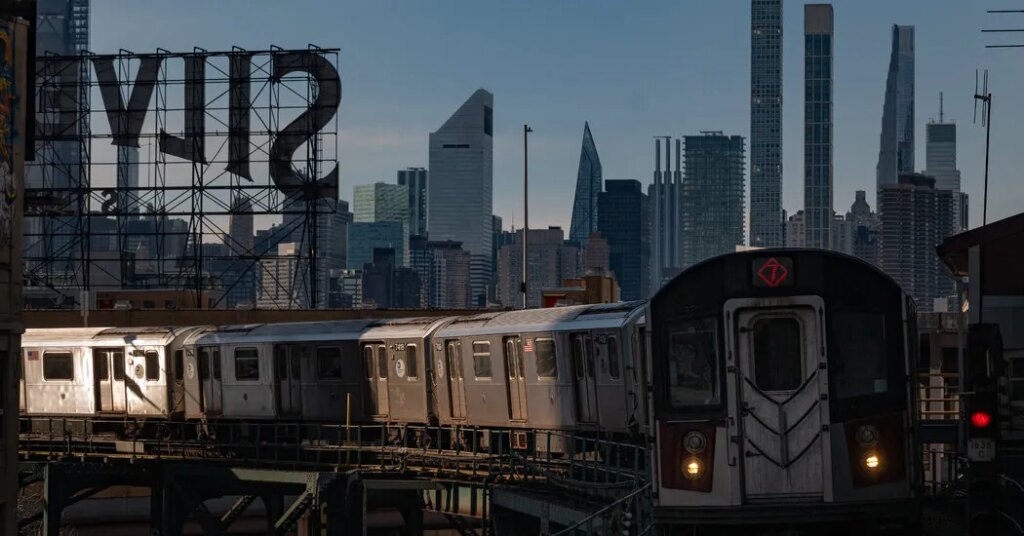
Kathy Hochul, the first New York governor in a century to come from upstate, is not the likeliest champion of New York City’s subway.
Yet there she was, one October afternoon, snapping selfies with riders on an uptown D train on her way to showcase new elevators being built at the Bryant Park station in Manhattan. Hours earlier, she had been miles away in Queens, celebrating a drop in subway fare evasion.
Granted, she traveled between the boroughs in a black Suburban S.U.V.
“I’m not going to pretend I’m a daily commuter,” said Ms. Hochul, who was born and raised in Buffalo. But, she said, “I feel protective of this. This is something that I understand means everything to everybody over here.”
It’s an unusual posture. Many past governors have regarded the mass transit system — with its aging train stations, slow buses, fractious labor groups and perennial budget woes — as more of a liability than an asset.
Ms. Hochul’s predecessor, Andrew M. Cuomo, was often at odds with city officials over who was responsible for the system, though the Metropolitan Transportation Authority is a state agency the governor effectively controls. Years of deferred maintenance and funding fights led to a disastrous series of train delays and track fires in 2017 that came to be known as the Summer of Hell.
But Ms. Hochul, a moderate Democrat who took office in 2021 and is up for re-election, embraced the M.T.A. early in her tenure — a canny choice, political observers said, for a governor with few ties to the state’s biggest urban center. And though bad commutes are still a source of outrage among voters, she is banking on her transit record to help send her back to Albany.
“She is probably the best governor for the M.T.A. in a long time, and the most surprising,” said Maxwell Young, the former head of external affairs at the authority, who served during Mr. Cuomo’s tenure.
In 2023, Ms. Hochul helped the M.T.A. avert a fiscal crisis by directing more than $1 billion in new tax revenue to the authority and filling a budget gap that was blown open during the Covid-19 pandemic.
In 2024, amid concerns about safety, she deployed the State Police, the National Guard and mental health workers underground. Some criticized the show of force as excessive; supporters have credited it with helping to lower subway crime to near-record lows, though a recent rise in assaults and a handful of high-profile killings have unsettled riders.
And in 2025, she approved a $68 billion, five-year capital plan for the M.T.A., its largest ever. Nearly all of that money will go toward repairing long-neglected infrastructure across the subway, buses and New York’s two commuter rail systems.
The improvements include installing new fare gates across 150 of the subway’s 472 stations; replacing Depression-era electrical equipment to make trains more reliable; and adding elevators and other accessibility features to dozens of stations.
Kathryn Wylde, the former head of the Partnership for New York City, an influential business group, said most of Ms. Hochul’s transit projects had something in common: They were unglamorous and even thankless, yet badly needed.
“She’s not interested in putting her name on buildings or facilities,” Ms. Wylde said. “That’s male ego stuff — Trumpian, if you will. She has no need for that.”
But her hands-on approach has also exposed her to criticism.
In May, several Long Island Rail Road unions went on strike for three days over salaries, paralyzing a service relied on by 270,000 daily commuters. Some workers, and riders, blamed the governor.
Bruce Blakeman, Ms. Hochul’s Republican opponent in November, used the strike to criticize her leadership. He has close ties to Long Island — an area she lost when she ran for her first full term in 2022.
New labor disputes are brewing. The Transport Workers Union, which represents subway and bus workers, is negotiating its latest contract with the M.T.A., and the two sides remain far apart on health care contributions, said John Samuelsen, the labor group’s international president. He called Ms. Hochul a “disaster for public sector workers.”
“If she loses, I’m going to get a big, frothy pint of Guinness, and enjoy every second of it,” he said.
Still, the union has stopped short of endorsing Mr. Blakeman, who trails Ms. Hochul by between 10 and 14 percentage points in recent polls.
Ms. Hochul’s biggest transit achievement may be the introduction of congestion pricing, a toll on vehicles entering the busiest parts of Manhattan that was advanced by Mr. Cuomo to speed up traffic and raise revenue for the M.T.A.
In June 2024, weeks before it was set to start, Ms. Hochul paused the program, arguing that a $15 toll was too great a burden. “She took a lot of heat,” said Karen Persichilli Keogh, her top adviser, and transit advocates questioned whether the move was meant to spare fellow Democrats blowback in an election year.
Ms. Hochul revived congestion pricing in January 2025, with a $9 charge for most drivers. People still complained, and President Trump tried repeatedly to kill it.
But Ms. Hochul kept the toll cameras on, endearing her to many of the progressive transit groups that helped propel Mayor Zohran Mamdani into office. In March, a federal judge ruled that the program — widely considered a success — could continue.
Mr. Blakeman, for his part, said at a news conference on Tuesday that he would end the program if elected, though he did not explain how he would fund the transit projects that already rely on the toll revenue.
Transit advocates clashed with Mr. Cuomo over his diverting funds from the M.T.A. to other projects and his insistence that New York City, not the state, was in charge of many of its functions.
“Cuomo was a passionate infrastructure guy about a lot of projects, but he wasn’t sure if he liked the M.T.A., six out of seven days a week,” said Janno Lieber, the chief executive of the M.T.A., who joined the agency during Mr. Cuomo’s tenure but was promoted to its top role by Ms. Hochul.
Rich Azzopardi, a spokesman for Mr. Cuomo, dismissed those criticisms and credited the former governor with a number of transit achievements, including increasing the M.T.A.’s multibillion-dollar operating budget, completing the first phase of the Second Avenue subway expansion and finishing a major Long Island Rail Road project called East Side Access. (Both of those projects were criticized for being late and over budget.)
Much attention has focused on Ms. Hochul’s relationship with Mr. Lieber, whom she said she plans to keep in his post if she wins in November.
After Mr. Trump said last year that he would take over a plan to overhaul Pennsylvania Station, the bustling but widely detested transit hub in Midtown Manhattan, Ms. Hochul said she was happy to oblige, if it meant the federal government would cover more of the renovation costs.
But, in June, Mr. Lieber wrote a scathing letter to federal officials, accusing them of trying to override the M.T.A.’s authority on the project.
Ms. Hochul was not pleased with the letter, which was not authorized by her team, according to two people familiar with the matter. She spoke by phone with Mr. Trump, who suggested she fire Mr. Lieber, though he did not mention him by name, according to those people and a third person familiar with the conversation.
Ms. Hochul defended Mr. Lieber to the president.
“I said, ‘We’re working together, so don’t worry about it,’” the governor recalled, adding that she still wanted the renovation to move forward.
While Ms. Hochul’s transit record has helped her connect with city voters, another term could bring more challenges and political risks.
Fare evasion is stubbornly high, especially on buses, which Mr. Mamdani has promised to make free. He needs Ms. Hochul for that, but she has not supported it and does not want to raise taxes to make up for the $1 billion a year in lost revenue.
Still, Ms. Hochul seems to have decided that there is more upside in championing the transit system than in distancing herself from it.
“The M.T.A. has often gotten itself into trouble, and being away tends to protect you,” said Kathryn Garcia, her former director of state operations and infrastructure. But, she added, “If you asked a New Yorker today if the governor was responsible for the M.T.A., they would say yes.”
The post How Hochul Became a Surprise Champion of the Subway appeared first on New York Times.