Just north of the highway that runs through Southfield, Mich., is Congregation Shaarey Zedek, a soaring modern synagogue that has been an anchor for Jewish life in suburban Detroit since the 1960s. On the other side of the road stands Umma, a Muslim congregation that opened this year and regularly attracts hundreds to Friday afternoon prayers.
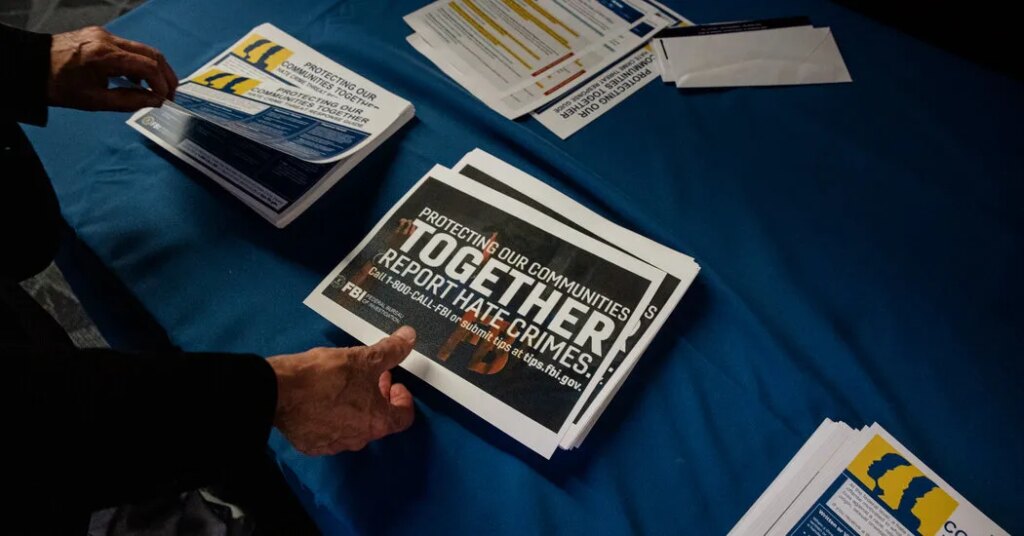
The two congregations, both worried about the hate that has permeated the national political atmosphere, share a quiet but persistent fear that they could be victims of hate crimes at any time.
This year’s high-stakes Senate race in Michigan has inflamed those tensions and heightened their anxiety.
The Democratic nominee, Dr. Abdul El-Sayed, would be the country’s first Muslim senator if elected, and his candidacy has drawn ugly Islamophobic rhetoric from agitators at campaign events and from high-profile supporters of his Republican opponent, Mike Rogers, including President Trump. At the same time, Dr. El-Sayed has been accused of stoking antisemitism with his relentless criticism of Israel. Some who have spent a lifetime voting for Democrats are considering casting a ballot for Mr. Rogers — or not voting at all.
“Somehow we’re suddenly arguing about which candidate we are most afraid of,” said Andy Bocknek, a financial planner and a former president of Temple Israel in nearby West Bloomfield, the site of a violent antisemitic attack in March.
“It’s a sad statement when we’re hoping for a candidate who will do the least amount of damage,” Mr. Bocknek, 46, said. “There’s a lot of pain in this current moment for us.”
Urgent and personal
In Southfield and across Oakland County, where Yemeni coffee shops sit next to kosher butcher shops, Muslim and Jewish voters make up a significant slice of the electorate. The sprawling front lawns of many homes blend into each other, much like the suburban communities themselves. Many move to the area for top-tier public schools, including the one Dr. El-Sayed attended in Bloomfield Hills.
For decades, the area has been the heart of Jewish Detroit, home to dozens of large synagogues. When Dr. El-Sayed was growing up in the 1990s, Muslims had begun to plant roots too, and the community has grown exponentially since. The same neighborhoods are also home to the country’s largest community of Chaldeans, Iraqi Catholics who emigrated to the United States over the past two generations.
The area can feel like a microcosm of the country and yet entirely singular. Like everywhere, voters are frustrated with the cost of gas and groceries. But more than in most American communities, foreign policy and local politics here are intertwined — urgent, personal and visceral.
Many Jewish voters worry about a repeat of the attack on Temple Israel, in which a man drove his truck through the synagogue, narrowly missing the preschool classrooms where 140 children were playing. Muslim voters, worry about Islamophobic attacks, fearing that either they or Dr. El-Sayed could be targeted.
Michigan has been politically divided for decades, especially in the Detroit suburbs. But the current fault lines are defined by a raw mix of fear, anger and resentment over U.S. foreign policy in the Middle East.
In 2024, feeling forsaken by the Democratic Party, which they had traditionally supported, some Arab and Muslim voters organized the “Uncommitted” campaign during the presidential primary, withholding their support from President Joseph R. Biden Jr. to signal their dissatisfaction with his backing of the Israeli government.
This year, some Jewish voters — also a mainstay of the Democratic coalition — have expressed their own feelings of abandonment as sentiment within the party has shifted sharply against Israel.
The Senate campaign has played out against this fraught backdrop. Dr. El-Sayed has linked U.S. aid to Israel to domestic problems, arguing that the money sent there could instead fund schools and health care here. And he has argued that Israel’s military operations in Gaza after the Hamas-led attack on Israel have amounted to genocide. The American Israel Public Affairs Committee, the country’s leading pro-Israel lobby, has spent millions of dollars to try to defeat him. Both Muslims and Jews feel deeply vulnerable. They worry that their children will see political advertisements that portray Dr. El-Sayed as un-American or blame U.S. support for Israel for the rising costs of eggs. They fear the heightened rhetoric will encourage violence against both communities.
‘As if your life depends on it’
Even amid their worry, Muslims in Michigan have a sense that the election of Dr. El-Sayed, the son of Egyptian immigrants, could represent an important shift in American politics. They regard him as the first national politician who shares their fervor for a Palestinian state.
“We were never this close to making this big of a difference,” said Asim Khan, a 62-year-old engineer and local leader who has helped establish several mosques in the area. For months, he has helped register voters during Friday prayers, hoping to get as much as 85 percent of the Muslim community to vote. Volunteers at Umma, which means community in Arabic and is also an acronym for the United Michigan Muslim Association, have also handed out voter information.
“I keep saying, work as if your life depends on it,” he said. “Because you never know when we will get another chance like this.”
Fatima Salman, 48, was a young adult in Oakland County during the “war on terror” that followed the 9/11 attacks. Back then, she said, she could never have imagined that Michigan would be on the verge of electing a candidate like Dr. El-Sayed. She could have hardly imagined the possibility even two years ago.
Ms. Salman is the daughter of Indian immigrants, and her father often helped new arrivals settle into the area through his work at a local mosque.
Mr. Trump’s first election in 2016, and especially his anti-immigrant rhetoric, had frightened many Muslim Americans, but in some ways the aftermath gave Ms. Salman hope. Many non-Muslim acquaintances were eager to protest the new administration’s “Muslim ban” barring people from several majority-Muslim countries from entering the United States.
She worked with interfaith groups for several years. But those relationships began to fray in early 2024, amid the Israeli bombardment of Gaza.
“I was seeing everyone so behind Israel and whatever it did,” she said. “I thought, we can’t continue this relationship. We broke bread and now you can’t even see the humanity of Palestinians? What was all of that for?”
She began to think that the reported rise of antisemitic incidents was overstated. When she read through some media reports, she said, she was taken aback by complaints that involved people shouting insults on the street. “I just thought, I deal with this happening to me every day as a hijabi,” she said.
Ms. Salman began to focus on pushing for change within the Democratic Party, organizing with Uncommitted. While the movement had some success, organizers were enraged by the party’s refusal to allow a Palestinian speaker to address the Democratic National Convention from the stage.
Ms. Salman is stunned by how much has changed in two years.
“What’s happening now is heartening, but I can’t believe it — it’s shocking to see in my lifetime,” she said.
Still, for others, the spotlight on Dr. El-Sayed has reminded them that Muslims are still viewed with suspicion.
Sumaiya Ahmed Sheikh, 35, remembers the heightened security at her Islamic school after 9/11. This year, she cajoled other parents to pay for security guards at the Islamic school her two sons attend. “When you grow up knowing you have a target on your back,” she said, “you’re kind of used to it.”
Snipers on the roof
Rabbi Aaron Starr looks out over stained glass panels in Shaarey Zedek and winces when he thinks about the staggering sums the congregation spends on private security each year.
“We haven’t yet dug the moat and built the wall,” he said dryly. “But that might be coming next.”
Security cameras and armed guards are now an inescapable feature of Jewish communal life. For the High Holy Days this year, Temple Israel placed snipers on the roof.
For many Jews here, the attack on Temple Israel on March 12 irreparably broke their sense of security.
The next day, Dr. El-Sayed released a video on social media in which he condemned the attack but also declared that “hurt people hurt people,” referring to the fact that the attacker had lost relatives in an Israeli airstrike on Lebanon. Many Jews were enraged, believing that he was making an excuse for the attack.
Dr. El-Sayed apologized, but the anger has lingered.
“That line felt to us like being kicked after we had already been attacked,” Rabbi Starr said. “Some people have forgiven him for that. Most of us have not forgotten.”
Some Jewish voters say Dr. El-Sayed’s candidacy has left them deeply discouraged about the election and the future of the Democratic Party.
Mr. Bocknek finds himself unable to bring himself to vote for either Dr. El-Sayed or Mr. Rogers. He is leaning toward writing in Representative Haley Stevens, a moderate Democrat who lost in the primary.
“It feels like an opportunity to make a statement that says there are still moderate Democrats here who aren’t so far left, but who also can’t justify voting for a Republican,” Mr. Bocknek said. “The push from the far left has been significant, and there is a definite slice of the community who feel politically homeless right now.”
In synagogue halls and on group texts, Jewish voters have engaged in intense arguments over how to navigate the election.
Rabbi Starr addressed the situation directly in his Rosh Hashana sermon.
“For us as Jews, for us as Americans, the world feels, quite simply, on fire,” he said that day. He added, “I am worried not only about feeling afraid, but about becoming a fearful person.”
He concluded with a startling rephrase of Dr. El-Sayed: “Hurt people help people.”
A few days later, another rabbi asked if he could use the quote on lawn signs, which now pop up around the neighborhood. (The signs infuriate Ms. Salman, who believes Dr. El-Sayed has apologized enough for his statement.)
Still, there is far from unanimous thinking among Jews. Jeremy Zeltzer, a local Democratic fund-raiser, recently organized a gathering for skeptical Jewish voters to speak directly with Dr. El-Sayed.
“There is nothing more quintessentially American than to listen, hear, and ask tough questions,” Mr. Zeltzer said.
Marcie Paul, a Democrat activist who attended the event, said she has been so consumed by the election that “it is in my dreams.” Every day, she said, she talks with friends who are weighing whether they are more worried about Mr. Trump or Dr. El-Sayed.
“I know I will vote for him,” she said of the Democrat. “And I will complain about it endlessly.”
The post Michigan Senate Race Drives Anxiety Among Jewish and Muslim Voters appeared first on New York Times.