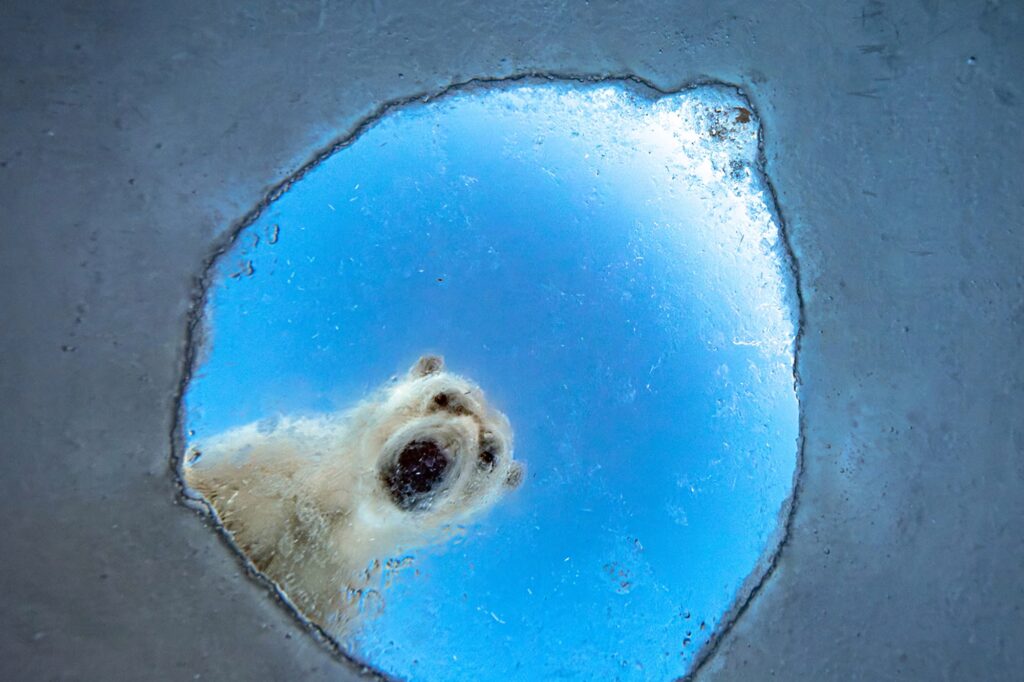
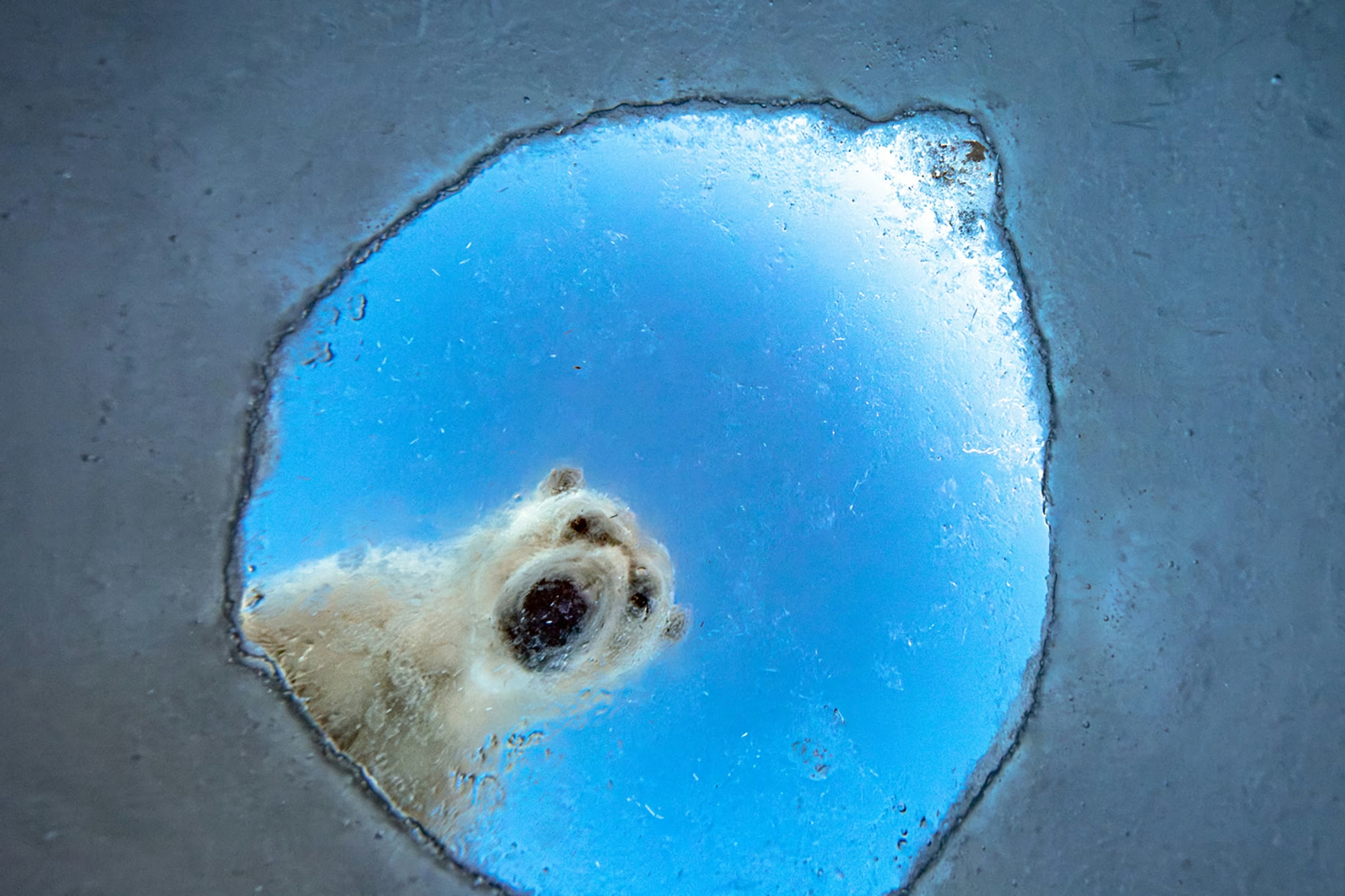
 © Audun Rikardsen / European Wildlife Photographer of the Year 2026A Seal’s Worst Nightmare. Highly Commended, Mammals. “For many years, I had been planning to photograph the most common hunting technique of polar bears (Ursus maritimus) from a seal’s perspective. In the dense pack ice at 83° N, I drilled a hole next to a seal’s breathing hole, installed my camera beneath it, and positioned a motion sensor on the ice above. Eight hours later, I spotted a polar bear in the distance heading straight for the breathing hole. By then, a thin layer of ice had formed on the water. The bear pushed its head through the ice to see what was going on below and looked straight into the camera. The bear then lay down and slept for nine hours, leaving me unable to retrieve my camera. When the animal finally moved on, I rushed over and was over thrilled to discover that I had captured my dream photo of a polar bear.”
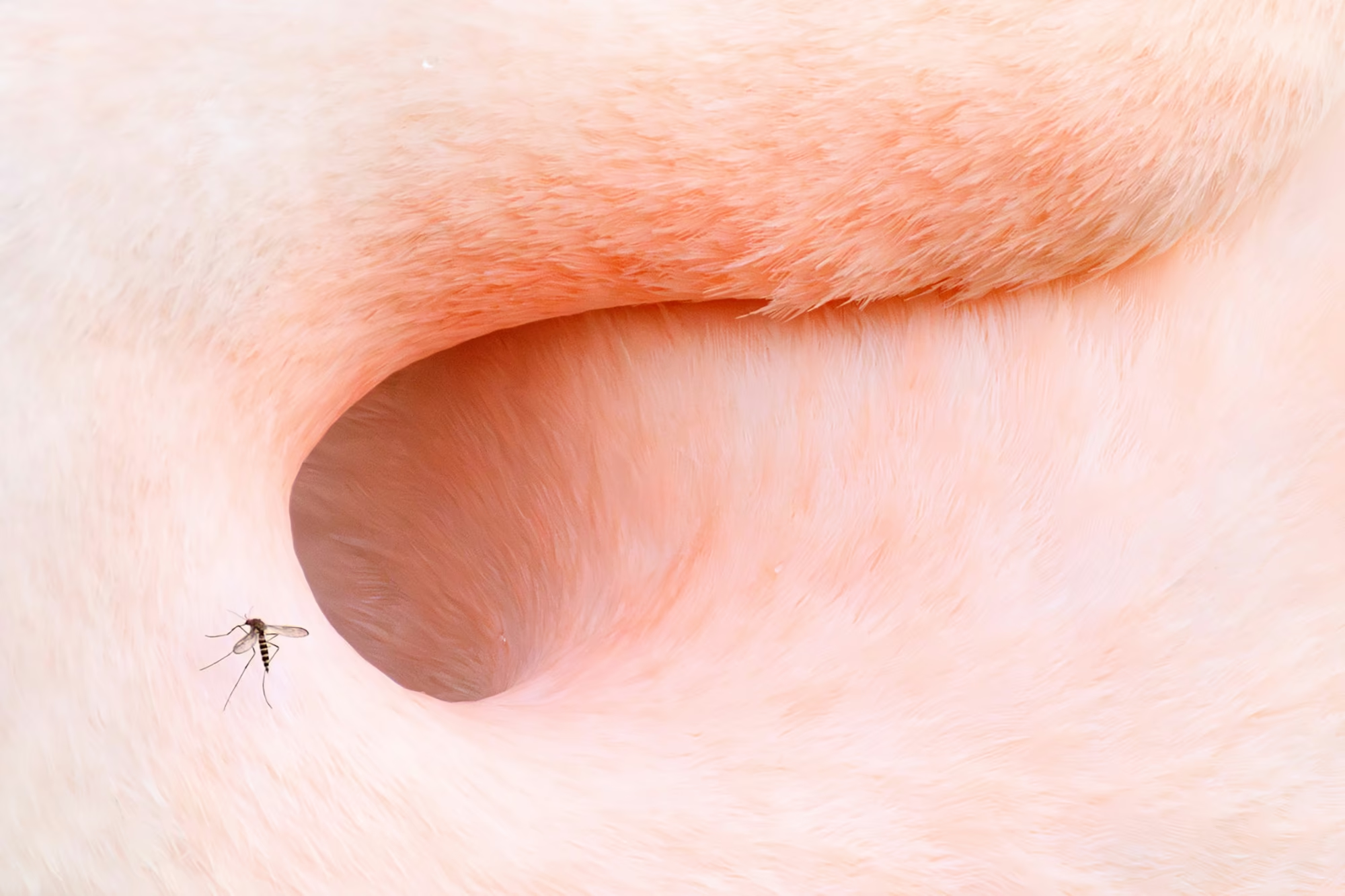 © Jan Leßmann and Hermann Hirsch / European Wildlife Photographer of the Year 2026Pretty on Pink. Highly Commended, Other Animals. “While staying in the Camargue in the south of France, we came across a group of greater flamingos (Phoenicopterus roseus) near Saintes-Maries-de-la-Mer. They were standing in a ditch and weren’t bothered in the least by the people walking past just a few meters away. Anyone who has ever photographed in the Camargue will know this all too well: You set up your camera, compose your image, and within seconds you are swarmed by mosquitoes. This particular mosquito was perched quite attractively on the neck of a resting flamingo.”
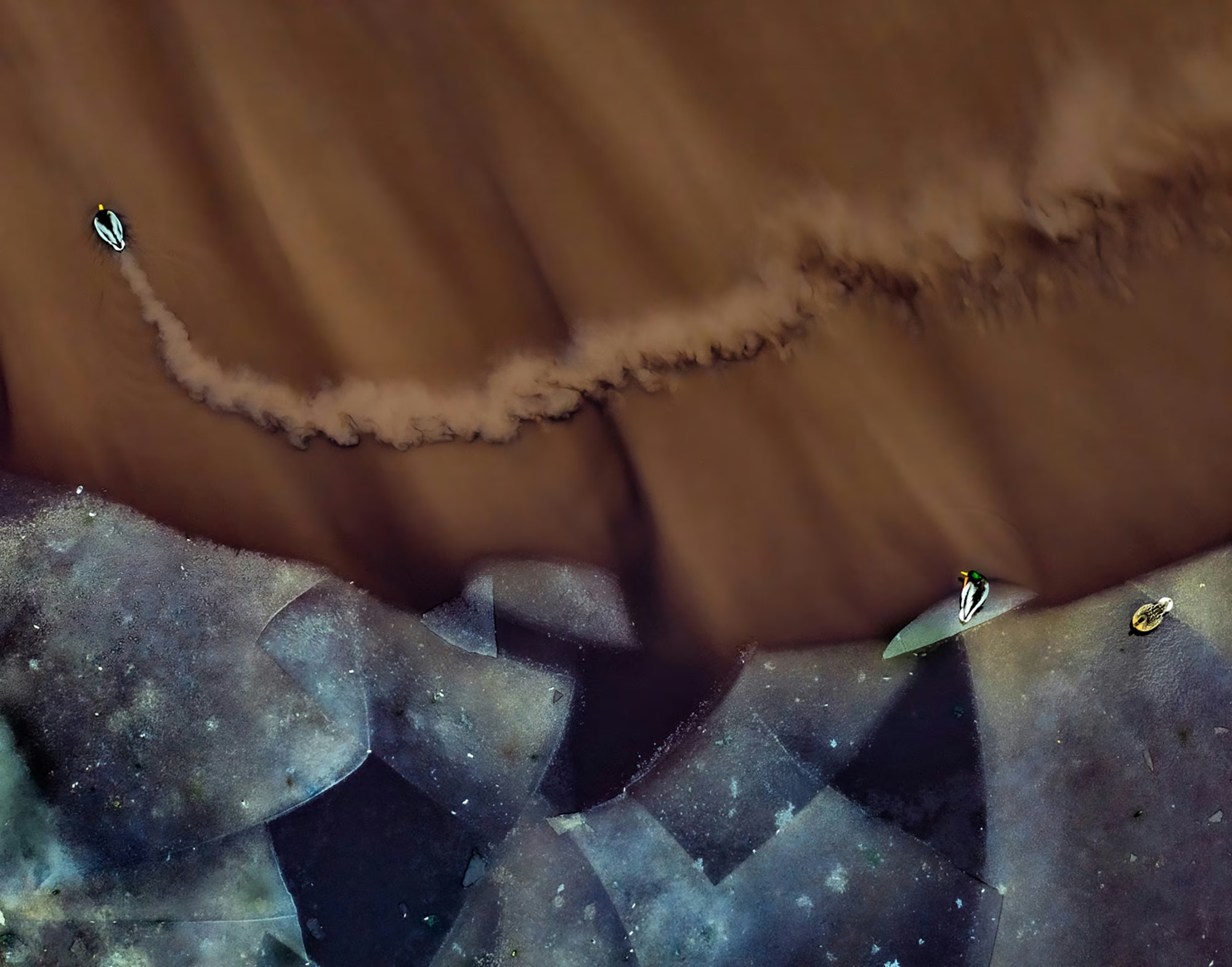 © Csaba Daroczi / European Wildlife Photographer of the Year 2026Water Rocket. Highly Commended, Birds. “This photograph was taken in January at the Kiskunság Lakes in Hungary. As these salt lakes are very shallow, they freeze over every winter and dry out completely in summer. They serve as important breeding and resting habitats for numerous bird species. Because of the mild winter, the ice on the lakes started melting in January. Waterbirds appeared almost immediately—mainly ducks and geese. The drone perspective offered an interesting sight as the birds churned up the mud, creating striking shapes and patterns.”
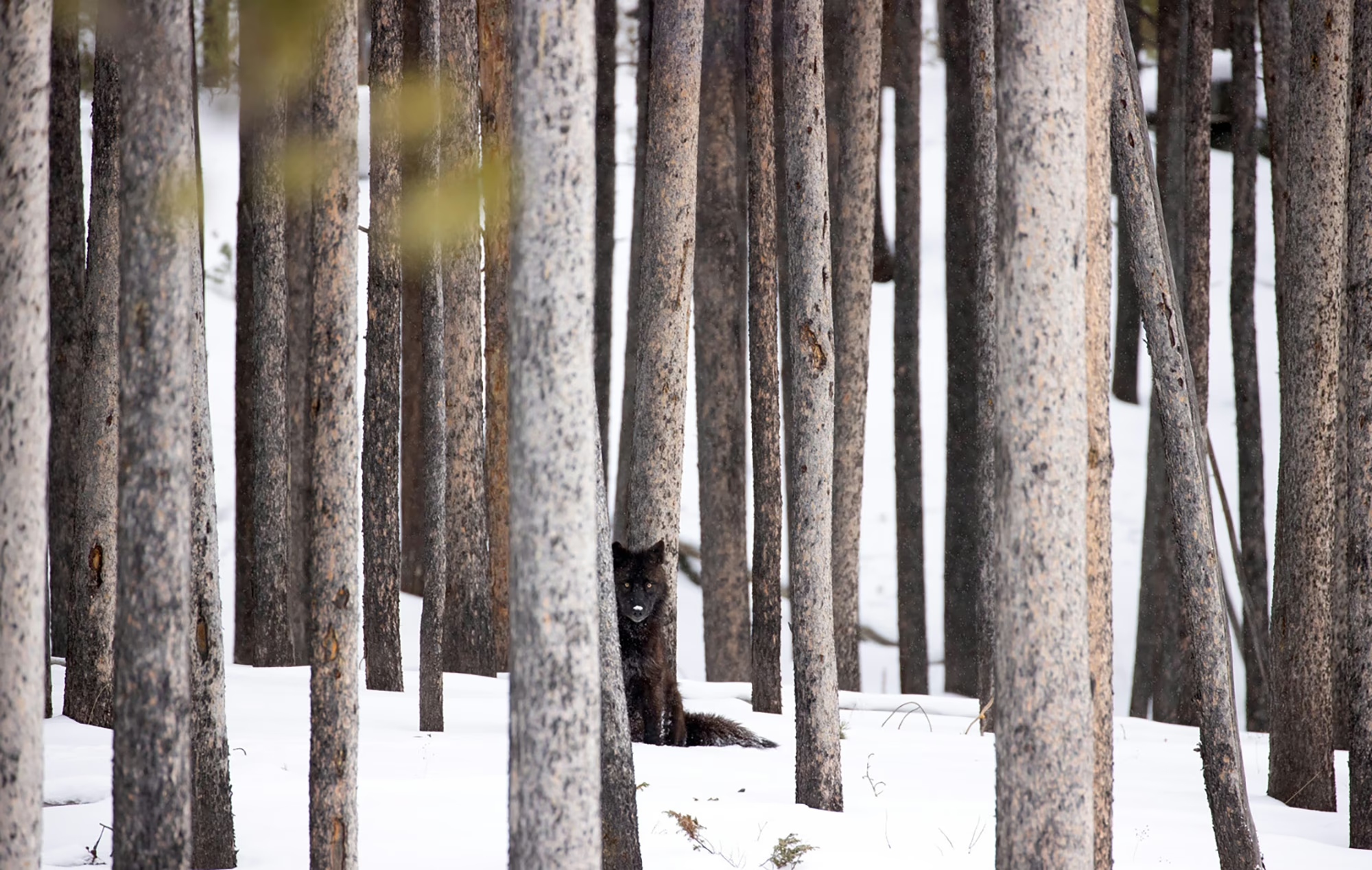 © Danny Green / European Wildlife Photographer of the Year 2026Black Wolf. Highly Commended, Mammals. “This image was taken in Yellowstone National Park in the United States, a place I have visited regularly for many years. One of the main reasons for my repeated visits is that there are few better places to observe and photograph wolves (Canis lupus). Even so, these animals are elusive and encounters are a matter of luck. Around 50 percent of the wolves in Yellowstone are black, and, although I have seen and photographed them many times before, I always felt that I had not yet captured a truly compelling image. During this particular visit, I encountered the Wapiti Pack which had taken down a bison along Firehole River and consists mostly of black individuals. It was an extraordinary experience, given that wolf sightings in Yellowstone typically last only a few minutes.”
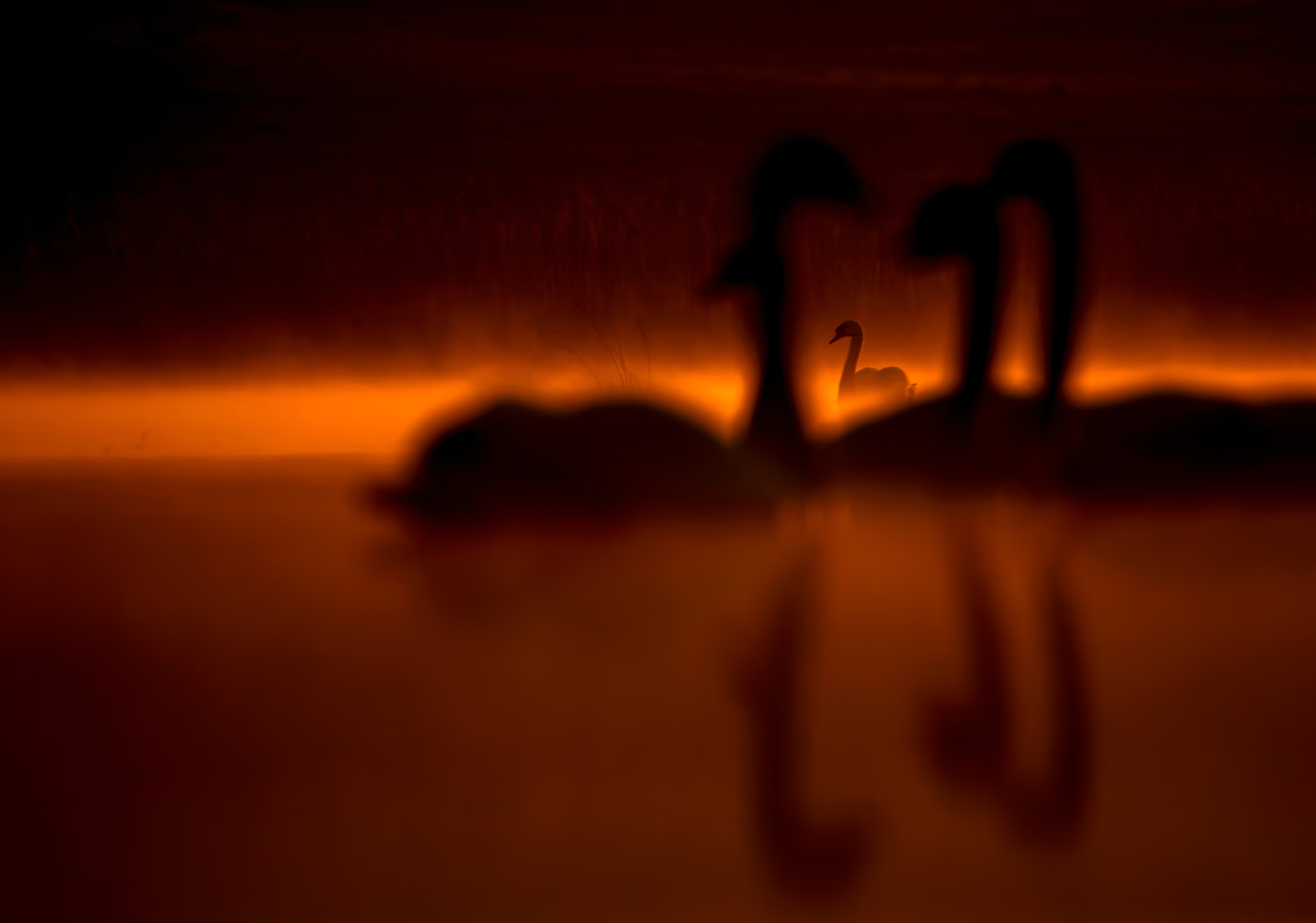 © Szymon Bartołd / European Wildlife Photographer of the Year 2026Swan Lake. Winner, Youth Category | 14–17 years. “Out walking, I came across a lake with a large number of waterbirds, and decided to return before dawn the next morning. Well hidden, I watched as mute swans (Cygnus olor) rose majestically out of the mist in a scene bathed in gold light.”
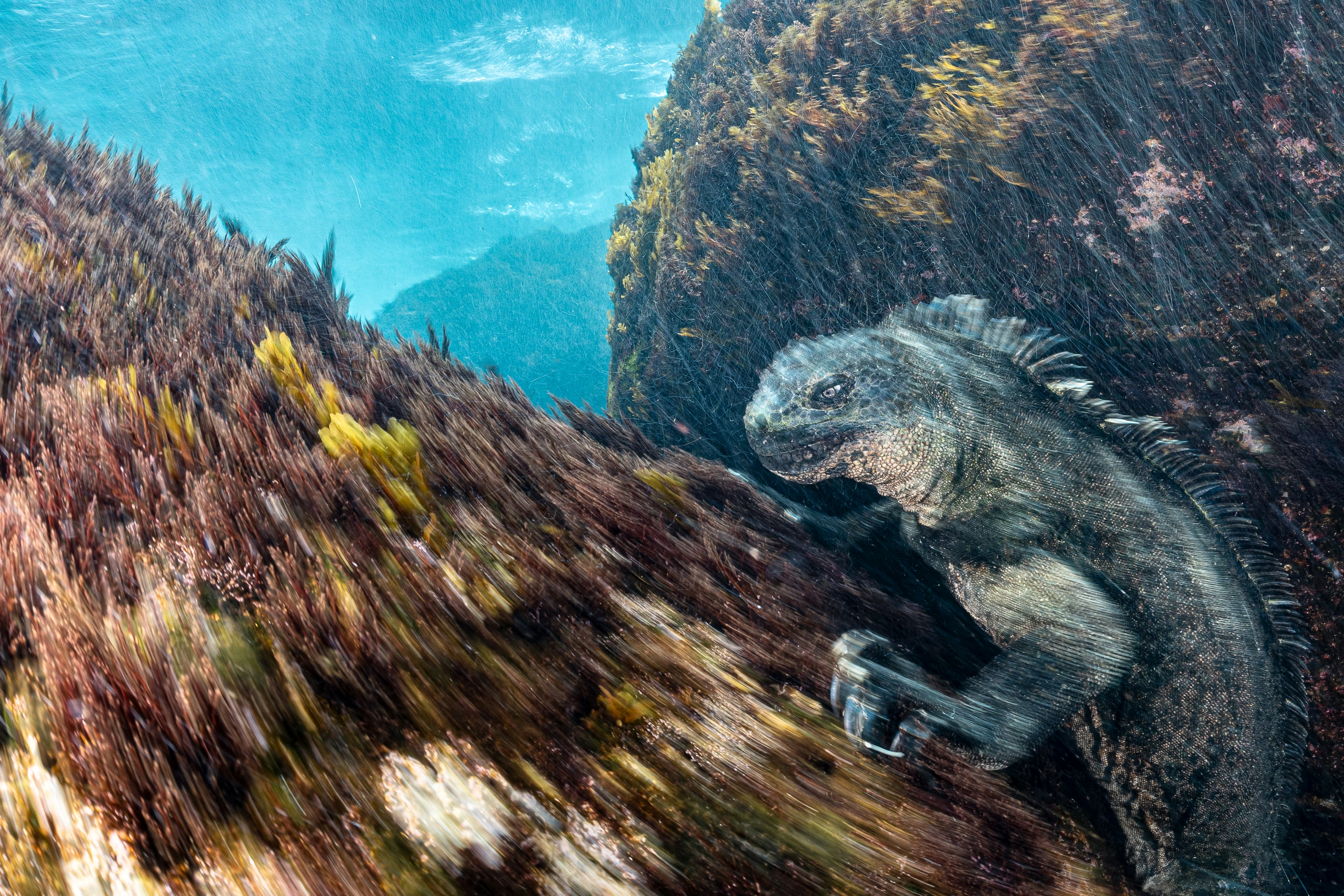 © Henley Spiers / European Wildlife Photographer of the Year 2026Turbulent Feeding Patch. Runner-up, Underwater World. “Marine iguanas (Amblyrhynchus cristatus) are endemic to the Galápagos Archipelago, Ecuador. They are most often seen basking in the sun, their dark bodies perfectly camouflaged against the black lava rocks. As ectothermic reptiles, they rely on external heat to regulate their body temperature. This is particularly important as they dive into the cold waters surrounding the archipelago to forage, primarily on marine algae. I followed this individual into the water and watched with fascination as it propelled itself swiftly and purposefully through the powerful surf with the aid of its muscular tail. While I was tossed about by the waves, the marine iguana clung firmly to a rock with its sharp claws and began methodically grazing on algae.”
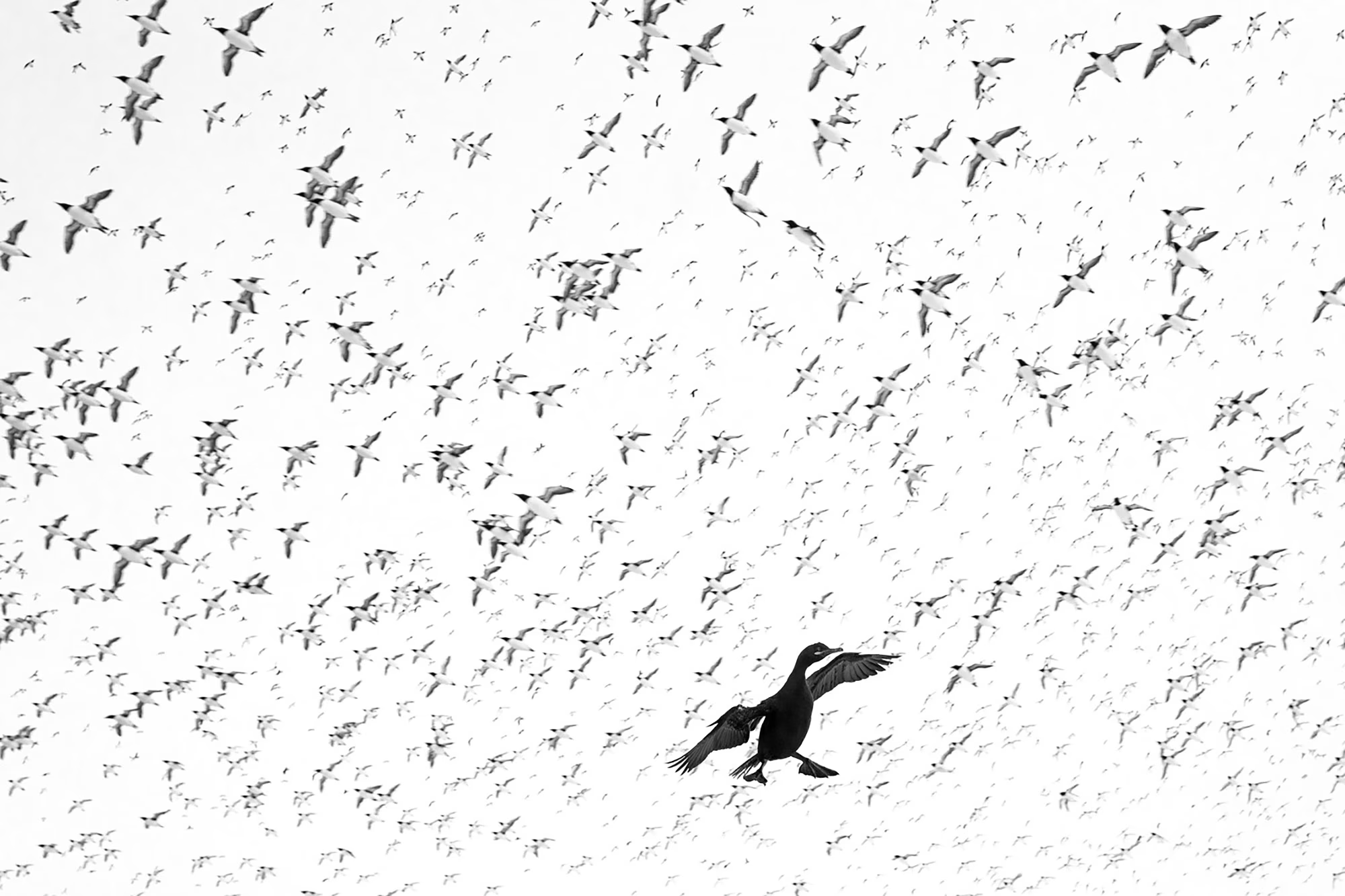 © Sandra Kenyon / European Wildlife Photographer of the Year 2026Sky Surfer. Highly Commended, Birds. “Each March, tens of thousands of seabirds return to the windswept Arctic island of Hornøya in the Barents Sea for the breeding season. This was my third consecutive visit, as in previous years I had missed this highly synchronized migration event—an experience I was determined to witness at least once. This time, everything came together. The deafening calls and the swirling movements of immense flocks passing just a few meters overhead were truly breathtaking. European shags (Phalacrocorax aristotelis) are giants compared to the smaller auks, and as I watched them weaving through the fast-moving streams of common guillemots (Uria aalge), I realised there was potential for a striking and dynamic image. When a shag came in to land, perfectly framed by countless guillemots, I was finally able to capture the photograph I had long envisioned.”
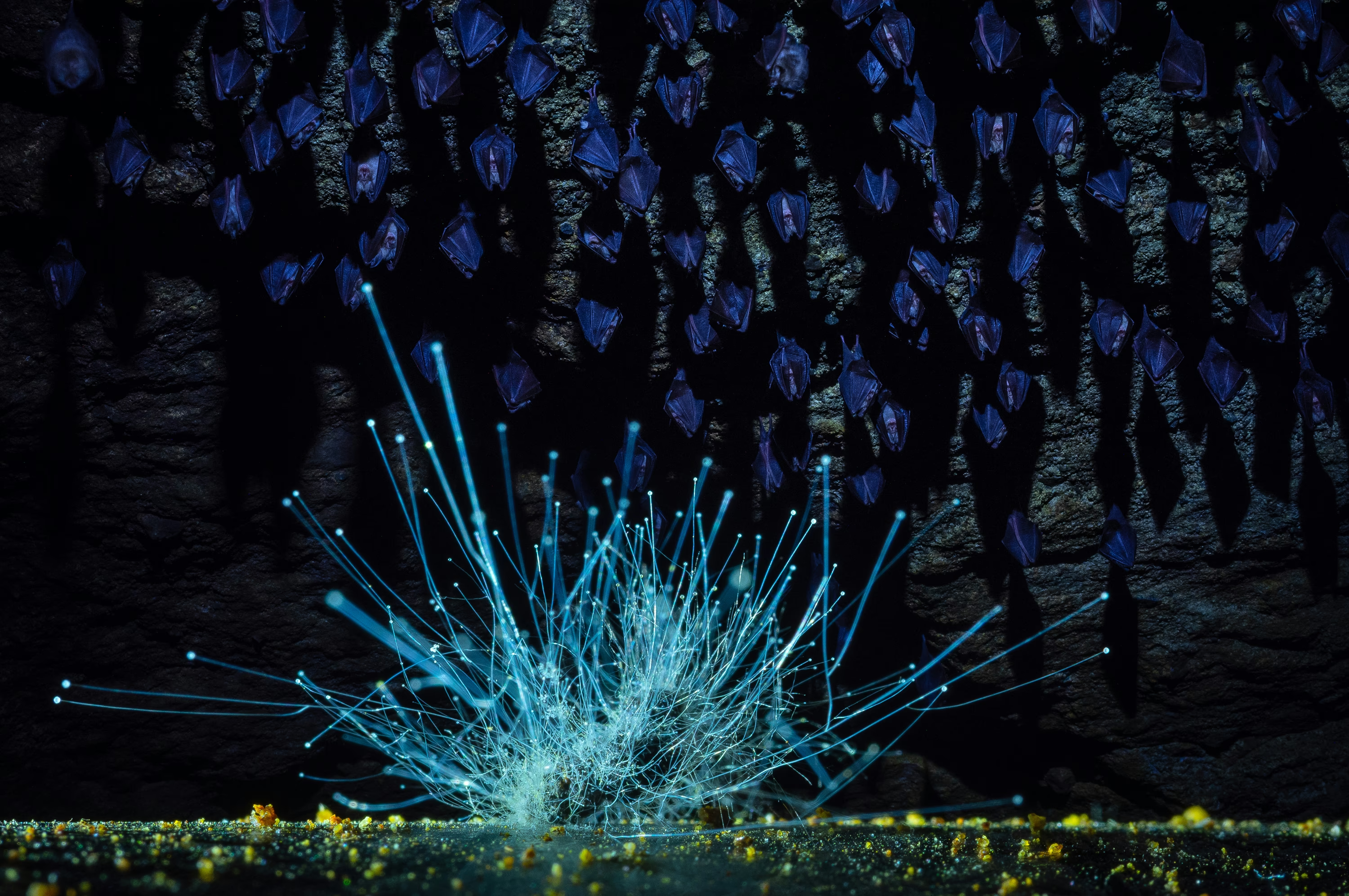 © Imre Potyó / European Wildlife Photographer of the Year 2026Hidden Worlds. Overall Winner. “I have been photographing hibernating bats for 13 years in restricted-access mine tunnels in the Börzsöny mountains of Hungary, and yet this particular composition was novel for me. A key characteristic of the lesser horseshoe bat (Rhinolophus hipposideros) is that, during hibernation it occasionally wakes and leaves its roost to hunt flying insects. In doing so, the bat leaves behind droppings that gradually accumulate into a continuous dark layer. And this is where the real wonder begins: in the beam of a torch, a whitish coating can be seen on the guano—a small pin mold thriving in this unusual habitat. Using a macro lens, I captured the mold in the foreground with the hibernating bats visible in the background.”
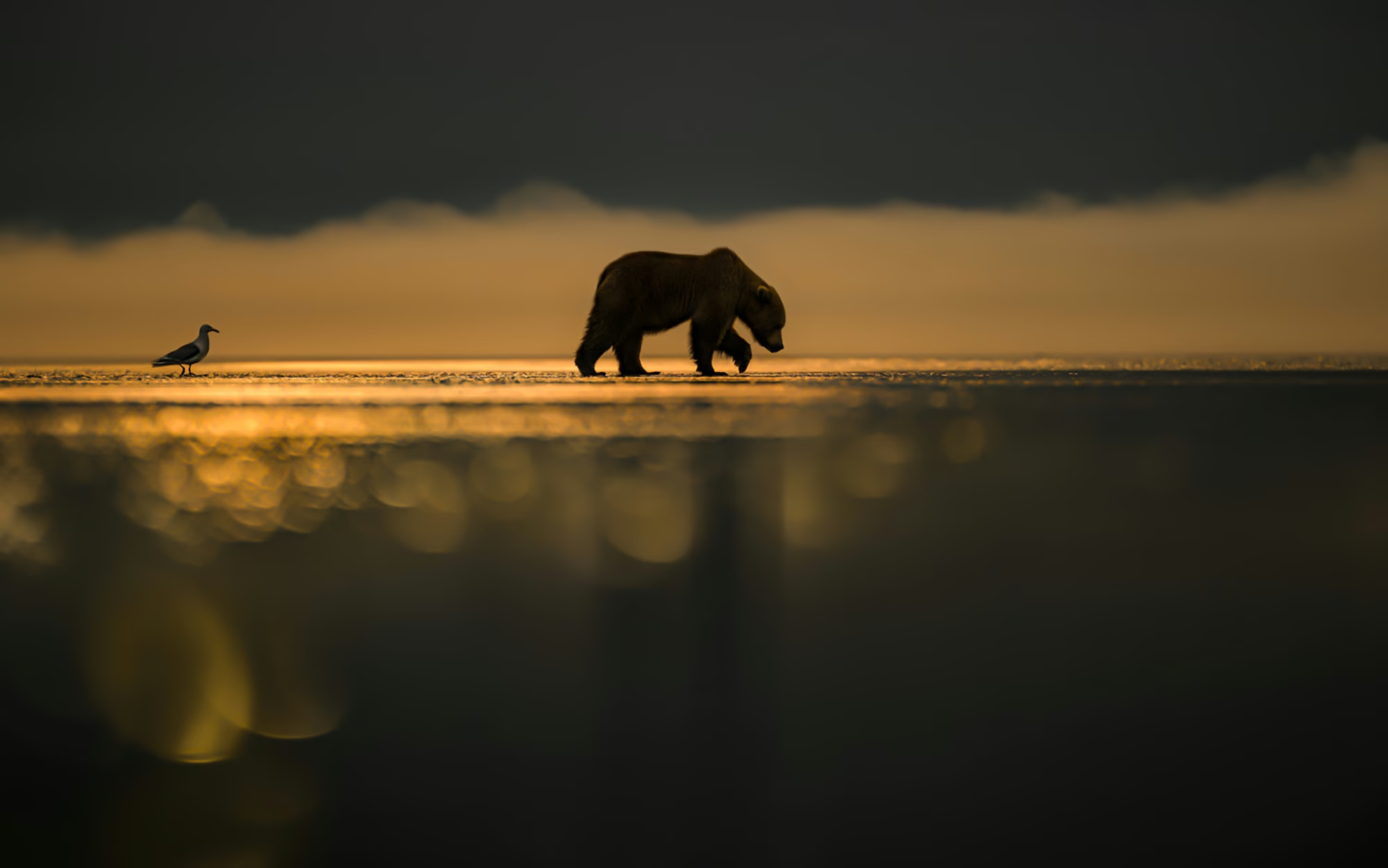 © Preeti John / European Wildlife Photographer of the Year 2026Exit Stage Right. Highly Commended, Mammals. “End of a performance in Lake Clark National Park, Alaska: The scene is over, and the grizzly bear (Ursus arctos horribilis) has had its moment in the spotlight. The animal leaves the stage without a bow, without a backward glance. Fog hangs like a flowing curtain, and the bokeh glows like fading stage lights. A gull remains behind, watching the main actor’s exit and perhaps wondering what it should do next.”
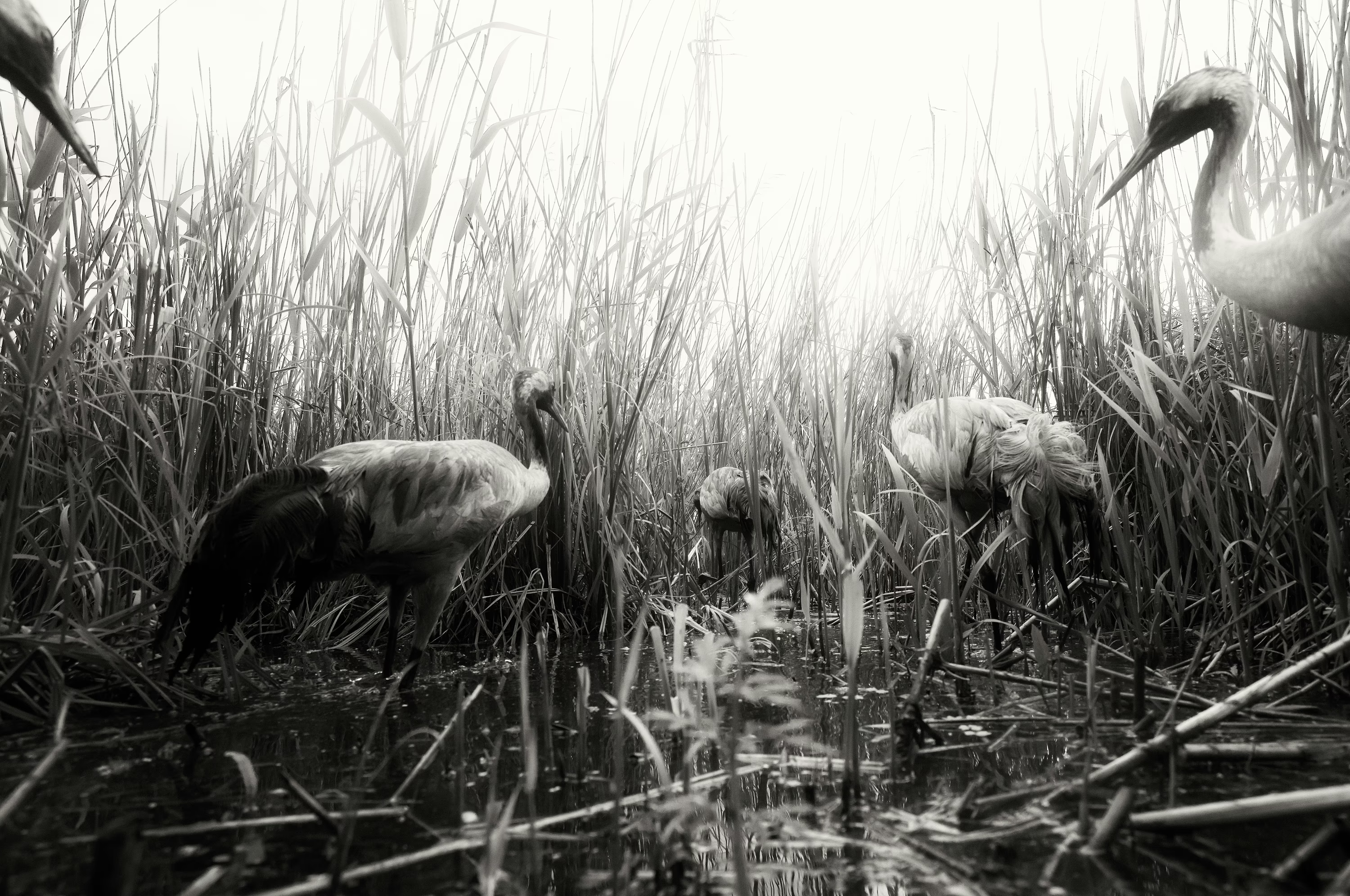 © Jan Wieczorek / European Wildlife Photographer of the Year 2026Secret Paths. Winner, Birds. “During moult, common cranes (Grus grus) lose all their flight feathers at once, rendering them earthbound for several weeks. During this period, they remain extremely vigilant and usually hide in wet forests where they can find food. At dawn, the cranes walk from their roosting sites via secret paths through reed beds to their feeding grounds and typically return via the same route.”
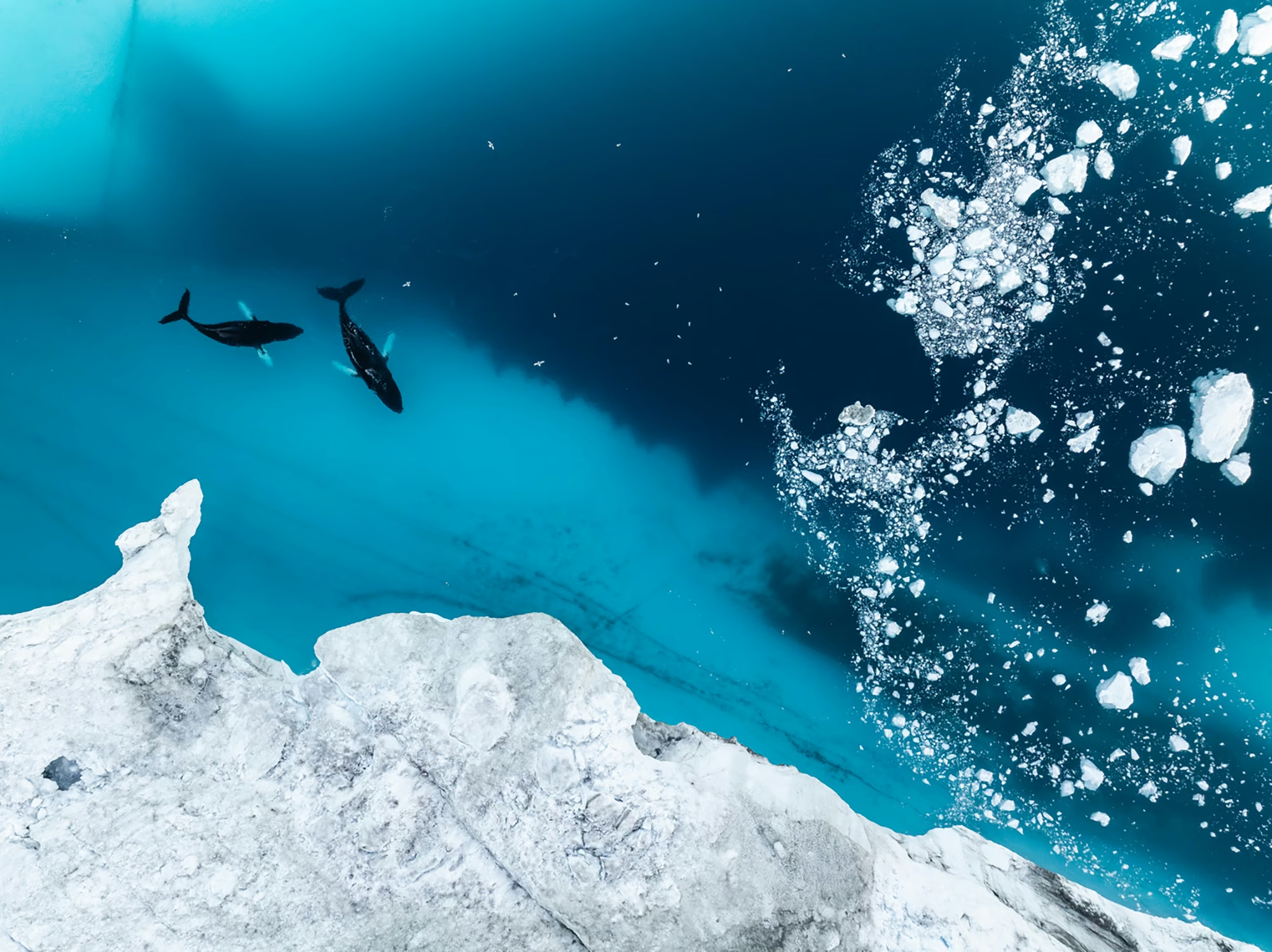 © Bart Heirweg / European Wildlife Photographer of the Year 2026Tiny Giants. Highly Commended, Mammals. “This photograph was taken using a drone near the Ilulissat Icefjord on the west coast of Greenland. It shows two humpback whales (Megaptera novaeangliae) swimming among drifting ice floes and towering icebergs. The drone was deliberately flown at a higher altitude to place the whales in the context of the wider landscape and to convey the immense scale of their Arctic habitat.”
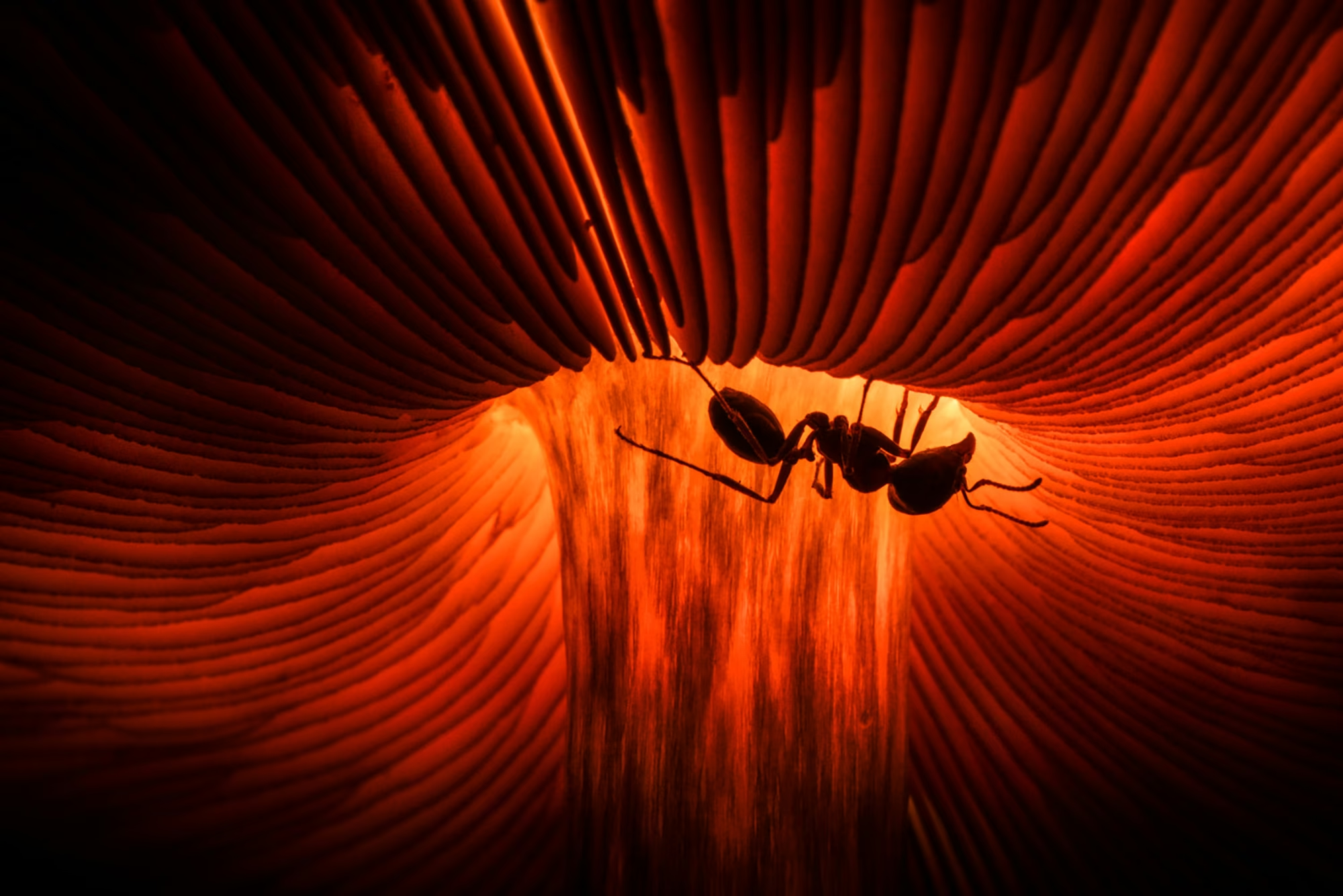 © Agorastos Papatsanis / European Wildlife Photographer of the Year 2026Microcosm. Highly Commended, Other Animals. “Sunlight transforms the underside of a fungus (Pluteus atrotomentosus) into an architectural masterpiece—a tiny illuminated cathedral. Photographed from an extremely low point of view on the forest floor of Mount Olympus in Greece, the scene takes on an unexpected sense of scale and drama. Beneath the glowing gills, an ant makes its way across the fungus, a subtle reminder of the microfauna that inhabits these miniature worlds.”
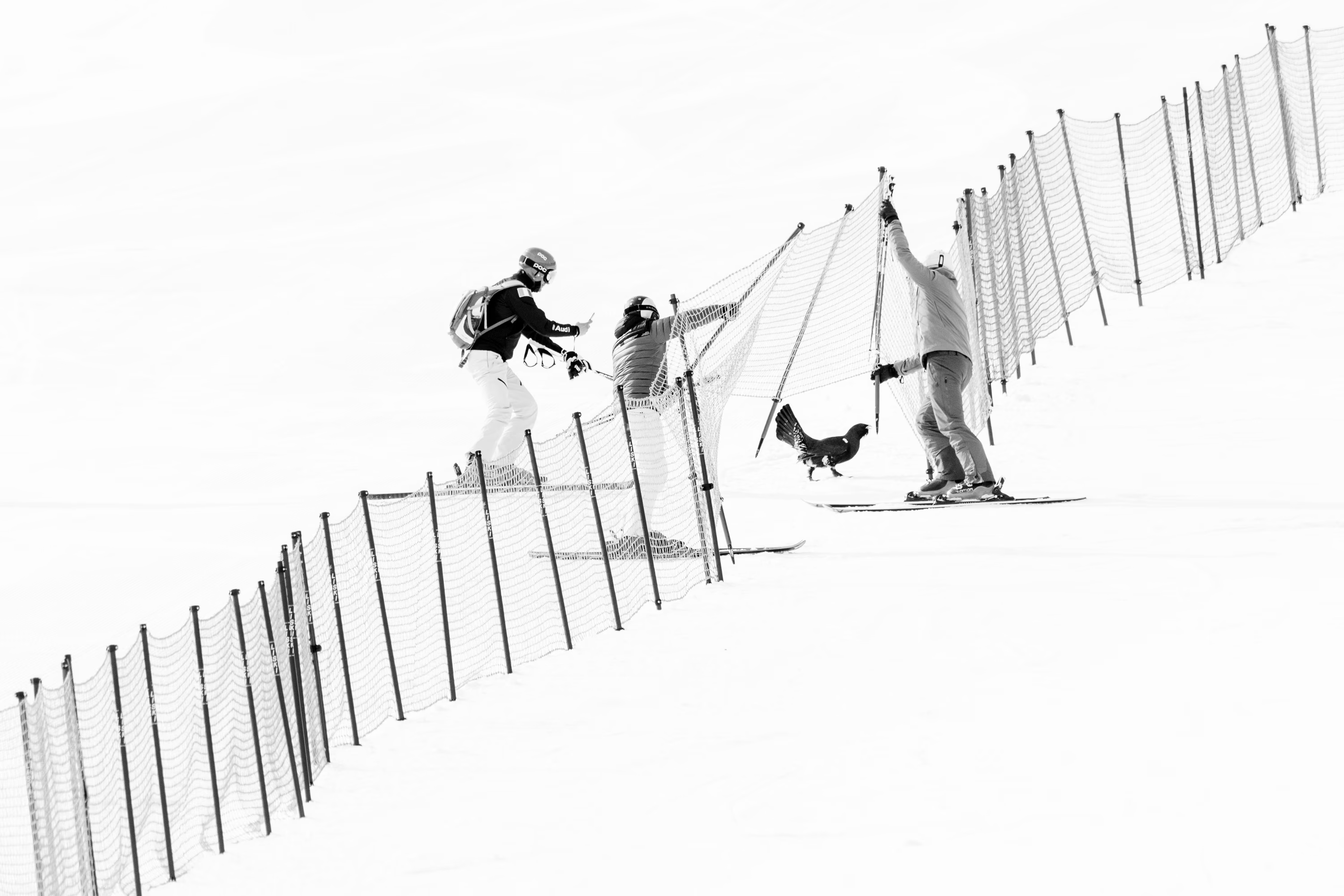 © Lukas Schaefer / European Wildlife Photographer of the Year 2026Helping Hands. Runner-up, Humans and Nature. “During the mating season, capercaillie (Tetrao urogallus) sometimes lose their wariness of people, seeing them instead as rivals. That is exactly what happened at a ski resort near my home, where a capercaillie took up position on the ski slope every day throughout the lekking season to defend his patch. The bird soon became something of a local celebrity, even making the news, and crowds came daily to watch and film him. Then, one day, a ski race was held—and the bird chose the middle of the course to display. Not the safest spot. Several people stepped in, gently steering him behind the safety fence and out of harm’s way. A year later, the same bird was accidentally killed by a skier who failed to notice it. Some people care. Others simply don’t.”
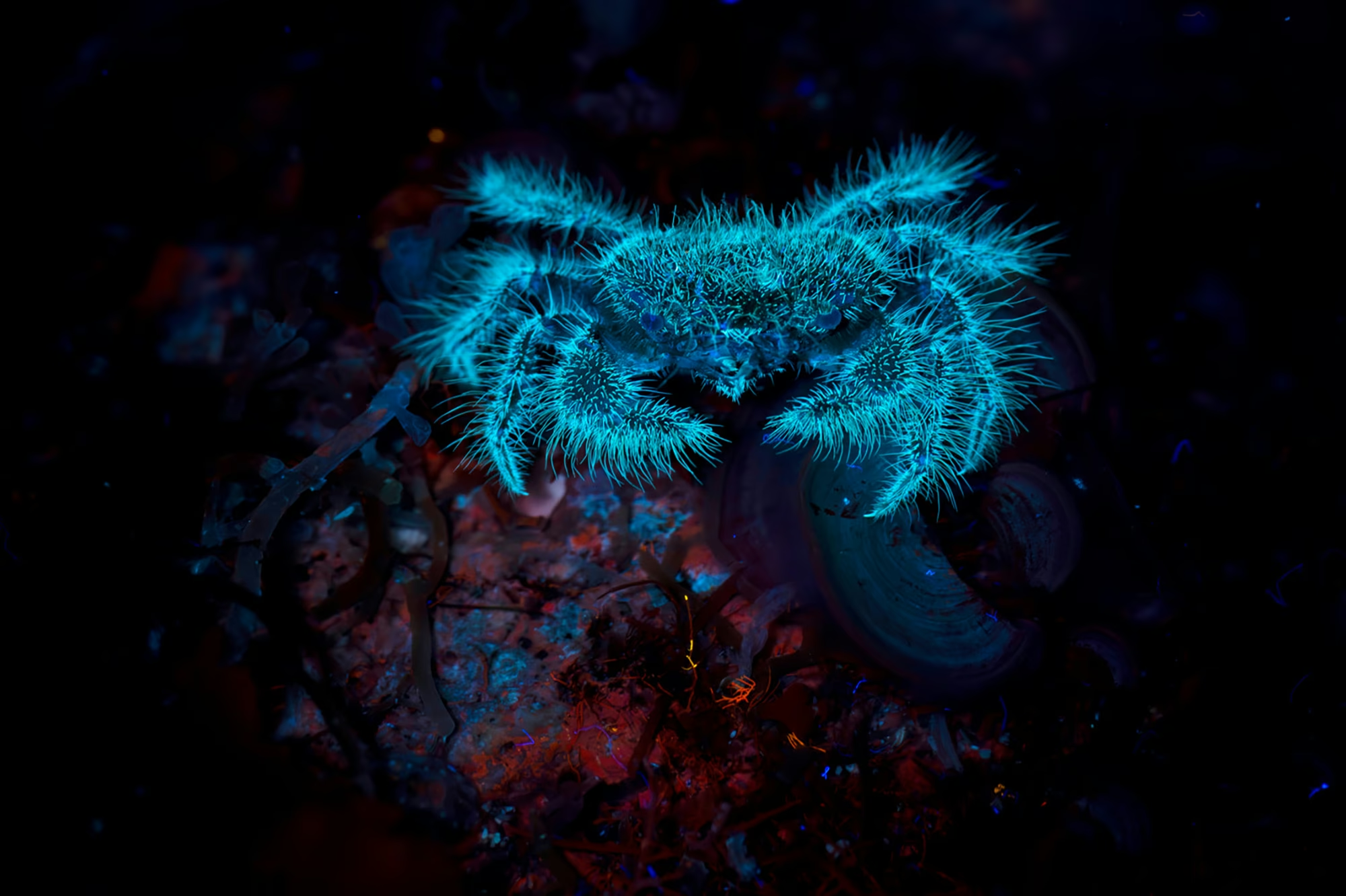 © Marco Colombo / European Wildlife Photographer of the Year 2026Furry Ghost. Highly Commended, Other Animals. “During a nighttime photography expedition along the coast of Sardinia, I discovered this fluorescent hairy crab (Pilumnus sp.) in a rock pool, glowing in the beam of my UV torch like a shaggy ghost in the darkness.”
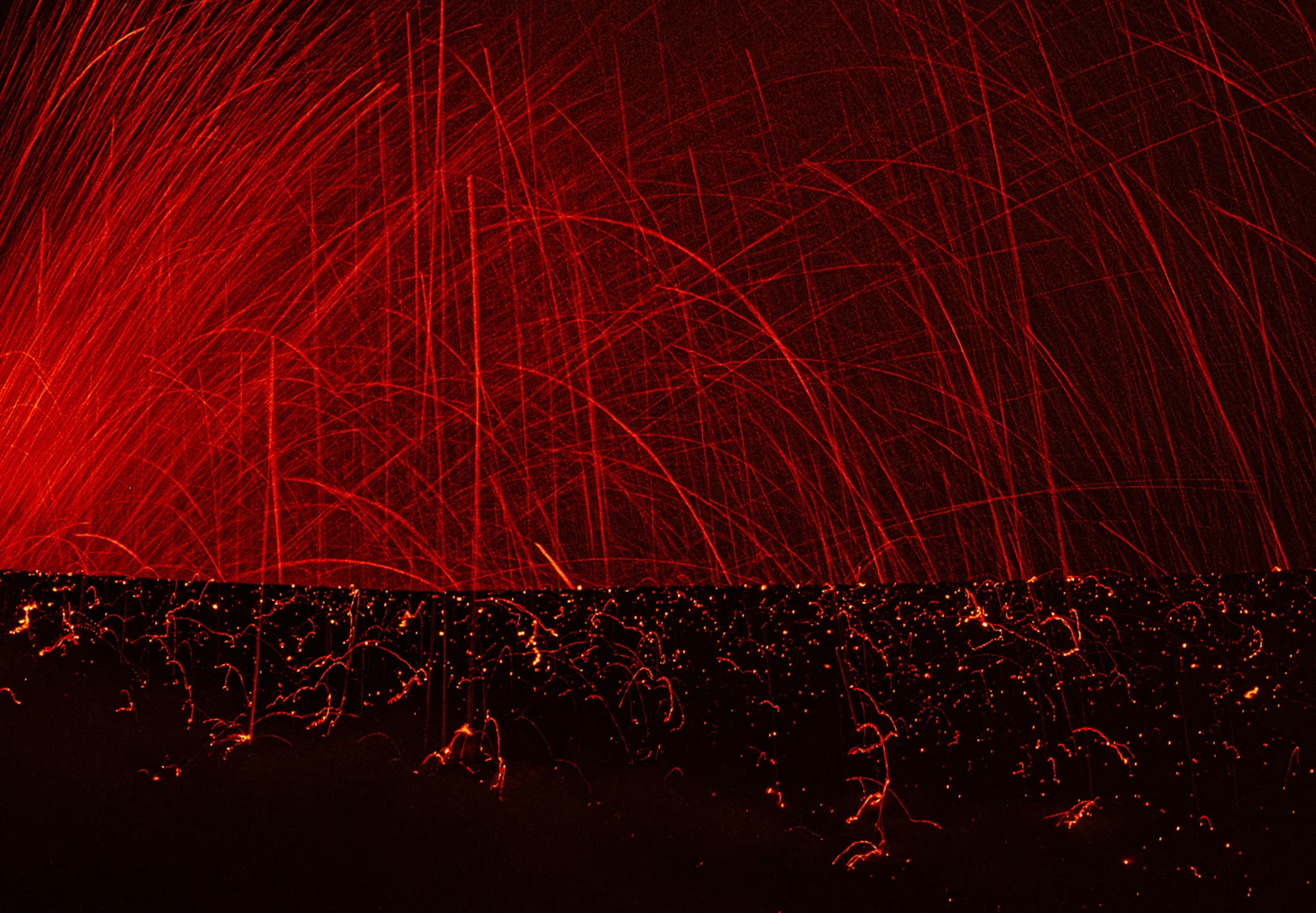 © Philipp Egger / European Wildlife Photographer of the Year 2026Rain of Fire. Highly Commended, Nature’s Studio. “During a volcanic eruption, molten lava is thrown out into the dark of night. The glowing arcs trace the paths of liquid rock, hurled skyward by explosive degassing. Shot as a long exposure from a safe distance, these natural movements appear as energy-charged lines. In the lower part of the frame, the ejected fragments cool and begin to solidify within seconds, laying down new crust.”
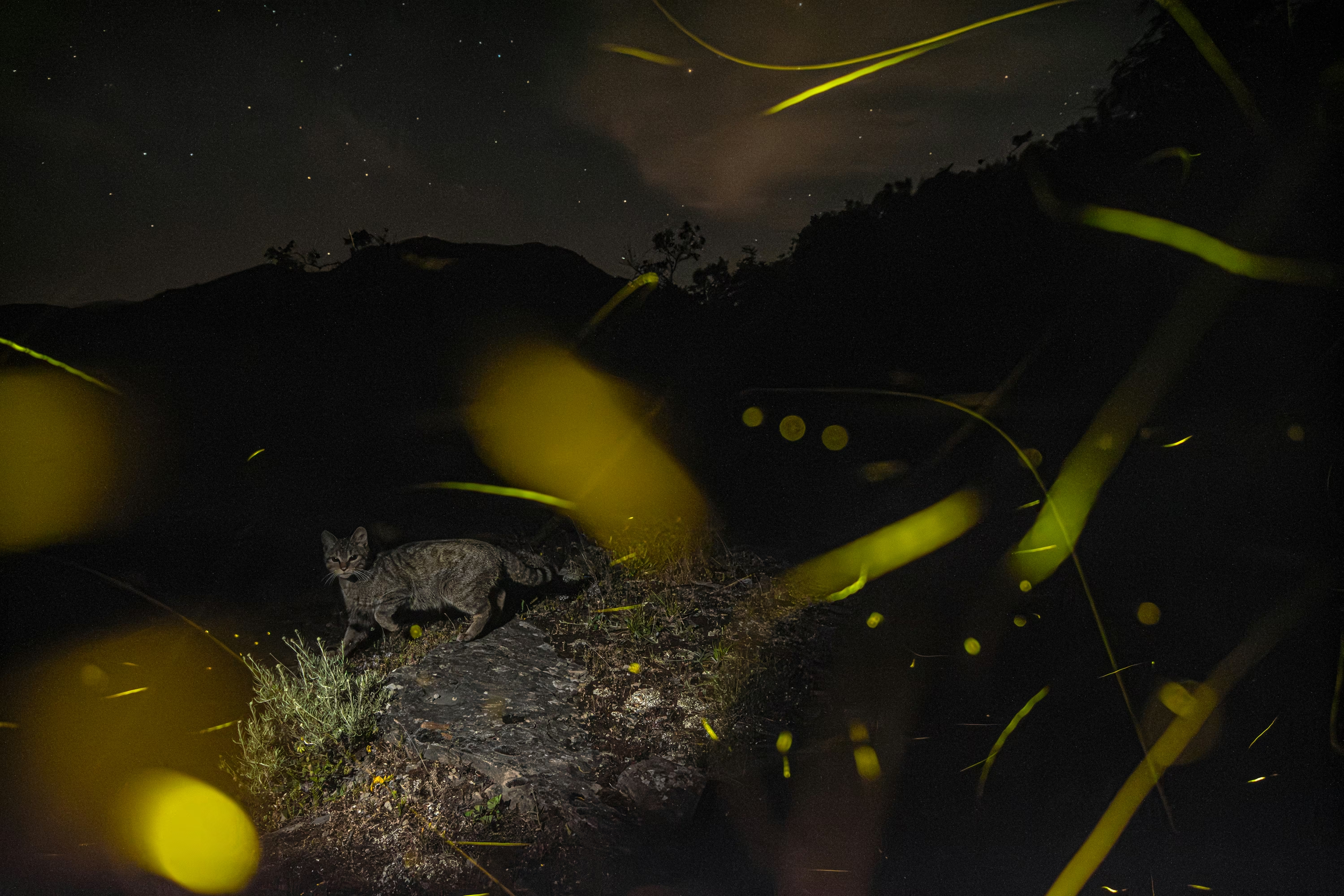 © Lorenzo Shoubridge / European Wildlife Photographer of the Year 2026The Cat and a Thousand Lanterns. Winner, Mammals. “In the wild, romantic mountain landscape of Alto Mugello, Italy, a European wildcat (Felis silvestris) moves silently through the night, framed by the ethereal dance of countless fireflies. Capturing this fleeting encounter required months of preparation and an almost invisible photographic setup: a DSLR camera trap installed with meticulous care to ensure that the wildlife remained entirely undisturbed.”
Be sure to visit the GDT’s website for full coverage of the winners and honorees.
The post Winners of the European Wildlife Photographer of the Year 2026 appeared first on The Atlantic.