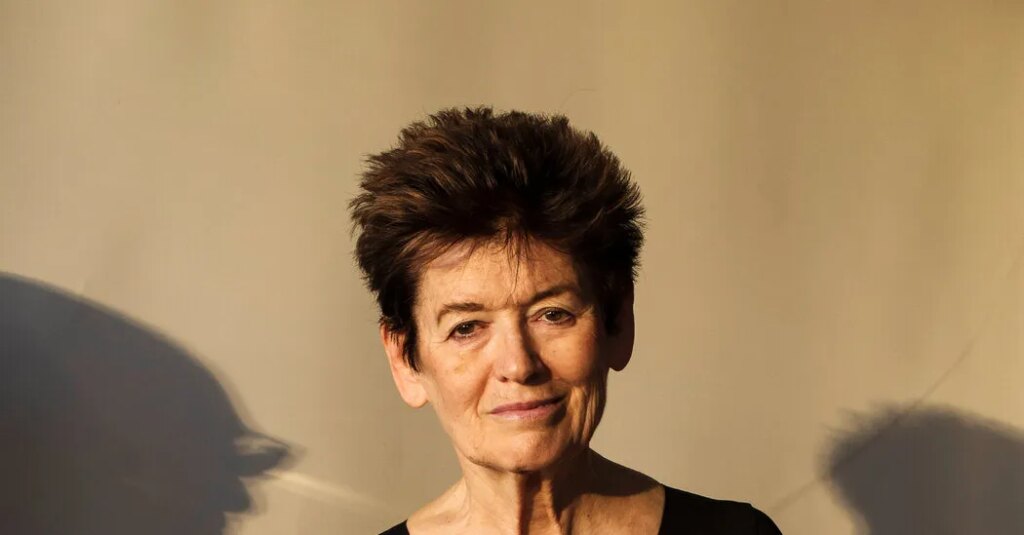
Ursula von Rydingsvard, a sculptor best known for complex, timeless, monumental forms constructed from hundreds of cedar beams, died at home in Manhattan on Tuesday. She was 84.
Courtney Childress, Ms. von Rydingsvard’s studio manager, confirmed the death and said the cause was Alzheimer’s disease.
Though Ms. von Rydingsvard experimented with a variety of other materials, and later made significant public sculptures from resin or bronze, the standard four-by-four cedar beam was her defining medium.
Marking them first with pencils, Ms. von Rydingsvard and her team of assistants elaborately distressed these beams with circular saws and then carefully assembled them like bricks into enormous, undulating structures that often spread out as they got taller. Some of their surfaces she also stained with graphite powder or marked with chalk.
The resulting sculptures evoked cave walls, frozen waves, seashells, ancient trees or the folds of a giant’s brain. Ms. von Rydingsvard’s use of repeated, off-the-rack components in the pieces had a clear relationship to the Minimalism of the 1960s and ’70s, but the organic shapes she carved into them also served as a rejoinder to what she felt was the inhuman austerity of that movement.
At the same time, if their folds and sensuality put them in conversation with the more frankly biomorphic and sexual work of sculptors like Louise Bourgeois or Eva Hesse, the pieces’ distinct ambiguity meant that they were never quite so revealing. Some critics read Ms. von Rydingsvard’s sculptures as being concerned with labor, catharsis or memory; she herself often connected them to the wooden barracks of the displaced-persons camps where she spent her early childhood.
“The artist does not start with ovens, planks, chopping blocks, coffins and other images of claustrophobia and oppression,” the critic Michael Brenson suggested in The New York Times in 1988. “Using wood almost as a psychoanalytical black forest in which she carves, chips and hacks away, she finds them. Her sculptural process has a great deal to do with release. Release is one of the effects she is after.”
What may be most remarkable about Ms. Von Rydingsvard’s sculptures, and possibly the source of their peculiarly lifelike quality, is the way they synthesize, or simply tower over, so many ordinary contradictions. Clearly made of hundreds of separate, more or less regular pieces, like a beehive, they have overwhelmingly singular presences. They’re stacked, assembled, marked and carved, a combination of additive and subtractive processes, intricately plotted and spontaneously gestural, and their negative space may be as striking as their positive.
For all their gouges, scrapes and drawn-on lines, they look as if they were grown or excavated rather than made, and they’re often surprisingly colorful. Every beam is the same as the next, and every one is different.
“In order to make an organic form,” she told she told Art21 in 2007, “you need to have many, many straight cuts.”
Urszula Karoliszyn was born in Deensen, Germany, on July 26, 1942, to Kunegunda (Sternal) Karoliszyn and Ignacy Karoliszyn, the fifth of seven children. Her father, a Ukrainian, had adopted a Polish spelling of his surname after marrying Ms. Sternal, and the family spoke Polish at home.
She spent the earliest part of her childhood on the farm in Deensen where the Nazis had placed her father after conscripting him for labor, and the years after the war in displaced-persons camps.
In 1950 the family reached the United States and settled in Plainville, Conn., where her mother worked at a restaurant called Cook’s Tavern and her father managed a farm attached to it, in addition to holding a job at the nearby Stanley Works factory.
Ms. von Rydingsvard helped run the household and look after her siblings and, when she was old enough, worked at Cook’s Tavern, too.
“I did everything dutifully,” she told Judith Richards in an interview for the Archives of American Art in 2011. “I did everything conscientiously. And I say that with regret. I wish I could have blown — the grid, the fenced-in psyche. But I am trying to still blow it, through my work.”
After studying for two years at the University of New Hampshire, she transferred to the University of Miami, Coral Gables, where she earned a B.A. and M.A. in 1964.
She left her first husband, Milton von Rydingsvard, in 1973 and moved with her daughter to Manhattan. She earned an M.F.A. at Columbia University in 1975.
She had already begun painting in New Hampshire, but she found herself mixing glue and sand into her paint to give it more definition. “When the paint got so thick on the surface of the canvas and fell onto the ground,” she once said, “that told me something.”
“Sculpture gives a greater sense of reality,” she added. “That’s a ridiculous word to use, but they have a greater substance. You can grab a sculpture. You can’t grab a painting.”
Still, she didn’t find her preferred material right away.
“The only studio they had was a steel studio,” she told Jason Farago in an interview for Even Magazine, speaking about her time at Columbia. “There was no woodworking. So I welded. Steel was just the most frustrating thing imaginable. I couldn’t get it to feel organic; I couldn’t get it to have a credible, soulful look to it.”
But then, she said in 2011, “at the very end of my stay at Columbia University, there was a guy by the name of Michael Mulhern, who was a monk, who was also a fellow student — very, very kind, wonderful human being, who bought me some four-by-four cedar beams.”
She was using the cedar, at first, to prop up objects made of other materials, but she quickly found herself attracted to the wood in its own right.
“The cedar is like butter,” she said in the interview for Even Magazine. “It yields so easily; it doesn’t fight you. It’s sensuous, and it’s almost pink when you first get it, so it’s sexy, and then it turns a light brown.”
Her husband, the Nobel Prize-winning neuroscientist Paul Greengard, died in 2019, and her daughter from her first marriage, Ursula Anne von Rydingsvard, died in 2022. She is survived by her siblings Christine Brooks and Stash Karoliszyn and by three grandchildren.
Ms. von Rydingsvard was a member of the American Academy of Arts and Letters, had been an artist in residence at the American Academy in Rome and, among many other prizes, had received grants from the National Endowment for the Arts, a Guggenheim Fellowship and, in 1997, the Joan Mitchell Award. She taught at Yale, the School of Visual Arts, Fordham University and the Pratt Institute.
Though she lived in Manhattan, Ms. von Rydingsvard had kept a studio in one or another neighborhood in Brooklyn since 1981. In 2013, her 19-foot, 12,000-pound sculpture called “Ona,” or “she” in Polish, was installed in front of Barclays Center.
“You don’t have to pay a fee or enter a museum, and no guard will tell you not to touch it,” she told The New York Times at the time, adding, “I would actually love people to touch it.”
Her work was collected by the Detroit Institute of Arts, the Museum of Modern Art, the National Gallery of Art, the Whitney Museum of American Art, the Metropolitan Museum of Art and Storm King Art Center.
“They say when you get older, life gets easier,” she told Art21 in 2013. “It does not. You know, my biggest hope is that I get more courage, I get more trust in myself, I get more faith, that I’m able to do things that I wasn’t able to do before.”
The post Ursula von Rydingsvard, Sculptor of Monumental Forms, Has Died appeared first on New York Times.