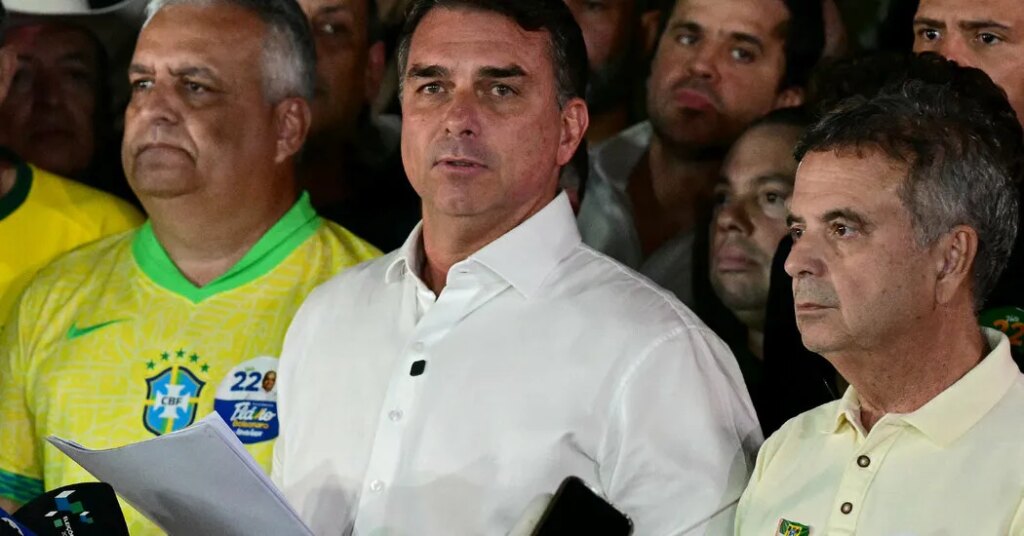
Brazil’s Supreme Court on Monday ordered the police to seize the passport of Flávio Bolsonaro, the presidential candidate defeated in Sunday’s election, because he is under criminal investigation related to a money laundering scheme.
The ruling, issued by Supreme Court Justice Alexandre de Moraes, stems from an inquiry into Mr. Bolsonaro’s links to a Brazilian lawyer who is accused of laundering more than $1 billion through a vast fraud scheme, according to a court document reviewed by The New York Times.
Mr. Bolsonaro, a right-wing senator, came on the radar of the authorities when the police said earlier this month that they had discovered that Mr. Bolsonaro had access to the bank accounts of a company owned by the lawyer, Willer Tomaz. In May 2025, a person employed by the lawyer asked the bank to revoke the senator’s access to the accounts, according to a Federal Police report reviewed by the Times.
The ruling also ordered Mr. Bolsonaro to stay away from Mr. Tomaz, a close friend of the right-wing senator. Mr. Tomaz has denied any wrongdoing and rejected claims that Mr. Bolsonaro managed his company’s account.
Mr. Bolsonaro has brushed off the investigation, denying having done any business with Mr. Tomaz and casting the case as political persecution. On Monday, he again framed the confiscation of his travel documents as an attempt to intimidate him following his loss at the polls, which he is disputing.
Mr. Bolsonaro, in a statement, said he would comply and turn over his documents, but insisted that he had “never considered” leaving Brazil. His brother, Eduardo Bolsonaro, had suggested on a podcast that, if the candidate were to lose, he should leave Brazil.
Days before the election, Mr. Tomaz traveled to the United States, according to the federal police.
In a separate case, Mr. Bolsonaro is also under investigation over millions of dollars he raised from a disgraced banker at the center of a massive corruption scheme to fund a biopic about his jailed father.
Mr. Bolsonaro’s father, Jair Bolsonaro, is serving a 27-year sentence for trying to stage a coup following the last presidential election.
This is not the first time Justice Moraes has collided with the Bolsonaros. Last year, the justice oversaw Mr. Bolsonaro’s trial on the coup charges.
That plot, according to prosecutorial evidence, included plans to assassinate Luiz Inácio Lula da Silva, who was the president-elect at the time and is now president, and Justice Moraes himself. Jair Bolsonaro was sentenced by a five-member panel of justices to 27 years in prison, which he is serving at home because of poor health.
Earlier this year, a panel of Supreme Court justices also convicted and sentenced Eduardo Bolsonaro for seeking to have the Trump administration interfere in his father’s trial.
Eduardo Bolsonaro, who has been living in Texas since early 2025, lobbied the Trump administration to pressure Mr. Lula’s government, through tariffs and sanctions, to drop its case against his father.
One of the targets of those sanctions was Justice Moraes, whom the right has accused of silencing conservative voices through his rulings on online posts. Justice Moraes’s work involving online disinformation has turned him into a hero and villain in a complicated global debate over the limits of online speech.
After the Jair Bolsonaro was convicted, the U.S. sanctions against Justice Moraes were dropped. But in recent months, Eduardo Bolsonaro and allies in the United States have been lobbying the Trump administration to reinstate them.
Underscoring the cloud of corruption that hangs over Brazil’s ruling establishment, Justice Moraes faces his own links to one of the same scandals dogging Mr. Bolsonaro.
A police dossier suggested that Justice Moraes may have exchanged dozens of messages with the disgraced banker, Daniel Vorcaro.
In texts apparently sent to Justice Moraes, Mr. Vorcaro asked for help avoiding arrest. In other exchanges with associates, Mr. Vorcaro mentioned paying millions to a law firm run by the justice’s wife. Justice Moraes has denied wrongdoing.
The post Flávio Bolsonaro Ordered to Hand Over Passport in Money Laundering Inquiry appeared first on New York Times.