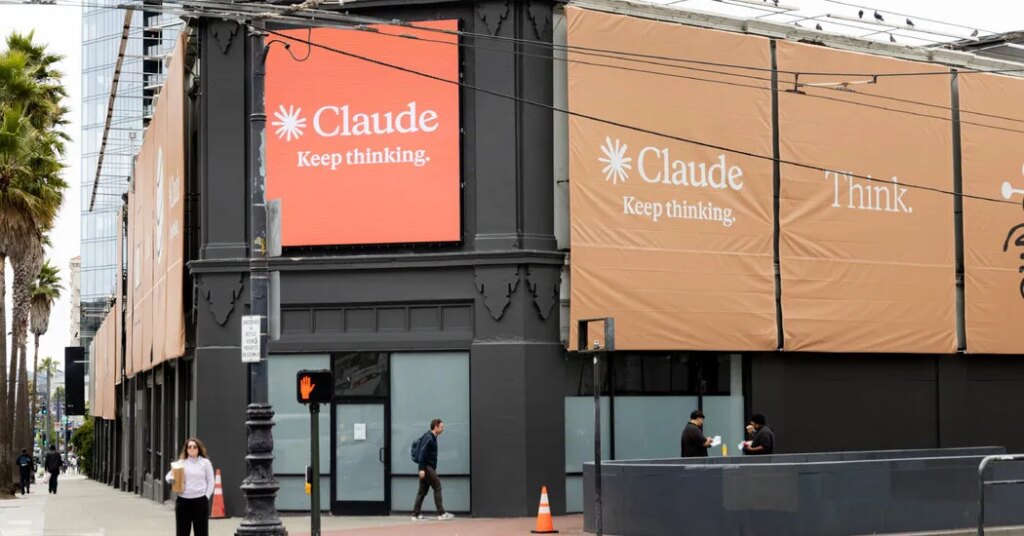
Anthropic, a five-year-old company whose artificial intelligence tools have made it a world leader in the technology, on Monday fully laid out the business behind its big ambitions for the first time.
In a financial prospectus for what could be the largest ever initial public offering, the San Francisco company revealed that sales of its A.I. products like the Claude chatbot to other businesses had grown at an astonishing clip. But it also said that it was losing money and planned to spend at an even faster rate as it invests heavily in A.I. infrastructure to support that growth.
Anthropic’s revenue was $16.3 billion in the first half of the year and its net loss was $80.7 billion, driven largely by a one-time charge. Stunningly, the company has committed up to $807 billion in contracts for data centers, chips and computing power, many of which cannot be canceled, over the next 10 years, according to a tally by The New York Times. Many of the contracts span different lengths of time, and the terms have yet to be finalized for some.
The numbers underscored how much Anthropic is betting that its future business will justify its outlays. Even its public offering, which could raise more than $100 billion, may not provide the company with enough money to fund its intense infrastructure needs, as it warned that it might need to seek additional financing sooner than anticipated.
Dario Amodei, the chief executive of Anthropic, and the company’s six other founders said the power of A.I. has driven the work and the sums.
“We believe that A.I. is one of the most consequential technologies in human history,” they wrote in the prospectus. They added that their company aimed to “realize” the benefits of A.I. “while navigating and preventing the risks that come with a technological revolution this fast and this powerful.”
Anthropic’s listing, which is expected to happen in the next month, is in many ways a test of the business of leading A.I. labs, which make cutting-edge models and sit atop an ecosystem of chip and cloud computing suppliers.
The listing could value Anthropic at $2 trillion, pushing it past Elon Musk’s SpaceX as the world’s biggest I.P.O. The privately held company had already surpassed rival OpenAI’s valuation in May, reaching $900 billion compared with OpenAI’s $730 billion. (OpenAI is considering a new funding that would value it at about $1.5 trillion in advance of its own public offering.)
But some companies have recently pulled back from going public amid uncertainty in the stock market. Oura, a maker of smart rings, recently delayed a listing, as did SB Energy, a subsidiary of the Japanese conglomerate SoftBank that has proposed to build the world’s largest data center project in Ohio. And fears have grown over whether the spending on A.I. will pay off if demand for the technology cools.
Anthropic’s filing showed that revenue soared to $16.3 billion in the first half of the year, 14-fold from a year earlier, largely from businesses using its A.I. software, including Claude.
The company lost more than $80.7 billion in the first half of the year, compared with a loss of $13 billion a year earlier. The net loss was abnormally large because it included a one-time $72.4 billion charge related to convertible notes, a type of debt that will later turn into equity. Anthropic posted a smaller operating loss, which excludes certain costs, of $693 million during that period.
Anthropic’s filing was unusual in that it warned its products could bring about disasters, including loss of control of the technology and authoritarian abuses. “To build A.I. is to harness cognition itself, and anything so powerful can be used for ill as well as good,” Dr. Amodei and the other founders wrote.
One jaw-dropping risk factor: Advanced A.I. systems could “pose catastrophic or existential risks to humanity,” the company said.
Anthropic’s technology is regarded as so powerful that it plunged the start-up into disputes with the Department of Defense, rattled governments worldwide with how it could penetrate security systems and brought company leaders into conversation with heads of state and even the head of the Catholic church. Last month, Dr. Amodei called for a slowdown in development of its A.I.
If the company’s public offering is successful, it would likely unleash an avalanche of wealth for Wall Street and Silicon Valley. It would be the second “mega” I.P.O. this year, following SpaceX’s listing in June, which briefly turned Mr. Musk into the world’s first trillionaire. OpenAI is also aiming to list its shares in an offering that could come next year.
(The Times has sued OpenAI and Microsoft, claiming copyright infringement of news content related to A.I. systems. The two companies have denied those claims.)
Anthropic was founded in 2021 when a group of employees left OpenAI over disagreements about how A.I. should be developed. Dr. Amodei, who was OpenAI’s vice president of research, created Anthropic with his sister, Daniela, and others who were focused on developing a superintelligent computer system as quickly and safely as possible.
“I think that most people are underestimating just how radical the upside of A.I. could be, just as I think most people are underestimating how bad the risks could be,” Dr. Amodei wrote in an October 2024 essay titled “Machines of Loving Grace,” inspired by a Richard Brautigan poem on a future in which all-powerful robots commingle with humans in “harmony.”
Interpretations of the poem — and of Dr. Amodei’s writings — range from techno-optimism to a pessimistic view of A.I.’s impact on the world. Dr. Amodei and the other Anthropic founders have sometimes been called “doomers” about A.I.
Venture capital investors initially dismissed Anthropic as a science project. Many early backers were prominent figures in the effective altruism movement, which applies data and analysis to social causes. Dustin Moskovitz, a co-founder of Facebook; Jaan Tallinn, an entrepreneur; and Sam Bankman-Fried, the disgraced founder of the bankrupt cryptocurrency exchange FTX, were among Anthropic’s first investors.
Anthropic toiled largely in obscurity as OpenAI broke through with the 2022 release of its ChatGPT chatbot. Anthropic eventually focused on A.I. coding tools, which were so effective at generating software code that they sent shock waves through Silicon Valley’s engineering ranks. After the start-up released updates to its coding chatbots last fall, its business surged as tech companies worldwide adopted the programs.
Investors including Menlo Ventures, Lightspeed and Iconiq Capital poured billions into the company. Anthropic has raised roughly $130 billion in private funding.
Along the way, Anthropic also became a singular target for criticism. The company has incurred the ire of many in the tech industry for Dr. Amodei’s hard-line stance in support of A.I. regulation and his wariness of open-source software. Other tech leaders including Jensen Huang of Nvidia and Mark Zuckerberg of Meta have criticized Anthropic, accusing Dr. Amodei of trying to centralize A.I. power.
The company warned investors that its backing of A.I. regulation and safety could subject it to “heightened scrutiny, political backlash or disproportionate regulatory action.”
To maintain its competitive edge, Anthropic has struck deals with the cloud computing giants Amazon, Google and Microsoft, as well as the chip suppliers Broadcom and Nvidia, to secure the A.I. infrastructure to advance the technology. The company said it spent nearly $9 billion on computing power and infrastructure in the first half of this year, nearly $2 billion more than it spent all of last year, and comprising half its total operating expenses.
The deals, some with competitors, led the company to warn investors that its “reliance” on partners, “some of which have strategic and investment relationships with us and are our customers, creates complex dynamics that could give rise to conflicts of interest and adversely affect our access to compute.”
The prospectus does not include details about Anthropic’s third quarter performance, which it previewed to investors at a private meeting this month. Analysts will likely watch closely for the company to update its numbers because the market for A.I. tools shifts constantly, with companies often leapfrogging each other in a matter of months.
Brandon Ross, an analyst at LightShed Partners, said investors were focused on “near real-time” results as they tried to project whether Anthropic could meet its spending commitments and grow into its valuation.
Goldman Sachs and Morgan Stanley are the investment banks leading the public offering.
Anthropic did not say how many shares it would sell in the I.P.O. or at what price. It will trade on the Nasdaq exchange under the symbol ANT.
The post Anthropic Reveals Skyrocketing Growth and Spending Plans in I.P.O. Filing appeared first on New York Times.