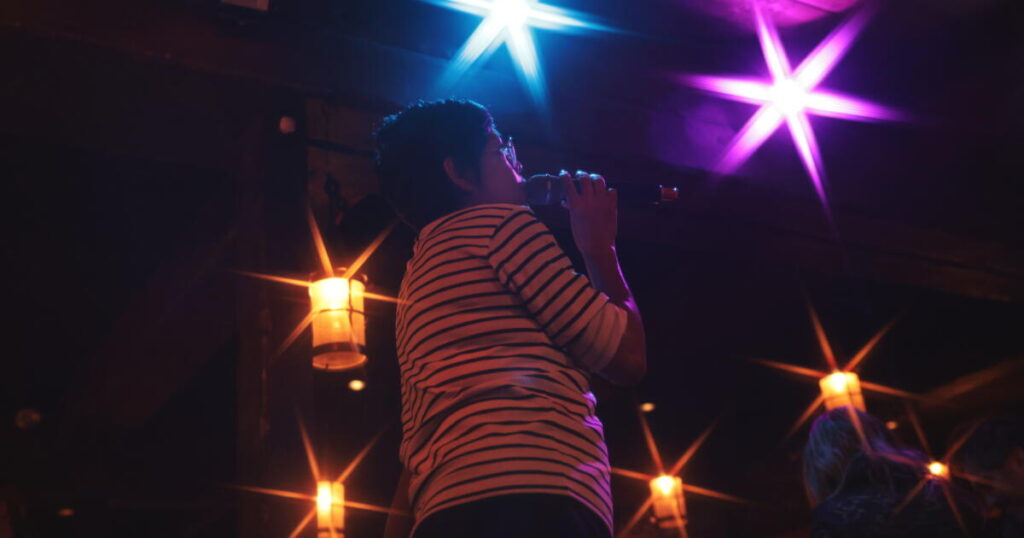
A man dedicates U2’s “With or Without You” to the ex-boyfriend who ghosted him. A woman sings “I’m Coming Home” from “The Rocky Horror Picture Show” for the late Tim Curry. The room pounds their fists on the tables to the bridge of Metallica’s “One,” a harrowing anthem about the horrors of war.
This is Blue Mondays, a karaoke night dedicated to sad songs that’s become a ritual of catharsis for its regulars. It happens the first Monday of every month at the Fable, where singers compete for what KJ (karaoke jockey) Teri Gamble calls, “the most coveted shirt in all of Eagle Rock”: a blue T-shirt featuring a pajama-clad Garfield (the cat, not the president) with the caption “I hate Mondays.”
Gamble, an actor, musician and podcaster, has sung karaoke since childhood with their babysitter. They host several karaoke events, including a Broadway night at Akbar in Silver Lake, and have helmed Blue Mondays for about two years.
Gamble doesn’t always choose the best singer to win the Garfield shirt. They consider performers who make a song their own, get everyone singing along, or seem like they need a win.
“There was a girl who … had a cast on her arm. She cried her whole song. I said, ‘you don’t have to tell me what happened, but I love you and I hope everything gets better.’ And then I definitely gave her the shirt that night,” Gamble said.
Thom Sigsby, who owns the Fable with his wife, Monica Katzenell Sigsby, enjoys the low-key performances. “Someone did [Sara Bareilles’ “She Used to Be Mine”] and it was just devastating. There wasn’t a single moment of feeling like she realized there was anyone else in the room,” he said.
You’d expect long faces nursing their drinks, but it’s often the opposite. There’s something freeing about exorcising negativity through song that keeps people coming back. There’s community here, across the dedicated regulars and the staff — Gamble’s an incredible singer, and bartender Megha Wescombe absolutely crushes “Maybe This Time” from “Cabaret.” As Nicole Kidman might say, “Heartbreak feels good in a place like this.”
“I think I end up feeling less sad about my own personal sads because we are sharing them together,” Gamble said. “So it feels like the burden is lessened by the end of the night every time.”
Akhil Indurti, a software engineer who also performs musical improv at the Upright Citizens Brigade, won October’s shirt. He sang System of a Down’s “Chop Suey” (frontman Serj Tankian owns Kavat Cafe, two doors down), though his go-to is Chris Isaak’s “Wicked Game.”
“I think oftentimes [people] listen to sad songs because they’re sometimes more musically interesting,” he said. “They’re not just a major chord progression. It’s not usually just sadness. There’s nuance and subtlety. There’s some storytelling.”
Soraya Sebghati won September’s shirt with Linda Ronstadt’s “Long Long Time.” She fronts the band Night Talks, and said sometimes people tell her she shouldn’t be allowed to do karaoke because she’s a professional. She still loves it, both as a performer and a spectator, and — despite her seemingly upbeat demeanor — enjoys Blue Mondays as a “safe space for the freaks and the goths and people who want to sing sad stuff.”
“I’m the kind of person, when I’m sad, I like to listen to more sad music. I’m also a big cinephile. Bleak Week at Cinematheque’s [Bleak Week: Cinema of Despair] is my favorite week of programming of the year,” she said.
The Fable’s crowd and the songs they choose are eclectic, spanning generations and musical tastes. Some songs you’re guaranteed to hear every time — Radiohead’s “Creep” and Johnny Cash’s cover of “Hurt” are staples — but some performers choose more subversive tracks.
For example, OutKast’s “Hey Ya” sounds happy, but it’s about loveless relationships. Barry Manilow’s high-energy “Copacabana” describes a woman who drank her life away following her lover’s murder. Gamble recalled a performer who writhed on the floor while sob-singing Lou Bega’s “Mambo No. 5,” which could be sad considering the protagonist’s inability to maintain a steady relationship.
Blue Mondays didn’t start at the Fable. Sigsby was already a karaoke enthusiast when he began KJing at Bigfoot Lodge in Atwater Village about 14 years ago. By his own admission, he “got way too into it,” spending his own money to add songs to his book. A former theater kid and commercial actor, karaoke gave Sigsby a new way to express himself on stage and make friends. He and his wife even bonded over karaoke before they married.
Given that Mondays are usually slow, Sigsby and his co-workers began adding shticks: single-artist blocks, nights where KJs chose singers’ songs, and Blue Mondays, which offered a free “Prozac” shot for each depressing tune (a mystery blend with an on-theme hue). Free booze — which singers still receive today — was a motivator, but so was the theme, which seemed to “resonate” more than the others.
Sigsby later founded his own karaoke company, HiHo Karaoke. It operates at bars including Ye Rustic Inn, Glendale’s the Gold Rail and Bigfoot Lodge, whose own Blue Mondays, Sigsby said, draws a younger crowd. Compared with some karaoke outfits, Sigsby admits HiHo may appear “antiquated,” but that’s intentional. “There’s no app, there [are] no [paper] slips. You literally just come talk to us because we want to meet you and talk to you and have a relationship with the singer[s],” he said.
The same goes for HiHo’s book. Streaming services may offer 50,000-song catalogs, but HiHo’s 12,000-plus book is curated by its hosts and clientele. Licensing each song ensures musicians and rights holders are paid, and lets people request the songs they’ve been dying to sing, from emo deep cuts to Puccini operas.
In 2019, Sigsby and his wife purchased the Fable (formerly the Old Chalet and before that, the Black Boar) less than six months before the pandemic. It was after stay-at-home orders lifted that Blue Mondays really took off. “I think it really was just this need for everyone to reconnect coming out of COVID and also have a safe space … where they really could emote,” he said.
Through the Eaton fire in nearby Altadena and today’s economic uncertainty — Sigsby notes the first Monday means everyone’s just paid rent — the Fable has continued to offer that space.
Regular Mel Minghelli, whose impressive four-octave range let her nail both the Phantom and Christine in “The Phantom of the Opera,” said, “I think in the way that sad music has helped people as a comfort, it’s really nice to be able to perform it and have other people … hear it or also feel comforted.” Minghelli used to treat her unique talent as a “party trick,” but now wants to record her own music with singer-songwriter Johnny Mace, another regular she met at the Fable.
Mace chose Calum Scott’s cover of Robyn’s “Dancing on My Own” that evening, though he said he often does Black Sabbath’s “War Pigs.” He described the Fable as a “magical” place where he’s found numerous friends and opportunities. “I was in the deepest depression and coming out here got my confidence back and I found my voice again. I [had given up] on my music career. I was really hurting and this place gave me life again so I owe this place a lot,” he said.
He won the shirt once singing the Goo Goo Dolls’ “Iris” but has since given it away, to whom he can’t remember. Why? Unlike Garfield, he likes Mondays.
The next Blue Monday is Nov. 2, 8:30 p.m.-12:30 a.m., at the Fable, 1630 Colorado Blvd. in Eagle Rock.
The post Why does this sad-song karaoke night in L.A. feel so good? appeared first on Los Angeles Times.