In the summer of 1998, Richard Kelly was a recent U.S.C. film graduate making minimum wage at a Hollywood postproduction house but eager to get something going. He was struck by a memory from his childhood in suburban Virginia: a story about an ice chunk falling from a jet and crashing into a boy’s bedroom.
In an interview, Kelly recalled wondering: “What if it’s not ice but a jet engine? And what if they couldn’t find the plane?” From there, he unspooled a story beyond the mystery — turning the engine into a metaphor for the unknown. “Then I created this teenage character, and the name just popped into my head.”
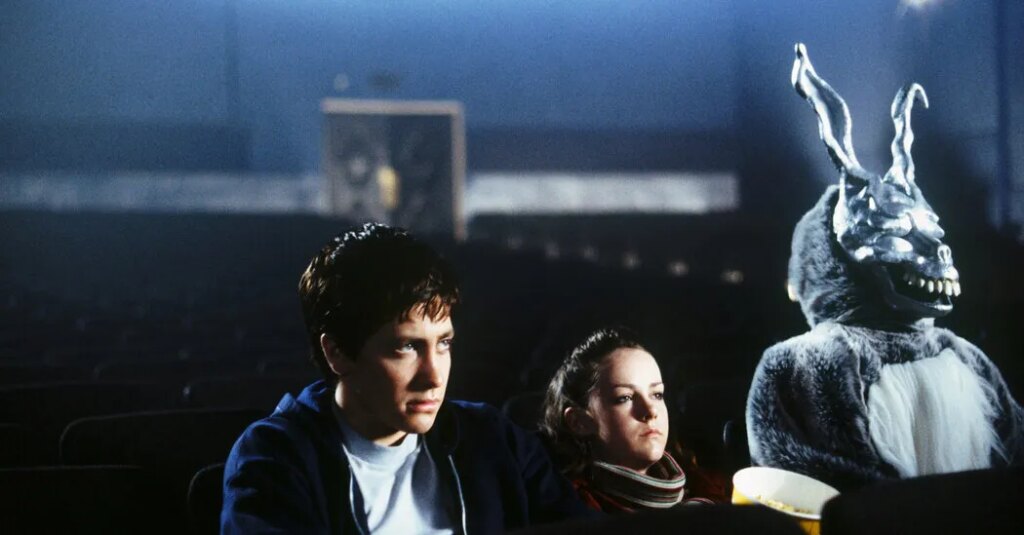
That name was Donnie Darko, which would become the title of his first feature, released 25 years ago this month: a science-fiction psychological thriller and social satire packed with horror overtones and superhero undertones. Set in October 1988, it follows the disaffected Donnie, who, guided by apocalyptic visions of a monstrous rabbit, navigates suburban hypocrisy, time travel and fate.
Filmed in Southern California in less than a month in summer 2000, the low-budget movie featured up-and-coming actors like Jake Gyllenhaal (as Donnie), Maggie Gyllenhaal and Seth Rogen (in his first movie). They joined seasoned performers like Patrick Swayze, Noah Wyle and Drew Barrymore.
Kelly is continuing the story in the novel “The Philosophy of Time Travel,” due in December and taking place immediately after the events of the film.
In the cast and crew’s own words, this is how the indie film weathered early lows to become a cult classic. Interviews have been edited and condensed.
As Kelly’s script circulated, Hollywood power players clamored to meet him. But when he insisted on directing it himself, enthusiasm cooled.
RICHARD KELLY (writer-director) I just knew if I sold it, they would rewrite it and change so much about it. It would become something completely different. I taught myself computer animation. I’d written the songs into the script. I had to believe in myself.
MARY McDONNELL (Rose Darko, Donnie’s mother) This vision had been so strong for him, he had to fight for it. We knew we were doing something extraordinary.
JENA MALONE (Gretchen Ross, Donnie’s girlfriend) I remember my agent sending me the script. She’s like, “I have no idea what this is, and I think you’re going to love it.” I was a bit of a weirdo. So when I read it, I was just like, “I cannot wait to know who wrote it.”
BETH GRANT (Kitty Farmer, teacher) I read that thing so fast, and it’s going to sound dramatic, but when I finished, I stood up in the middle of my bed. I was a grown woman standing in the middle of my bed, and I’m looking around for somebody to tell. I’m going, “This is the greatest script I’ve ever read!”
SETH ROGEN (Ricky Danforth, school bully) I remember thinking, “This will either be really good, or it’ll be like the weird B-movie of itself.”
Jason Schwartzman, fresh off “Rushmore,” signed on to play Donnie, and Drew Barrymore came aboard as an executive producer and performer. But scheduling conflicts forced Schwartzman to exit, and Jake Gyllenhaal, 19, was cast.
KELLY It was so heartbreaking to lose Jason. I was really scared Drew was going to back out. Then she left this incredible voice mail: “Richard, we’re going to find another Donnie. It’s all going to work out.” Joseph Middleton [the casting director] got meetings with every hot upcoming 20-year-old or 19-year-old actor. I met with [Gyllenhaal] in Drew’s office. He had spiky hair, very goth, and a chain belt. It was just like, “That’s it. He’s got the part if he wants it.”
JAKE GYLLENHAAL (Donnie Darko) The transition from adolescence into semi-adulthood is a semi-psychedelic journey. So when I read the script, it felt the same way. [Donnie] was really struggling with enormous feelings that he couldn’t contextualize. I just went, “This is what I’m feeling.” No movie or story had reflected that.
ROGEN I remember seeing [Gyllenhaal] on set and being like, “I don’t know how this is going to land.” He wasn’t playing this charming version of it. I remembered thinking he put a level of thought into this that I didn’t even realize, as an actor, was on the table.
McDONNELL Meeting Maggie and Jake at this moment in their lives, their brilliance was so clear. You can tell that with young actors by the questions they ask, or in some cases don’t ask.
JOLENE PURDY (Cherita Chen, bullied outcast) On the last day of filming, Jake said: “You have made an impact in this, and you need to be aware of how you can shape other people’s lives through this medium. Someone in the audience is going to have experienced the bullying that you experienced, and they are going to feel a camaraderie with you and support from feeling not so alone.” I have carried that with me for 25 years.
Swayze played against type as a self-help guru who presents a deeply moral facade but is in fact a pedophile.
GRANT He knew it was a big deal for him to do it, and he did it fully. He was crying after he saw it. We had a big hug. Aw, I miss him.
MALONE I noticed how a lot of the older actors were just rejuvenated. I remember Patrick Swayze would come to set, even though he wasn’t working — there was a contagious excitement in the air.
No element from the film burned itself into pop culture quite like Frank, the nightmarish rabbit-suited harbinger of doom played by James Duval.
KELLY I did all the sketches. I knew it had to be a rabbit, but I didn’t want it to look like a traditional rabbit. The late, great April Ferry [costume designer] brought in Dale Brady, a sculptor, who did this beautiful metal mold that he dipped in the rubber plaster substance. Then we built two of the masks. April did the beautiful fur suit. There was only one full suit made, which is now in the Academy Museum. The other, the B mask, is owned by one of the members of Metallica [Kirk Hammett].
GYLLENHAAL When I first saw it, I was like, that came out of that guy [Kelly]? It was so meticulous. I expected like a bunny rabbit. I pictured this innocent thing, but what he chose was not that.
MALONE It was weirder than I thought, but also I’m like, “Is it supposed to be funny?” But it ended up being wildly perfect. It was definitely a part of the film where I was like, it’s potentially going to be very divisive.
Michael Andrews’s minimalist score punctuated with post-punk tracks supplied the film’s melancholic heart. His stripped-down cover of the Tears for Fears song “Mad World” with the singer Gary Jules became a hit.
ANDREWS I write music from the mind of the character rather than the mind of the filmmaker often. I wanted to create this dreaminess, so I used a lot of echoey modulation stuff. The movie had such an incredible look to it. It made me feel this was something important.
We were joking that “Mad World” has become a verb like, “Oh they ‘Mad World-ed’ that song.”
Almost everyone credited Steven Poster, the scrappy cinematographer, with making the movie an indelible visual experience.
STEVEN POSTER It’s always been a trick of my career to make it look better than what it should for the money. I was kind of conning the producers into letting us do what Richard wanted.
GYLLENHAAL Steven said, “You’re not going to be one of those actors who never looks up at a camera and is always in their angsty bubble.” I remember thinking, “Oh, that was my plan.” So that look — where I’m looking down and then I look up — is born from Steven.
I had to choreograph a lot of times. Like when the cameras spun, I was aware of the fact that the shot was moving in this way and that they were shooting things upside down and with mirrors. It was really an advantage — all the trippy ways we were using the camera.
MALONE When I really felt like, “Oh, this is going to be something completely different,” is when I saw what Steven Poster was doing.
At the film’s January 2001 Sundance premiere, scenes of Donnie wielding a gun spooked distributors in the post-Columbine era. When it reached theaters weeks after 9/11, its central plane-crash story line proved ill-timed.
KELLY We barely got a tiny little distributor after the Sundance response. There were people who loved the movie; they just were not the buyers. All the distributors were like, “We’re not touching this thing.”
Newmarket scraped together barely enough money to do 50 screens in eight markets. Then 9/11 happened, and it felt ridiculous to think about promoting a movie in the aftermath of a tragedy of that magnitude. They wanted to cancel the [Oct. 26] release, but they had already paid.
MALONE It’s very similar to the character Donnie Darko. He sacrifices himself for the greater good. That film had to be offered to 2001 politics to die on the vine, to be reborn in a different way.
GYLLENHAAL Early on there was a conversation where they were going to put it on the equivalent of [premium video-on-demand]. I remember calling the financiers myself and being like, “You guys, we shouldn’t do that. There’s something here.” People loved this script for years before it was made. It was this really cherished thing, and something felt odd about putting it out that way as a business move.
A dejected Kelly caught sight of a “Donnie Darko” poster in the window of Two Boots Pizza in the East Village in the spring of 2002. To him, the moment signaled the start of the film’s comeback — followed by British acclaim, DVD rentals and early internet buzz. It continues to spellbind viewers.
KELLY I go into the pizza joint, and I’m like, “Can I speak to the manager?” He’s like, “We have a theater in the back, and we’re playing your movie every Saturday night, and it’s selling out.” They asked me to show up the next Saturday. There was a packed house and people with camcorders. I was like, “Oh my God, maybe this movie isn’t dead.”
The U.K. release was planned for Halloween 2002, and it was a whole different ballgame. They went bananas. All the U.K.-based post-punk, new wave music in the movie really connected.
MALONE It was just this combustible crossroads of internet, Blockbuster, DVD, LimeWire — these very potent tools, new and old, that allowed film to exist in a way it had never existed before. That’s how cult things are created.
ANDREWS The movie, the song, the score were gaining traction. It was kind of a viral hit in a very early way. It was at the very beginning of the download thing where people would share for free, and [“Mad World”] had been shared like four million times or something crazy.
GYLLENHAAL There’s a certain group of people of each generation, even younger people, who will be like, “I love that movie.” I’m like, “Wait, you watched that movie?”
PURDY It’s a rite-of-passage movie like “The Breakfast Club.” You’re questioning who you are and the impact you have on the world and the people around you and who you’re becoming.
GRANT It’s a movie that really is mythological and biblical, and so it allows us to project our own coming-of-age story onto it and our own families. It’s a great brainiac story, too. You don’t come out of this movie going, “Let’s go get a cup of coffee.” You need to talk about it.
ROGEN If a thing is good and resonates, it will find its people. I think “Donnie Darko” very much was that.
GYLLENHAAL It was a slow burn, and the slow burn has been 25 years long.
The post ‘Donnie Darko’ Oral History: A Mind-Twisting Cult Classic Turns 25 appeared first on New York Times.