Last year, Alexandra Pitzer paid $290 to meet a group of strangers.
Ms. Pitzer, 33, had just relocated from Nashville to Honolulu for her husband’s Army job when an Instagram ad for a friendship matching app caught her attention. The app, Real Roots, organizes get-togethers for groups of women after they fill out a personality survey. If the women get along, they can pay Real Roots to arrange meet-ups with the same group for the next several weeks.
Ms. Pitzer clicked in, signed up and soon found herself at a brewery with eight other women. They quickly bonded, and she continued meeting some of them after the package ended, going camping and to the beach.
“I can see most of them being lifelong friends,” Ms. Pitzer said. “We have a genuine connection.”
Fueled by a loneliness epidemic and increasingly online lifestyles, more people are paying start-ups to make new friends offline. And friend-matching companies such as Real Roots, 222 and Timeleft are exploding in popularity as a result, each one generating millions of dollars in revenue annually.
The start-ups are meant to remove the strain caused by online dating and other meet-up apps — no profiles to swipe through, no schedules to align, no locations to discuss.
When they sign up, the apps’ tens of thousands of users, typically in their 20s to their 50s, fill out questions related to their background, interests and values. The companies consider unusual criteria like sense of humor, how you like to spend time with friends and if you like meeting people on the other side of the political spectrum.
Once users pick an event off the apps’ calendars, the companies’ algorithms kick into motion. Users are matched with a small group from all the people who signed up — based on characteristics like age and other answers — and told to meet at a predetermined location.
Sometimes it’s a designated table at a restaurant. Other times it’s a bus to a hike, a dumpling-making class or shuffleboard. Once they have paid, all they have to do is show up.
“I think our generation craves the in-real-life environment of meeting each other in a more intimate setting, without digital preconceptions,” said Arman Roshannai, one of 222’s co-founders.
The concept of connecting strangers in person has proved successful, and more start-ups have entered the market. In September, Tinder, the dating app, started a “Group Hangout” feature to help friends plan “in-real-life activities together.”
The apps are taking off at a time when about 67 percent of adults have reported social-emotional loneliness, in part because they did not feel part of a meaningful group, according to a 2024 study by the Making Care Common Project at Harvard University. About 45 percent of lonely adults said they “don’t really know how to develop close friendships.”
“I think it’s a fragile time in the world, and a lot of young people are also feeling vulnerable in a variety of ways,” said Richard Weissbourd, a psychologist and senior lecturer at Harvard and co-author of the report.
In August, 25-year-old Sylvia Le paid around $170 to attend a mountain day-trip organized by 222. Ms. Le, who works in marketing, moved to New York in April after growing up on the West Coast.
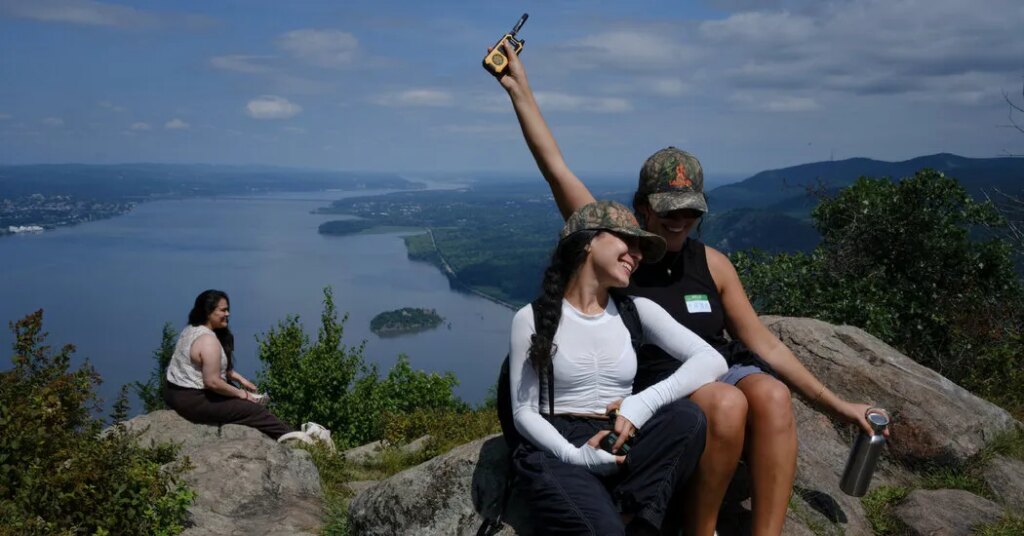
The day of the event, she went to a meeting point at Washington Square Park, after which she rode on a bus with her assigned group for an hour and a half. They hiked and had lunch before heading back into the city.
“It can kind of feel kind of awkward for me, sometimes, to socialize when that’s the whole point of the dinner, or something like that,” she said. “So having the activity just makes it more natural.”
That type of human connection was the reason Mr. Roshannai, Keyan Kazemian and Danial Hashemi came up with 222 as part of a research project in college to “crack the code on human compatibility.”
A year after the country had shut down during the pandemic, the students received a $1,000 grant from University of California, Irvine, to study whether personality survey data could help predict social compatibility. They got their friends to fill out surveys, then expanded the effort by recruiting other students.
After first connecting groups over video calls, the 222 founders started hosting dinners in their backyard. The project became a full-time job in 2023.
Since then, 222, which employs 27 people, has expanded into 21 cities and hosts at least one experience a day. The app asks potential matches questions like “What do you think about astrology?” and “How attractive do you consider yourself?” It charges $22 a month to match people and curate the event, on top of costs that may be associated with experience, like the fees for a yoga class or the meal paid for a dinner.
The company tripled revenue last year and is on track to quadruple revenue this year to the high seven figures, according to the co-founders.
Real Roots and Timeleft have experienced similar demand. Real Roots got its start when a co-founder, Dorothy Li, was looking to make friends after moving to San Francisco and hosted group hangouts in her apartment with women she met online. She decided to build the experience into an app, which was introduced in 2024. Real Roots, which arranges activities for groups of women from bowling to scavenger hunts, is in 120 cities.
Timeleft started a similar app to coordinate dinners with strangers in 2023, after several prior iterations failed, the start-up’s founder, Max Barbier, said. The app is now available in more than 200 cities.
The apps are not always a hit. Some users complain on social media that they did not click with their group or that the experiences can feel awkward and forced.
Alex Cheney, 34, attended several friendship-matching events in cities including Los Angeles — organized by apps like Timeleft, Groupvibe and Kin — over the last two years. But he did not form any meaningful friendships, he said.
“In terms of building a deep friendship, it’s almost something that you have to explore and co-create and build in real time,” said Mr. Cheney, who had also tried building a matching algorithm for coffee meet-ups. “I don’t necessarily know if it’s something that you can build into a matching algorithm because you might have a lot of compatibility on paper with someone.”
For others, it has proved more successful.
Lauren Valenti, an executive assistant in finance, tried a Real Roots meet-up in San Francisco in February. Ms. Valenti, 38, was single at the time and lived alone, while many of her friends had families. She realized she was stuck in a trap of dating for social connection.
At her first meet-up at a wine bar, she connected with two other women who were similarly the single friends in their friend groups. They felt so comfortable, they even talked about personal topics like freezing their eggs.
“It felt so good to finally see someone equal to myself and share that connection,” she said. She paid roughly $290 for the package and committed to a six-week-long series of meet-ups.
Today, she has a group chat with her friends from her first meet-up and sees them regularly. They also reach out to one another for advice.
“There’s one girl that I’m about to message and be like, ‘Hey, girl, I have a ton of clothes I’m trying to get rid of in my closet — they’re all yours if they want them,” Ms. Valenti said.
The post Why Some People Are Paying to Make Friends appeared first on New York Times.