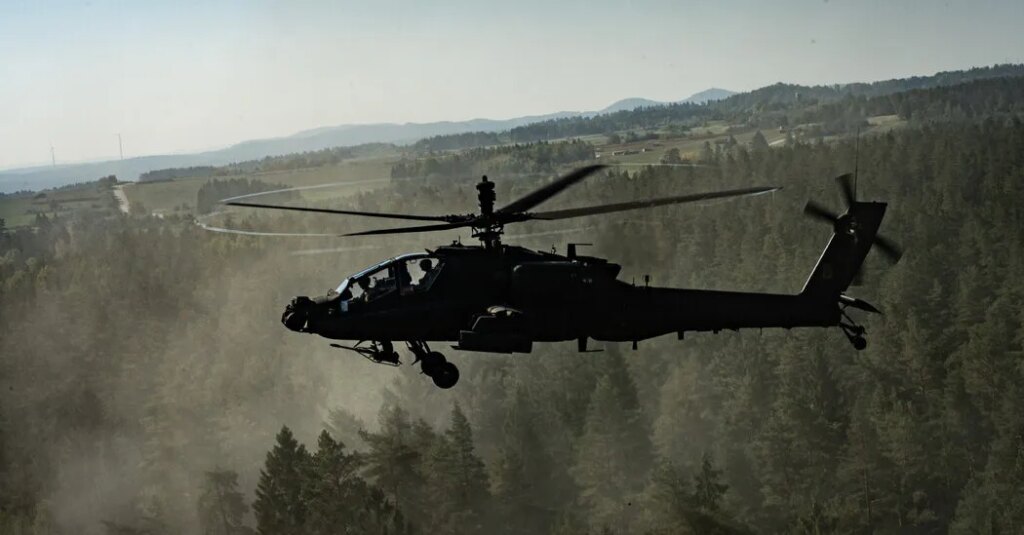
Watching a nine-ton Apache attack helicopter chase a small drone is a bit like witnessing a lion hunt a squirrel. A lot of energy is expended for seemingly paltry gains.
But in war, as in nature, you do what you must to survive. In a battlefield dominated by drones as in Ukraine, the Apache’s natural prey — tanks and armored vehicles — largely disappear, leaving helicopter crews in search of new purpose.
Around the world, military officials have begun to reassess the efficacy of 20th-century battlefield technologies. With that in mind, Apaches from the U.S. Army’s 2-159th Attack Battalion, known as the Gunslingers, took to the air this month on a training mission in Germany to see what value, if any, they could bring to a drone fight.
In the exercise, called Skyfall 2, pilots took turns chasing propeller-driven drones called Outlaws, which have wingspans of about 11 feet. That roughly matches the wingspans of Russian and Iranian long-range attack drones known as Shaheds, which both countries use to great effect on battlefields.
These weapons are cheaper than traditional rockets and missiles and much simpler to make. The threat they pose is grave. Despite their relatively slow speed and simple design, Iranian Shahed drones have slipped through American air defenses. They were responsible for almost all American deaths to date in the war with Iran.
Crews of helicopters and other legacy weapon systems have to learn not only to shoot down these weapons but also to protect themselves from them. In June, over the Strait of Hormuz, a Shahed took down an Apache.
“It was like, this is a real threat, so let’s see what we can do about it,” Chief Warrant Officer Michael Weisskopf, one of the 2-159 Attack Battalion’s senior pilots, said. “It’s not easy compared to what the Apache usually does, which is air to ground,” he said, referring to the tanks and armored vehicles that the helicopter normally targets.
At the exercises, Apache pilots banked and swooped over Bavarian pine forests at the Grafenwöhr training center near Nuremberg. They chased down the Outlaw drones, which are like large model airplanes flown by pilots with radio controllers on the ground. Viewed from a Blackhawk helicopter monitoring the exercises, it looked like a graceful, if occasionally fiery, dance.
The Apaches used 30-millimeter training rounds, not the explosive rounds they might use in combat, together with missiles and rockets. But they still performed well. One crew took out all four drones launched during a single flight.
“If we had our go-to-war load, it would be a lot easier,” Chief Warrant Officer Jarrad Walter, one of the pilots, said. “These are just steel rounds.”
In Ukraine, drones have made tanks and armored vehicles, as well as helicopters, largely obsolete at the front, and they have pushed Russia’s once-mighty Black Sea Fleet out of the Black Sea. Where once there was a front line, there is now a vast area of treacherous territory called the kill zone, where drones dominate and life expectancy for troops is sometimes measured in minutes.
Whether a military as advanced as the United States’ could end up bogged down in a drone war similar to the one in Ukraine is being debated. But few U.S. military officials dismiss the impact drones will have.
“Drones are the biggest battlefield innovation in a generation, accounting for most of this year’s casualties in Ukraine,” Defense Secretary Pete Hegseth said in a memo in July 2025 titled “Unleashing U.S. Military Drone Dominance.”
“Drone technology,” he added, “is advancing so rapidly, our major risk is risk avoidance.”
As part of the anti-drone toolbox, helicopters have already proven their worth — up to a point. The Ukrainian military uses Soviet-era Mi-8 attack helicopters to shoot down propeller-driven Shaheds, and recently began trying to use helicopters as launchers for drone interceptors against jet-powered variants. Israel has even used Apaches against Iranian versions. A year ago, when more than 20 drones crossed into Polish airspace, military helicopters along with fighter aircraft were deployed to shoot them down.
U.S. officials said they envisioned the Apache as one piece of a broad anti-drone package, not as a stand-alone defense. Though the helicopter can carry advanced rockets and missiles, one of its advantages is that it can also fire 30-millimeter rounds, among the cheapest ammunition in Army inventories.
“Having an Apache engage with a 30-millimeter, it’s not only cheaper but it also helps me with a major problem that I have, which is that nations are not only developing a lot of drones, they’re developing the ability to attack at the same time,” said Lt. Col. John Verwiel, commander for the 5th Battalion, 4th Air Defense Artillery Regiment. “How do I defeat mass? I’m all about bringing as many systems to bear on that mass problem that I have.”
But whether the Apache or any other 20th-century defenses can keep up with rapidly advancing drone technology is not clear. Increasingly, drones come with features that match or beat those of their piloted counterparts at a fraction of the cost and without putting pilots at risk. The Ukrainian company SkyFall has a massive new drone called the Stargate that is capable of evacuating troops from the battlefield.
Russia’s latest model of Shaheds, known as the Geran-4, have jet engines and travel at speeds that the Apache cannot match.
“It’s really the speed that’s a factor for us,” said Chief Warrant Officer Cody Schoonover, a master gunner with the 2-159th Attack Battalion. “We can only go so fast in a helicopter, so you put a jet engine on a drone, that’s kind of out of the ballpark for us.”
Pilots acknowledged that the Apache helicopter would play a different and perhaps more limited role in future warfare. As the war in Ukraine shows, helicopters do not last long on a battlefield saturated with drones. This month, a Ukrainian military unit released video of a first-person view, or F.P.V., drone hitting a Russian attack helicopter.
In the wars in Iraq and Afghanistan, Apaches could linger in the battle space for hours, Mr. Weisskopf said. Now, he said, they would need to rush in undetected, take out a target and speed away.
“We’re not envisioning these at the front,” he said.
The Shahed that brought down the Apache over the Strait of Hormuz last summer highlighted the dangers. Experts have debated whether that particular model was capable of shooting down a moving target like a helicopter. It is possible the drone possessed advanced targeting technology similar to that of more advanced drones used by Russia. Or the helicopter could have collided with the drone accidentally, officials said.
The two pilots survived. They were rescued by a remotely piloted Navy sea drone.
The post A New Era of War: A Nine-Ton U.S. Helicopter Versus a Drone appeared first on New York Times.