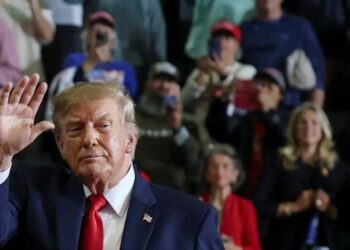
The morning after Donald Trump won re-election, investors fled renewable energy with remarkable speed. Solar stocks fell sharply, and so did those of wind developers.
The conclusion seemed obvious enough. A president who derides wind turbines as cancer-causing, stalls the nation’s first offshore wind permit and denies the urgency of climate change would surely become the industry’s greatest obstacle. Yet markets sometimes focus on the headline without understanding the underlying story. This may prove to be one of those moments.
There are periods in history when governments shape markets. There are others when markets become so powerful that governments struggle to redirect them. The clean-energy transition increasingly appears to belong in the latter category. Public policy helped encourage the adoption of LED lights because they lasted longer and used far less electricity. Uptake was slow at first because LED lights were pricey. But once LEDs could compete on price, the market took over, making incandescent lighting obsolete.
Public policy still matters. Elections matter. Regulations matter. Leadership matters. But there comes a point when economics exerts a force that politics can only slow, not reverse.
Not that the administration hasn’t demonstrated unmistakable hostility toward renewable energy. Offshore wind projects such as Empire Wind were ordered to stop work, and the U.S. wind pipeline shrank from 45 projects to 23 in a year, while Shell wrote off nearly $1 billion on the Atlantic Shores project off the coast of New Jersey. Solar approvals slowed. Coal was championed (foolishly, if not criminally), and renewable developers faced uncertainty that imposed real costs.
At the same time, the administration, via an executive order from Mr. Trump, pursued efforts to reduce permitting delays by shortening environmental reviews and accelerating electric transmission approvals. Congress is now taking up a rare bipartisan deregulation bill to bolster those efforts and speed the permitting of energy projects. Green or otherwise. The bill also bars presidents, including the current one, from unilaterally blocking projects. It could pass in a lame duck Congress should the Democrats win control of the House in the midterm elections.
Mr. Trump’s reforms were certainly not intended to promote renewable energy. But permitting is technology neutral. Faster approvals benefit whatever the market wants to build.
The economics are increasingly favoring renewable energy. Across much of the United States, large-scale solar and onshore wind have become the lowest-cost sources of new electricity. Utilities are not choosing green energy projects because they have become environmental organizations. They are choosing them because the numbers increasingly leave little alternative. The same dynamic is playing out in battery technology. Policy changes have slowed investment in electric vehicle manufacturing, but they have not halted the rapid decline in battery costs.
Instead, much of that battery manufacturing capacity intended for E.V.s is finding new demand in large-scale energy storage. That’s where increasingly inexpensive batteries are making renewable electricity more reliable and economically attractive. That’s why Jupiter Power was able to raise $1.4 billion in September for 10 battery storage projects in Texas and Michigan.
Even if the extraordinary demand from artificial intelligence data centers disappeared tomorrow, the case for investing in renewables would remain intact. Coal plants continue to be retired. Electricity demand continues to rise. Gas turbines, the on-site power choice of some A.I. data centers, are now facing multiyear manufacturing backlogs. Utilities need generating capacity that can be deployed quickly.
This is not simply an American phenomenon. China is both the world’s largest emitter of greenhouse gases and its largest builder of renewable energy; it manufactures more solar panels and batteries than any other country, and continues to dominate critical minerals supply chains. That achievement did not emerge from markets alone. It reflects decades of deliberate industrial policy and government support.
Markets have a habit of rewarding lower costs regardless of ideology. Texas, which produces and exports more oil and gas than any other state, also leads the United States in wind generation, and it is rapidly expanding solar because the economics increasingly make sense for that state’s overstressed grid.
Community solar — smaller solar farms built on farmland or former industrial sites — is also attracting investor attention. It allows municipalities and other entities with available acreage to develop solar power that can be bought locally, lowering electric costs in places such as West Friendship, Md., near Baltimore. Community solar answers to state law, so Mr. Trump can’t stop it.
And while Mr. Trump has been able to use his grip on domestic policy to undermine E.V.s, his foreign policy choices have done the opposite. Attacking Iran has driven gas and diesel prices to staggering levels. Globally, drivers are giving up their gas-powered cars in greater numbers. In the United States, E.V. sales are beginning to rebound after having dropped last year when government incentives were discontinued.
Both investors and consumers are realizing that the current geopolitics of trade wars and turf wars are putting their access to reasonably priced energy at risk. Just ask farmers who voted for Mr. Trump and are now paying more than $6 a gallon for diesel fuel that is critical to their operations. These same farmers have also invested enormous sums in agricultural technology that helps them use fertilizers (which depend heavily on fossil fuels) more precisely and efficiently.
The transition toward cheaper, cleaner energy is a structural shift likely to unfold over decades. Mr. Trump may have slowed that transition. He won’t stop it. The greater risk is that our retrograde approach allows others to build the industries, supply chains and strategic advantages along the way.
Despite the deserved perception that he is the worst president for renewable energy, the elements of the renewable energy industry will continue to expand while he is in office. Because in the American economy it is markets, not presidents, that generally have the last say.
Michael Sonnenfeldt is the founder and chairman of TIGER 21, a peer network for entrepreneurs and wealth creators, and host of the podcast NEXT.
The Times is committed to publishing a diversity of letters to the editor. We’d like to hear what you think about this or any of our articles. Here are some tips. And here’s our email: [email protected].
Follow the New York Times Opinion section on Facebook, Instagram, TikTok, Bluesky, WhatsApp and Threads.
The post How Trump Unwittingly Boosted Green Energy appeared first on New York Times.