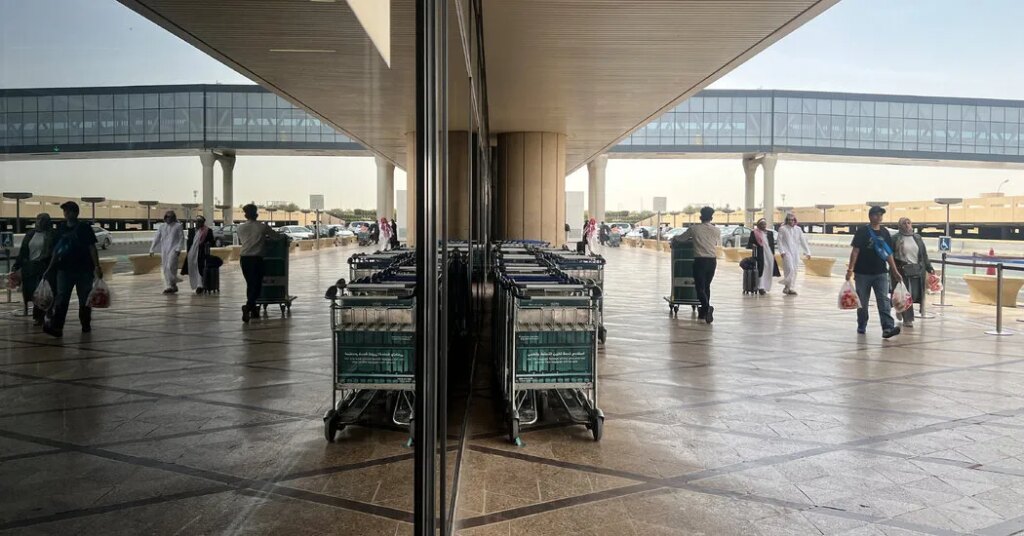
The authorities in Saudi Arabia reopened an international airport in the capital on Sunday after a spate of deadly attacks, even as the Iran-backed Houthi militia in Yemen vowed to keep striking the facility.
King Khalid International Airport in Riyadh, the capital, said on Saturday night that flights would resume on Sunday. In a statement, it advised travelers to “verify the status of their bookings and flights before heading to the airport.”
The airport had been closed to the public since Oct. 10, when a cruise missile launched by the Houthis struck a passenger terminal, killing at least 13 people and injuring more than 300. The militia has launched at least three other deadly attacks on the airport this month, including one that hit a plane on the tarmac and killed three people.
Soon after the airport issued its statement on Saturday, a Houthi military spokesman, Yahya Saree, renewed the militia’s warning to airlines and travelers. He told them to avoid using the airport “because it is a military target” and said the Saudi government would “bear responsibility for the consequences” of reopening it.
After four years of relative peace, the Houthis and the Saudis resumed attacking each other earlier this month amid the broader U.S.-Israeli war with Iran, the Houthis’ primary backer.
The Houthis have been launching near-daily attacks on Riyadh, described those attacks as retaliation for deadly Saudi airstrikes in Yemen, including many that have killed and injured civilians.
The Saudi authorities did not immediately respond to questions about how they had assessed it was safe to reopen the airport, or if they had put in place additional air defenses.
On Saturday, Mr. Saree claimed in a statement that the militia had carried out an operation against the airport, among other attacks around the country, without specifying when.
The Saudi authorities have not said whether the airport was targeted this weekend. The Saudi-led military coalition in Yemen, which is fighting the Houthis, said it had intercepted missiles and drones heading toward Riyadh on Friday, Saturday and Sunday.
On each of those days, residents of the capital received emergency alerts warning of incoming attack, and people in northern Riyadh — where the airport is — reported hearing several loud booms each time.
It was not immediately clear how many flights were scheduled to depart from Riyadh airport on Sunday.
Flightradar24, a flight tracking website, showed that a Saudi Arabian Airlines plane flying from Jeddah had landed in Riyadh on Sunday afternoon. It also showed that a flight operated by the Saudi budget carrier Flynas, heading from Damascus to Riyadh, had diverted to the city of Dammam, in the kingdom’s east, and that dozens of flights to and from Riyadh that had been canceled.
In recent weeks, fighting has reignited inside Yemen between the Houthis and the internationally recognized government, which is backed by Saudi Arabia.
A Saudi-led bombing campaign launched against the Houthis a decade ago aimed to rout the militia and restore the government. It lasted for years and precipitated one of the world’s worst humanitarian crises, contributing to the deaths of hundreds of thousands of people in Yemen from violence, hunger and disease.
A truce in 2022 brought a fragile peace to the country and left the Houthis in control of northern Yemen.
Tensions began to rise again after the United States and Israel attacked Iran in February, sparking a regional war. In July, the Houthis accused Saudi Arabia of attacking the international airport in Yemen’s capital, Sanaa, in order to prevent an Iranian plane from landing.
The militia declared a blockade on Saudi oil exports in the Red Sea, and both sides began to launch a series of escalating attacks. After a full-blown war reignited earlier this month, the militia turned its focus to Saudi airports, threatening to turn them into a “theater of military operations.”
In doing so, they have hit at the heart of Crown Prince Mohammed bin Salman’s ambitions to transform the kingdom from an insular, oil-dependent nation into a global hub for business and tourism.
The prince, Saudi Arabia’s de facto ruler, recently launched a new international airline, with its hub in Riyadh. His annual investment summit, the Future Investment Initiative, typically draws billionaires, executives and officials from around the world to Riyadh. It was set to begin on Monday, but was postponed at the last minute until 2027.
Despite the threats from the Houthis, Saudi officials have sought to maintain a sense of normalcy. The authorities kept Riyadh airport open after two deadly attacks, closing it only after the mass casualty event on Oct. 10.
Shuaib Almosawa contributed reporting from Sanaa, Yemen.
The post Saudi Arabia Reopens Riyadh Airport After Weeks of Houthi Attacks appeared first on New York Times.