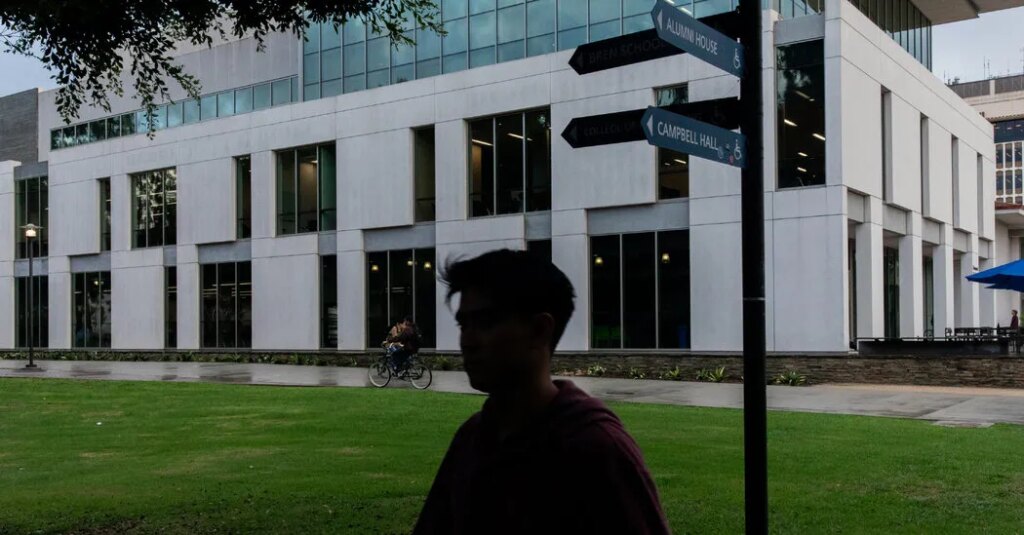
People who graduated from the University of California in the 1960s didn’t pay a dime for tuition. If they have offered to pay for their grandchildren to attend now, they may be in for a shock.
The University of California, Berkeley, posted an all-in price — tuition, room, board, fees and other expenses that make up the full cost of attendance — of $54,674 this year for new in-state students living in a campus residence hall.
The Santa Barbara campus lists a $50,946 price. The cost of attendance has crossed the $50,000 barrier in Irvine, too, where undergraduates are guaranteed only two years of on-campus housing. The all-in price for a student living off campus there is $50,130.
The $50,000-per-year figure is likely to act as a kind of psychological tripwire for families who thought that state schools were supposed to be a bargain.
It does come with asterisks. Plenty of people get financial aid and pay much less. These estimated list prices include health insurance, which many students do not need to buy.
And the price reflects the fact that California is an expensive place to do most anything. According to the College Board, the average list price for tuition and fees at an American four-year public university was $11,950 during the 2025-26 school year. At the California schools in question, that figure was many thousands higher.
Still, there is one big reason that many families there will indeed pay $200,000 over four years, while out-of-state students will shell out over $300,000.
Student housing — even in university-owned residences — can cost more than tuition and related fees.
This, like so many laments about what things cost in America, is a housing story. Public schools that provide a residential undergraduate education are also selling undergraduates an education in what it means to afford a residence.
Rents at the Break Point
How much housing should a university provide, and does a state school have a special responsibility to provide cut-rate beds to everyone who wants one?
If you’re a parent shopping for college, you might assume that the answers are “a lot” and “yes.” But if you’re considering Santa Barbara, you would also be wrong, at least some of the time.
The first thing you should know about the University of California’s campus there is that its Blum Center on Poverty, Inequality and Democracy saw fit to publish an 85-page “people’s guide” to the university’s “housing crisis” in 2024.
The second is that the university recently announced that it would guarantee the availability of on-campus housing for incoming undergraduates. But that promise lasts for just two years, up from one before, and it’s possible only because of some long-planned (and delayed) construction of new campus residences.
Plenty of schools don’t guarantee four years of housing. Decades ago, landlords and developers near the Santa Barbara campus rented out single-family homes and built apartments faster than the university could or wanted to on its own land.
But the housing supply both on campus and off did not keep up as the university grew, and the area’s geography is one big reason. The school is hemmed in by an airport and bodies of water, including the Pacific Ocean.
The only real neighborhood within walking distance is an unincorporated area called Isla Vista. When you visit the school’s admissions office, you can pick up a map that calls I.V. “U.C.S.B.’s college town.” It’s roughly 50 square blocks of often dated houses and low-slung apartment buildings, where landlords are effectively in charge.
Rents at the Breakpointe & Coronado, for example, start at a budget-breaking $1,336.65 per month price point, per person (per bed, technically), for a shared room in a small two-bedroom apartment. Interested parties can already join the fall 2027 wait list.
Over at the Penthouse, a climb up the cobwebbed exterior stairway leads to a top-floor landing overlooking electrical wires and a few palm trees. A sign out front directs people to an error-strewn website promising that the company “will begin leasing all 330 of it’s apartments, townhouses and duplex’s on a first come, first served basis in early January.”
If you’re a student, get in line. Seriously.
Isla Vista landlords know that campus housing won’t be available for everyone. By firing the starting gun on the race for off-campus housing for the 2027-28 academic year now, they can profit from the uncertainty.
“After October, you start hearing, ‘Have you found housing for next year?’” said Nicole Meng, the student team leader at the university’s Blum Center. “All of my friends were like: ‘What do we do? We’re 18. We don’t really have any resources. I’m first generation, low income — how am I going to come up with deposits? And I need to find roommates.’”
She did, and she does. Her rent is $2,988, split three ways among roommates who share a 450-square-foot one-bedroom apartment.
It isn’t shopping, either. “This is to find a spot,” said Jasmine Hsieh, external vice president for statewide affairs for the Associated Students of U.C. Santa Barbara. “You’re not selecting. You’re just hoping to be able to continue to go to school.”
Undercutting the Landlords
When universities spend decades ceding their undergraduate housing market to nearby landlords while the student population grows, they lose a certain measure of control. Eventually, it becomes a crisis, the school’s cost of attendance approaches $50,000 and they need to try to regain it.
There are several ways that University of California schools build dorms, according to Kyle Gibson, the director of strategic communications for U.C. Berkeley’s administration division.
You can hope for a big donation, seek grants from the state or borrow money and perhaps team up with a private developer. Then, you build in such a way that student rents will cover the costs.
After decades of debate, Berkeley is building a new dorm in a small park it has owned for decades. In the wake of protests over potential development there, it surrounded the site with unclimbable shipping containers, in lieu of normal fencing, and topped them with barbed wire for good measure.
In 1970, Isla Vista protesters set fire to the Bank of America branch there, in part because of high rents. Presumably students will not take umbrage with new campus housing that will come online in the next two years.
There will be deals. Willie Brown, the Santa Barbara associate vice chancellor for housing, dining and auxiliary enterprises, said rates would be far below rents in Isla Vista. “For us, this works well, because Isla Vista is so overpriced,” he said.
Meanwhile in Berkeley, off-campus rents on older properties have actually fallen in recent years. Does Mr. Gibson take pride in whatever role his new housing has played in creating competition? “I do,” he said.
Stable housing is fundamental to people feeling good and, for students, performing well, said Gaye Theresa Johnson, the Blum Center’s director and a professor of Black studies.
“When you want to propose a solution, whose feet do you hold to the fire?” she said. “The one steady to me is the university.”
Hers isn’t the only school that could use a little foot warming.
Flagship state schools in Colorado, Connecticut, Illinois, Michigan, New Jersey, Pennsylvania and Virginia have all posted prices over $40,000 for in-state students for at least some undergraduate programs.
This is where college shoppers can make schools uncomfortable. Ask questions of expensive public universities, preferably in large rooms in front of other visitors.
“I hear this is a tough real estate market. Why not build more housing and guarantee four years of availability?”
“Does the lack of a guarantee put lower-income students at a disadvantage?”
“Just how hard and expensive will it be to find housing off campus?”
“Does your on-campus housing lottery coincide with lease-signing season off campus, or will I need to go all in on one or the other?”
This is a service to other visitors listening in. Ms. Meng said she and her friends had arrived on campus in Santa Barbara unaware of the intensity of the housing derby that awaited them.
The best students in any state ought to be able to afford the best state schools without fearing insolvency or homelessness. If they decide to go elsewhere, hopefully they’ll tell the schools (and their state legislators) why.
And then, at last, just maybe, the ones that are losing good students will build more, cheaper and faster.
The post Public Colleges Are Passing the $50,000-a-Year Mark. For Locals. appeared first on New York Times.