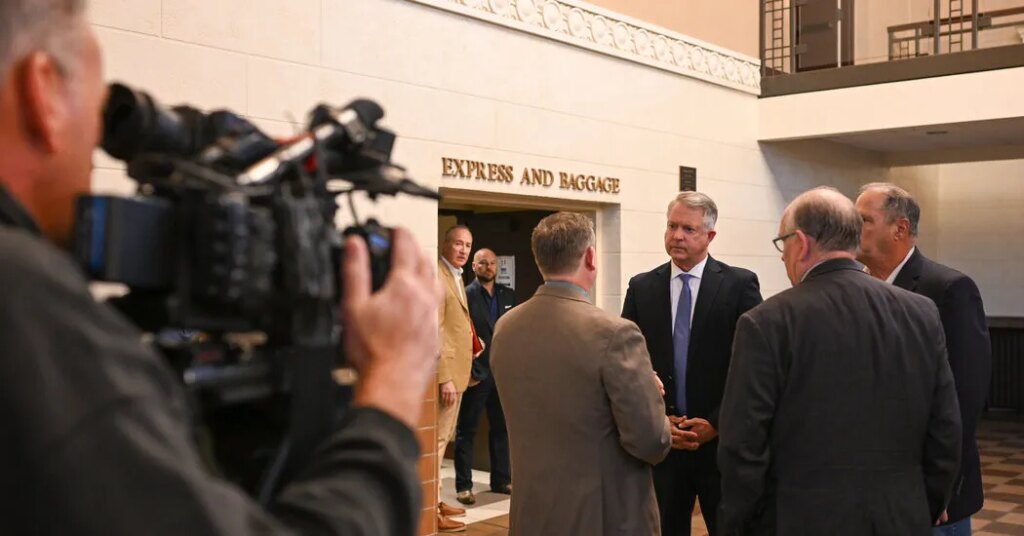
In a restored 1920s train station in North Topeka last week, Senator Roger Marshall, Republican of Kansas, listened as a constituent spoke up to complain about how badly President Trump’s tariffs had hurt his family’s manufacturing company.
Customers were pulling back, Zachary Surritt told Mr. Marshall at a Chamber of Commerce gathering, while costs were rising and employees were struggling to make ends meet.
“Our small businesses can’t sit and wait on a promise for things to happen because we’re feeling the crunch right now,” Mr. Surritt told the senator.
Mr. Marshall begged to differ.
“I think your experience is different than most of the other manufacturing companies that I’ve talked to,” the senator said. “Most of them are expanding and business is great.”
It was an unusual message for a Republican facing an unexpectedly steep re-election challenge as voters grapple with economic anxieties exacerbated by tariffs and the costs of the war with Iran. But then Mr. Marshall, a first-term senator who rode Mr. Trump’s political wave into Congress and has styled himself as an ultra-loyal acolyte of the president’s ever since, has never faced much of a challenge in his solidly conservative state.
It may be one reason his closing pitch leans heavily on discounting his own constituents’ concerns.
“Certainly the cost of gas is an issue,” Mr. Marshall told reporters at another stop in Topeka last week, “but now people are coming home saying, ‘Oh, what’s more important than money?’ There are things more important than money to Kansans.”
Back at the Chamber of Commerce event, Mr. Marshall, a tall, somewhat ungainly 66-year-old, flashed his broad, white-toothed smile as he made a similar argument to Mr. Surritt, defending the tariffs as a necessary tool for bringing manufacturing jobs back to the United States and countering unfair trade practices, particularly by China.
“I’m sorry that it’s impacting you in a negative way,” he said. “I look forward to the tariffs coming off, but other countries have got to treat us fairly.”
The encounter encapsulated how Mr. Marshall, who has spent his political career portraying himself as a champion of the state’s farmers, ranchers and small-business owners, is now grappling with the frustrations of some of those same people — many of them lifelong Republicans.
The challenge has Mr. Marshall fighting to keep a Senate seat Republicans have held continuously for more than a century, an almost unheard-of predicament in Kansas politics.
Mounting Problems at Home
His struggles extend beyond the economy. A New York Times investigation found that Mr. Marshall, who spent decades practicing as an obstetrician-gynecologist before entering politics, sued more than 700 patients over unpaid bills, with some patients arrested after failing to appear in court.
He has denounced the revelations as a politically motivated “hit job.”
A campaign finance watchdog group filed an ethics complaint this week alleging that Mr. Marshall illegally used taxpayer funds to pay campaign staff, as well as for political trips and events. The group, End Citizens United, cited an investigation by the Kansas Reflector that found texts and emails suggesting his Senate staff improperly sought to use taxpayer money to pay for campaign trips.
Mr. Marshall’s campaign finance filings listed no staff salaries as recently as the summer, though a more recent one shows staff being paid in the month of October. Aides from Mr. Marshall’s official Senate office have accompanied him to campaign events, at times acting as spokespeople and helping manage his appearances. Though it is not unusual for congressional aides to take on dual rolls supporting campaigns, members of Congress typically take great pains to ensure that political tasks, trips and functions are not paid for by taxpayers.
In a statement, his campaign said “the narrative that Senator Marshall’s campaign has no paid staff is blatantly false. The team is made up of multiple paid, professional campaign staff.”
Mr. Marshall also faced heavy criticism after a bakery owner complained that she had never received payment for $678 worth of cookies bearing the senator’s name and other sweets that his campaign ordered in 2020. After a brief social media furor, the Marshall campaign paid the vendor $1,300, and the senator said he had “absolutely no idea how this happened.”
He has also faced criticism over property he owned in Florida and questions about how much time he has spent in Kansas.
“You don’t live here!” attendees shouted when the topic came up at a recent debate.
Mr. Marshall has dismissed the criticism about the property, which he says he recently sold, calling it “baloney.” He has insisted he spends most of his time in Washington or Kansas and said the Florida home was meant as a place for his wife to decamp while they were visiting family.
Mr. Marshall and his aides did not respond to repeated requests for interviews from multiple Times reporters. During a recent campaign appearance, an aide briefly prevented a Times reporter from remaining at the event.
Mr. Marshall retains formidable advantages in a state where Republicans have dominated federal elections for generations. Mr. Trump carried Kansas by roughly 16 percentage points in 2024, and Republicans hold a substantial voter-registration advantage.
But his Democratic opponent Adam Hamilton, a Methodist pastor who founded one of the nation’s largest congregations, has become unexpectedly competitive. Recent polling shows the race in a statistical dead heat, alarming Republican leaders in Washington and prompting millions of dollars in outside spending.
It has also upended the usual financial advantages of incumbency. Mr. Marshall raised roughly $6.7 million and spent $7.2 million winning his first Senate race in 2020. He is now on pace to match or possibly exceed that to defend his seat, an unusual trajectory for a Republican incumbent in a reliable conservative state.
Privately, many Republicans believe Mr. Marshall grew comfortable in what he assumed was a safe seat and waited too long to prepare for a serious challenge, despite urging from colleagues to mount a more robust effort long before Mr. Hamilton entered the race, according to several people familiar with conversations among party leaders and operatives.
Early Indications of Trouble
But there were signs more than a year ago that Mr. Marshall could be in trouble. At a town hall meeting in March 2025 in western Kansas, constituents confronted him over tariffs, federal spending cuts and the elimination of government jobs. The senator grew increasingly irritated, accused the audience of being rude and abruptly left the gathering as attendees booed and shouted after him.
His office accused Democratic operatives of sabotaging the event, and Mr. Marshall amplified an unsubstantiated allegation that protesters had been paid to attend. He later acknowledged having no firsthand evidence for the claim.
“It was a complete overreaction,” said Bob Beatty, a political science professor at Washburn University who has studied Kansas politics for decades. “He’s in Oakley, Kansas. This is not Berkeley.”
Mr. Beatty said the episode exposed a growing distance between Mr. Marshall and his constituents, who are more accustomed to figures like former Senator Bob Dole and Senator Jerry Moran making themselves accessible even to those who disagreed with them.
Mr. Marshall has since curtailed traditional public town halls and remains elusive on the campaign trail, opting for more controlled gatherings almost exclusively for supporters, including a bus tour this month that crisscrossed the state.
When he does appear, he offers little in the way of personal connection.
At a bus tour stop on a recent rainy afternoon in Abilene, his wife, Laina Marshall, treated Republican attendees to a warm portrait of Mr. Marshall, recalling him as the ambitious young medical student she met more than four decades ago who had dreams of holding elected office.
He listed roughly 100 goals, she recounted, culminating in a plan to enter politics after his medical career, an aspiration that sprang from a fascination with public service stretching back to age 10, when he had asked to visit Dwight D. Eisenhower’s presidential library for his birthday.
The following morning in Topeka, Mr. Marshall offered no such inspirational backstory, saying only that Republicans had recruited him relentlessly to run for Congress.
“Everyone that would ask me to run, they would try to organize, and my wife would tell them ‘He’s not interested,’” he said. “She’s not happy about it now, but she knows it’s the right thing to do.”
A Trump Loyalist
For now, Mr. Marshall’s greatest liability may be what has propelled his political rise: his close alignment with Mr. Trump, whose policies have now alienated some of the state’s most important Republican constituencies.
Agriculture has been central to Mr. Marshall’s political identity since he entered politics criticizing Representative Tim Huelskamp, the Republican he defeated in a primary, for losing his seat on the Agriculture Committee.
But as Trump administration policies have disrupted markets and raised costs, Mr. Marshall has more often defended Mr. Trump than challenged him.
When the president last year proposed increasing beef imports from Argentina to lower grocery prices, the move angered American cattle ranchers. But Mr. Marshall said the impact would be minimal, comparing the amount of Argentine beef entering the country to a single hamburger among thousands of tailgates at a Kansas City Chiefs game.
Americans concerned about high beef prices could simply choose to eat something else, he said.
“You can buy chicken, you can buy pork,” he said during an interview with CBS Mornings.
Earlier this year, the Kansas Livestock Association’s political action committee, which supported Mr. Marshall in 2020, declined to endorse him for re-election over tariffs and remarks Mr. Trump made about beef prices being too high.
On other issues, having the president’s ear has proved beneficial. Mr. Marshall has championed year-round sales of E15 ethanol-blended gasoline, which would expand markets for Kansas corn.
During a speech at the White House over the summer, Mr. Trump said Mr. Marshall frequently called him pleading, “you’ve got to save the ethanol.”
At a rally in Wichita on Monday, Mr. Trump explicitly tied the fate of E15 to Mr. Marshall’s political survival.
“With Roger Marshall in the Senate, we will make year-round E15 permanent,” Mr. Trump said. “But if Adam Hamilton is in, I’m not doing it. That’s it. I’m only doing it for him. That’s a big deal for Kansas, actually.”
Mr. Hamilton, who has built his candidacy around faith, moderation and finding common ground, has proved difficult to caricature as too far to the left for the state. He has won endorsements from two of the state’s former Republican governors, Mike Hayden and Bill Graves.
Still, Mr. Marshall has worked to cast him as an extremist.
“My opponent, Adam Hamilton, is the most radical liberal Democrat to ever make it this far in a Senate race,” he told supporters in Russell during a recent campaign stop.
“He’s way too woke for Kansas,” he added.
But those attacks have competed for attention with the series of controversies surrounding the senator, which come as Democrats have made corruption in Washington — and how it is costing ordinary Americans — a defining campaign theme.
Mr. Hamilton and allied groups have blanketed the airwaves throughout the state with ads about the senator’s legal action against former patients. Mr. Marshall’s campaign has responded with advertisements featuring former patients praising him as a caring physician.
For all the signs of vulnerability, there remain plenty of voters who see little reason to abandon their senator.
Sidney Hammond, 78, who attended the Abilene event featuring Mr. Marshall’s wife, said the senator had been a dependable advocate for the state’s agricultural communities.
“I don’t know really why it’s that close, because we’re a rural area and Kansas is fairly strong Republican,” he said. “He seems to care about what’s out here in the Midwest.”
But he noted that the senator could do a better job of letting Kansans know where to find him. Mr. Marshall skipped the Abilene stop of his bus tour, where many voters, including Mr. Hammond, had hoped to greet him.
The post In Deep Red Kansas, a Trump Loyalist Fights to Defend a Senate Seat appeared first on New York Times.