The United States has had a problematic history of interfering in foreign elections, much of it during the Cold War. Over the past few decades, however, Washington has grown more respectful of other democracies and mostly avoided intervening in their campaigns. Presidents and their aides have rarely even expressed a preference about who wins an election elsewhere.
President Trump is returning the United States to its meddlesome and counterproductive past. During the past two years, he or members of his cabinet have endorsed candidates in Argentina, Colombia, Honduras, Hungary, Israel, Japan and Poland. In some cases, the Trump administration has gone further and rewarded its preferred candidates with friendly policies or punished countries run by politicians it hopes to unseat.
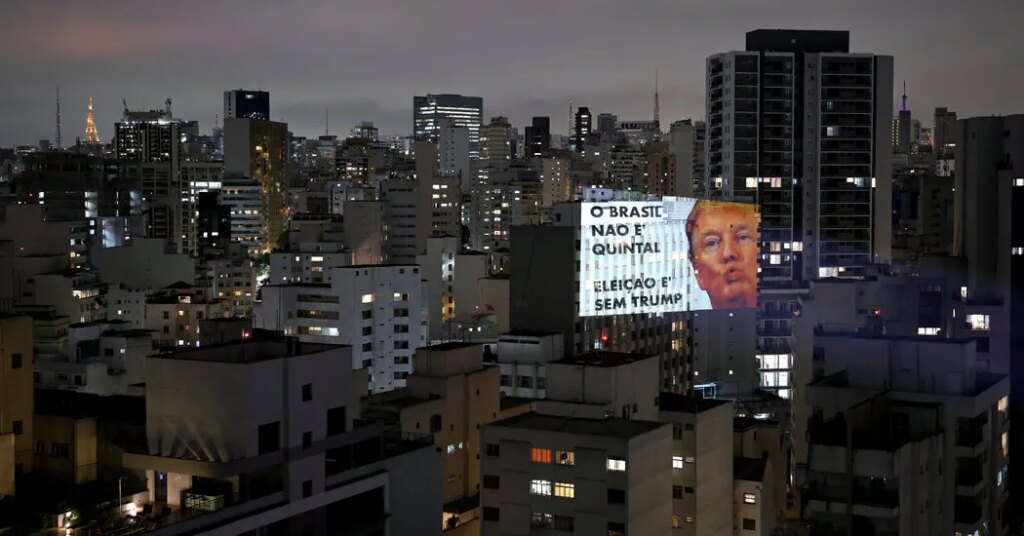
The latest example is in Brazil, where voters on Sunday will choose between President Luiz Inácio Lula da Silva, a left-wing populist, and Flávio Bolsonaro, a far-right senator whose father, former President Jair Bolsonaro, is serving a 27-year sentence for attempting a coup after he lost the last election.
Mr. Trump has not formally endorsed the younger Bolsonaro, partly out of concern that the move could backfire, a White House adviser told The Washington Post. Yet he has done everything but officially endorse. In a failed effort to keep the elder Bolsonaro out of prison, he enacted policies far outside the mainstream of American diplomatic tradition. The administration placed a 50 percent tariff on most Brazilian imports in 2025 and imposed sanctions on the judge who oversaw Jair Bolsonaro’s trial and on the judge’s wife. The tariffs have weakened Brazil’s economy.
Last month, Democratic members of Congress wrote a letter to Secretary of State Marco Rubio accusing the administration of a “sustained, multifaceted campaign of interference and destabilization in Brazil.” Mr. Lula offered his own complaint at the United Nations last month. He referred to “the largest military power in the world” and said, “We are once again witnessing external interference in electoral processes.”
This meddling is damaging to the cause of democracy and America’s national interest. Outside interference in the elections of a democratic state is undemocratic: Americans are not part of the Brazilian polity, after all. Underlying the Trump administration’s interventions is a disrespectful message that Americans — or at least a small number of them — think they know better than Brazilians what is best for Brazil.
Historically, this paternalism has fared poorly, even for the paternalists. Democratically elected governments, free from outside interference, have been stronger, more stable diplomatic and economic partners for other liberal democracies.
Aggravating the damage, Mr. Trump’s favored candidates tend to be hostile to democracy within their own countries, much as he has been. They are mostly far-right politicians with autocratic tendencies. They use government power to secure lucrative deals for themselves, their sycophants and people close to Mr. Trump. They try to change election rules to keep their parties in power. In a few extreme cases, such as the elder Mr. Bolsonaro and Mr. Trump himself, they look kindly on extremist violence committed in their names.
It is impossible to know how effective Mr. Trump’s interference in Brazil has been. Some of his previous attempts to sway elections have backfired, including Vice President JD Vance’s embarrassing campaign swing through Hungary on behalf of the authoritarian-leaning Viktor Orban, whom voters ousted shortly afterward. In Latin America, the political winds favor right-wing parties even in countries with little Trump intrusion. Many voters across the region are frustrated with the economic performance of left-wing governments over the past decade and worried about high levels of crime and migration.
Still, the Trump involvement in the region has been meaningful. The United States has enough economic might to affect the economies of other countries, and the Trump administration has explicitly sought to reward allies and punish political opponents in Argentina, Brazil and Colombia. He and his aides brag about it. Last month, Mr. Trump said, “We’re doing very well in South America” and referred to “lots of people that I got elected.” In Venezuela, he went much further than election interference and illegally used military force to depose its autocratic leader, Nicolás Maduro, and install a government that often does as the Trump administration wants.
These interventions are especially damaging in the current environment. International politics are increasingly defined by two loose alliances, one dominated by democracies, including the United States, European Union and Japan, and the other by authoritarian states, including China, Iran and Russia. The authoritarian leaders often pretend to be democrats — as with Russia’s sham elections — while deriding the leaders of actual democracies as imperialists. Mr. Trump plays into their hands by disrespecting the citizens of other countries, telling them whom to support and using America’s economic might to influence the political atmosphere.
In the competition between democracy and autocracy, democracies should enjoy a big advantage in the court of global public opinion. Democracies are much better places to live than autocracies, and most people recognize this: Many millions of people around the world would like to move to United States or Europe; relatively few seek to move to China or Russia.
The Trump administration’s meddling has damaged the soft-power advantage. In 2014, residents of Brazil, Chile, Colombia and Mexico all had a substantially more favorable opinion of the United States than of China, according to surveys by Pew Research Center. By this spring, the American advantage had shrunk to almost nothing in Brazil; in the other three countries, China had a modest advantage. “People are much more likely to say the U.S. interferes in the affairs of other countries than they are to say the same of China,” Pew wrote.
The story of South and Central American democracy in the final decades of the 20th century was a positive one. Several military juntas and dictators left the scene, and democracies emerged. And the United States, which had propped up autocratic regimes, became a stronger, if still imperfect, advocate for democracy in the region.
Brazil was a case study: The Kennedy administration spent millions of secret dollars there in the early 1960s to swing congressional elections away from the left-wing president, João Goulart, who was perceived as a communist threat. That covert intervention led to a coup in 1964 and two decades of military-backed authoritarian rule and the death or disappearance of hundreds.
By 1985, though, a civilian opposition leader was appointed president, and President Ronald Reagan quickly met with him to signal support. In 1989, Brazil held a presidential election for the first time in three decades. The emergence of Brazilian democracy was good for Brazil, and it was good for the rest of the world, including the United States.
What Mr. Trump does not seem to understand is that the global standing of the United States benefits when our leaders attempt to live up to the highest American ideals. Mr. Trump disdains those ideals and cares mostly about himself. Along the way, he is damaging other countries and sapping American power.
The Times is committed to publishing a diversity of letters to the editor. We’d like to hear what you think about this or any of our articles. Here are some tips. And here’s our email: [email protected].
Follow the New York Times Opinion section on Facebook, Instagram, TikTok, Bluesky, WhatsApp and Threads.
The post Trump Should Stay Out of Brazilian Politics appeared first on New York Times.