Brazilians head to the polls Sunday to elect a new president in a fiercely fought election that is the biggest test yet for an ascendant right winning presidencies across Latin America.
The contest also carries major consequences for U.S. ambitions for political and economic dominance in the region, pitting a leftist incumbent who has repeatedly defied President Trump against a right-wing rival aligned with Washington on issues like using lethal force to fight drug gangs.
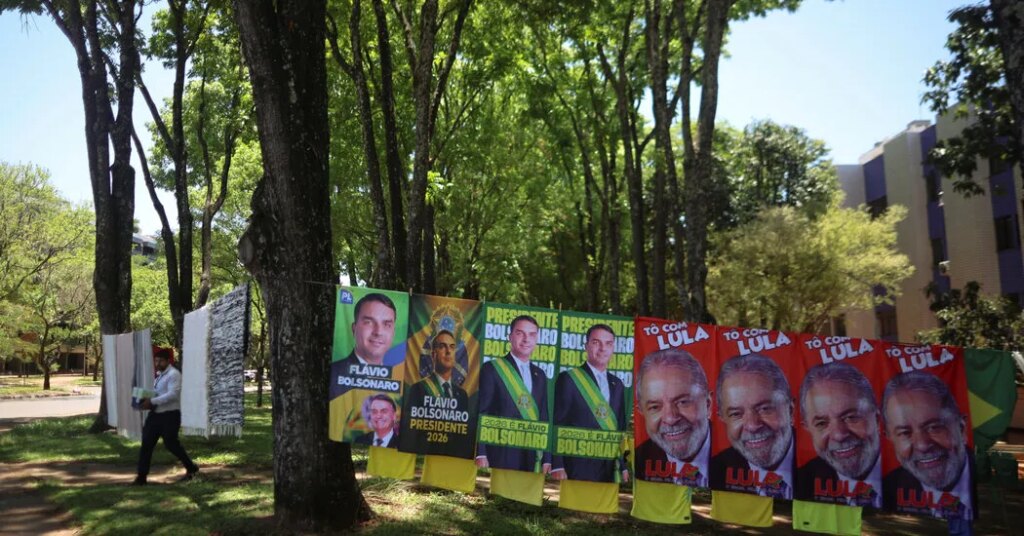
Voters will decide whether to give President Luiz Inácio Lula da Silva another term or elect Flávio Bolsonaro, a senator and the son of the last president.
Mr. Bolsonaro heads into the race as the front-runner, having won more ballots than Mr. Lula in the first round of voting this month but not enough to avoid a runoff. Still, the margin was the smallest in Brazil’s history and most polls show the two men in essentially a statistical tie.
The two candidates offer starkly different visions for the future of Latin America’s largest democracy on issues that include how to fight organized crime, shake up a sluggish economy and restore trust in Brazil’s institutions.
Who are the candidates?
The presidential contest is a familiar one, pitting Mr. Lula, once again, against a Bolsonaro. This time, though, he will face off against the eldest son of the former President Jair Bolsonaro, whom Mr. Lula defeated in 2022.
Mr. Bolsonaro was convicted last year on charges of orchestrating a vast coup plot, which included plans to assassinate Mr. Lula.
Mr. Lula, 80, has framed his candidacy as a vote for democracy and the only way to bar the return of the Bolsonaro family to power. His argument has struck a chord with Brazilians worried about the health of Brazil’s democracy if another Bolsonaro leads the country.
Mr. Lula has also promised to protect Brazil’s sovereignty, standing up to Mr. Trump last year when he tried, through tariffs and sanctions, to help Jair Bolsonaro avoid prison.
Yet Mr. Lula, an enduring presence in Brazilian politics who is now seeking a fourth term, has also struggled to energize many voters hungry for political and economic change. The first round of voting suggested that he has lost touch with many working-class Brazilians who were once his staunchest backers.
Mr. Bolsonaro, 45, seeking to harness the affection many right-wing voters still have for Jair Bolsonaro, has promised to restore his father conservative agenda. At the same time, he is trying to appeal to women and independent voters by casting himself as a more moderate successor by avoiding the sexist, racist and homophobic rhetoric that his father often employed.
Mr. Bolsonaro has said that, if elected, he would seek amnesty for his father and rioters jailed for storming Brazil’s halls of power after the last election, in an episode reminiscent of the attack on the U.S. Capitol.
Each candidate has cast the other as corrupt. Mr. Lula has pointed to a corruption investigation into Mr. Bolsonaro over millions of dollars he raised for a biopic about his father from a disgraced banker at the center of a billion-dollar fraud scandal. Mr. Bolsonaro has seized on a past corruption scandal that landed Mr. Lula in jail, a conviction that was later set aside.
What are the big issues?
Brazilian voters are seeking solutions to various challenges, including the spread of criminal networks and persistent economic stagnation that has left many people under financial strain.
Mr. Bolsonaro, seizing on voter worries about crime, has made fighting drug gangs a cornerstone of his campaign. He has vowed to “declare war” on crime groups and build five new maximum-security prisons inspired by the incarceration model adopted by El Salvador’s strongman, Nayib Bukele.
Mr. Lula has championed a different approach that targets the finances and weapons of organized criminal organizations, arguing that these groups must be dismantled from the top. He has pointed to Brazil’s history of bloody police operations that take out foot soldiers but fail to capture gang leaders.
Mr. Bolsonaro, inspired by President Javier Milei of Argentina, has adopted a pair of giant scissors as a symbol of a leaner state and promised $40 billion in cuts to public spending. He has also pledged to lower taxes and reduce red tape for entrepreneurs, seeking to appeal to a growing number of Brazilian workers who have migrated to the gig economy.
Under Mr. Lula’s watch, Brazil’s economy has remained largely unscathed by American tariffs while unemployment rates have dropped to record lows. Still, rising food prices and mounting household debt have weighed on his approval ratings.
Mr. Lula, seeking to reverse his fortunes, recently expanded a debt-relief program under which the government will buy billions in delinquent consumer loans. And just days before the elections, he banned online betting, which has accelerated Brazil’s personal debt crisis.
Has the U.S. interfered?
In Brazil, a nation where protecting its sovereignty runs deep, worries about America putting its thumb on the vote has loomed large.
Mr. Lula, casting Mr. Bolsonaro as a U.S. puppet, has accused the Trump administration of trying to sway the vote in his rival’s favor to seize Brazil’s vast natural resources, including critical minerals.
He has also frequently reminded voters that Mr. Trump applied steep tariffs on Brazil after a brother of Flávio Bolsonaro lobbied the White House as part of a campaign to keep their father out of prison. When those efforts failed, Mr. Trump dropped most of those tariffs.
While Mr. Trump has not formally endorsed the younger Mr. Bolsonaro, he has seemed willing to support him in more subtle ways. This has included designating Brazilian gangs as terrorist organizations, which helped Mr. Bolsonaro cast Mr. Lula as weak on crime.
Following Mr. Bolsonaro’s first-round win, Mr. Trump was quick to celebrate. “It’s a big victory,” he told reporters.
In recent days, questions have also emerged over the impartiality of American social media companies after Mr. Lula and independent watchdog groups accused Meta of giving his right-wing rival favorable treatment on its platforms.
What is the role of social media in the election?
In the race to sway a deeply divided Brazil, social media has emerged as a contentious political battleground since the first round of voting. And Brazil’s electoral court has become the referee that some accuse of picking sides.
The court, led by a justice appointed by Mr. Bolsonaro’s father, has ordered social media posts by news outlets criticizing Flávio Bolsonaro removed and barred Mr. Lula from posting some negative news stories about his rival.
Justice Kássio Nunes Marques, who leads the electoral court, set off widespread outrage by appearing to target a popular channel on WhatsApp, a platform long dominated by Mr. Bolsonaro’s right-wing movement, aimed at mobilizing Mr. Lula’s supporters on social media and on the streets.
The channel, which quickly attracted more 10 million followers, landed in the center of a firestorm when Mr. Bolsonaro asked the electoral court to shut it down, claiming it was spreading fake news.
Ultimately, the channel was allowed to keep operating, though Justice Nunes Marques pressed Meta to dig deeper to see if it was breaking any electoral rules.
When will results be known?
On Sunday, Brazilians will cast their votes using electronic voting machines; experts say it is one of the fastest and most secure electoral systems in the world. Voting in Brazil is compulsory and, in 2022, turnout for the second round of elections was close to 80 percent.
Brazil’s electoral authority will start releasing results after polls close at 4 p.m. E.T., and a final tally will most likely be announced a few hours later. The count can be followed in real time here.
The post Here’s What to Know About Brazil’s Election appeared first on New York Times.