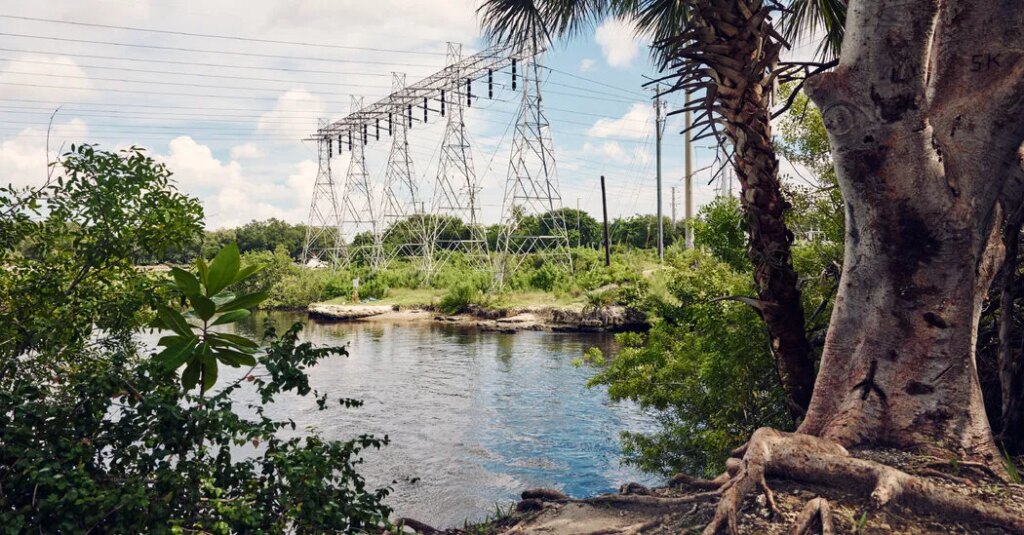
Standing along the edge of a canal near Fort Lauderdale, Fla., Edguin Morales Aguirre had just cast a line when officers with the Florida Fish and Wildlife Conservation Commission approached him and two of his friends. They spotted a bucket holding egg-bearing blue crabs, which are illegal to have in the state.
After running checks on their IDs, the officers summoned immigration agents to detain Mr. Morales and one of his friends, who were surprised to learn that the officers were working with federal immigration authorities.
“This never used to happen,” Mr. Morales said. “Before, if they caught you fishing in a place you weren’t supposed to, they would just issue you a citation.”
In Republican-led states, officers who hand out fishing licenses, inspect produce and investigate financial crimes have been deputized by Immigration and Customs Enforcement, using their contact with local residents on a day-to-day basis to broaden the reach of President Trump’s mass deportation campaign.
The increased cooperation among states that have embraced Mr. Trump’s immigration agenda is part of a federal program known as 287(g), which pays state and local agencies to assist with immigration enforcement. Once largely reserved for local police and sheriffs’ offices to increase ICE’s access to local jails, it has expanded under Mr. Trump to include unusual agencies like state agriculture departments, gaming commissions, fish and wildlife agencies, and alcohol control offices.
But these agencies have little experience carrying out immigration arrests, which can get contentious and even violent. Some incidents involving ICE officers have led to fatal shootings. Advocates have criticized the enlistment of the agencies, saying it increases the risk of officer misconduct and deepens fears in immigrant communities that people could be detained by seemingly innocuous authorities.
“We have really serious concerns that these state agencies that have traditionally not been accountable to local communities would see themselves as accountable only to ICE’s agenda,” said Naureen Shah, who leads the American Civil Liberties Union’s immigration policy and advocacy work. “What is it about their training that they receive as fish and wildlife regulation experts or agricultural experts that leads ICE to believe it should entrust them with really fraught situations?”
Civil rights advocates have long denounced the 287(g) program, questioning the qualifications of state and local officers for conducting immigration enforcement. Although the federal government previously required several weeks of in-person training, the Trump administration scaled back to 40 hours of virtual training for deputized officers making immigration arrests in their communities.
The Department of Homeland Security said in a statement that those officers “undergo ICE background investigations and clearances.” The department added that it had been having “tremendous success” in making arrests with the help of local law enforcement.
Trump administration officials have urged agencies to sign up, and have called the 287(g) program a “force multiplier.” More than 2,600 agreements have been signed across the country as of late October, up from about 130 at the start of Mr. Trump’s second term.
More than 29,300 state and local officers have been granted the authority to question people about their immigration status and make arrests, according to the Department of Homeland Security. That is nearly five times the number of deportation officers that ICE had before Mr. Trump’s return to office.
The program has become another point of partisan division. Many Democratic-led states, including New York and California, have restricted local law enforcement from cooperating with ICE, drawing the ire of Trump administration officials who say the limits make it harder to arrest people.
Still, the state and local partnerships have become a potent tool for the administration, making up a growing share of ICE arrests, which have hit record highs in recent months. The 287(g) program has also helped Markwayne Mullin, the homeland security secretary, achieve his goal of carrying out immigration enforcement in a quieter way.
“We’re still on track pushing as hard as we can,” Mr. Mullin said in a Newsmax interview in May. “We just are doing it in a different way by using local law enforcement to work with us.”
In Louisiana and Mississippi, fish and wildlife departments have similarly partnered with ICE. Even agencies that regulate alcohol and tobacco have signed up in Louisiana and Florida. Nationally, the bulk of immigration arrests are still carried out by ICE, in part because many officers have been deputized in Republican states with fewer immigrants, including West Virginia.
But the partnerships have been especially effective in Florida, which has tallied more than 16,000 arrests through the 287(g) program since August 2025, according to state data. ICE’s most prolific partner in Florida has been the state’s highway safety department, whose troopers have rooted out unauthorized immigrants during traffic stops. The agency has assisted with more than 8,300 immigration arrests.
The state’s fish and wildlife commission has also been one of ICE’s top partners. About 500 federal immigration arrests were made after its officers encountered immigrants, according to state data. The commission referred requests for comment to ICE.
Mr. Morales, a 51-year-old native of Guatemala, said his brush with fish and wildlife officers led to weeks in immigration detention before he was released on bond. He added that he had a pending asylum application at the time of his arrest last year.
Marlene Velazquez Moreno, who was with Mr. Morales when he was arrested, said that she was not detained, because she had a green card. Although she was charged with a misdemeanor, Ms. Velazquez said that someone else unknown to her had left the crabs behind, and that a Broward County judge ultimately dismissed the charge. But she said their friend spent months in immigration detention before he was deported to his native Nicaragua.
In a statement, the Department of Homeland Security said Mr. Morales illegally entered the country and had a prior conviction for driving under the influence. Mr. Morales said the arrest happened more than 15 years ago, and he went to traffic school and paid fines.
Fairuze Sofia, a Fort Lauderdale-based lawyer who represents Ms. Velazquez, said she now regularly hears about immigrants in Florida being arrested by fish and wildlife officers. Another one of her clients, Alfonso Mendoza Perez, is still in immigration detention after he was questioned by them at Lake Okeechobee nearly a year ago. Mr. Mendoza said that he and his brother-in-law frequently caught catfish and tilapia at the popular fishing spot in Central Florida.
“You relax and you catch food for your family,” Mr. Mendoza said in a phone interview from a Mississippi detention facility.
After he was approached by the officers, Mr. Mendoza said he handed over his fishing license, which was valid. But after they checked his driver’s license, he said he was detained on the suspicion that he was in the country illegally. ICE agents later picked him up from the local county jail.
Mr. Mendoza, a native of Mexico, said he lived in Florida for about 17 years and worked as a roofer. Dulce Cruz, his wife, said she and her five children had lost their source of income and now lived in a mobile home with her mother and brothers in South Carolina.
In a statement, the Department of Homeland Security said Mr. Mendoza had been previously arrested for the felony sale of opium drugs. Ms. Cruz denied that her husband had a felony record, and a New York Times search of public records only found traffic-related charges for Mr. Mendoza.
Florida’s agriculture department has also assisted with more than 480 federal immigration arrests, according to state data.
Joshua Chavez, 21, said that he and his father, Mario Chavez Walle, drove to Florida from their hometown in Georgia to sell watermelons at the Jacksonville farmer’s market in late July. They pulled over at one of the state’s agricultural stations to let officers inspect their produce.
According to an incident report from the state’s agriculture department, Mr. Chavez’s father presented his expired Mexican ID to an officer, who then contacted ICE. After ICE confirmed that he had entered the United States illegally, the agriculture officer arrested him and took him to the local jail.
“Undocumented — turned over,” the report says under “offense description.”
Mr. Chavez said the officer questioned them about their immigration statuses, even though he is a U.S. citizen and has a valid driver’s license.
In a statement, the Department of Homeland Security said that Mr. Chavez Walle had been convicted of three D.U.I.s, and had “accepted incentivized departure.” Mr. Chavez disputed that his father agreed to voluntarily depart the country.
The partnerships with ICE have faced intense pushback in local communities across the nation. But some sheriffs said there were clear benefits to signing up. Michael J. Chitwood, the sheriff in Volusia County, Fla., said his office had been awarded $2.7 million in federal funding for making immigration arrests, which it had used to buy new equipment.
He added that officers were not rounding up immigrants, but rather encountering them during their routine work. His officers were scrutinized last year after they arrested a woman who was walking her pug in an area of the beach where dogs were prohibited. After contacting ICE to check her immigration status, the officers detained her, according to an incident report.
Mr. Chitwood noted that sheriffs’ offices in Florida were required to cooperate with ICE under state law, and that the partnership was helping remove some criminals from his community. Although he questioned the need to deport unauthorized immigrants who were not causing trouble, he said his officers were upholding the law.
“If the law says that you should be detained and deported, then we should follow the law,” Mr. Chitwood said.
Sheelagh McNeill and Seamus Hughes contributed research.
The post They Were Accused of Illegal Fishing. They Ended Up in ICE Detention. appeared first on New York Times.