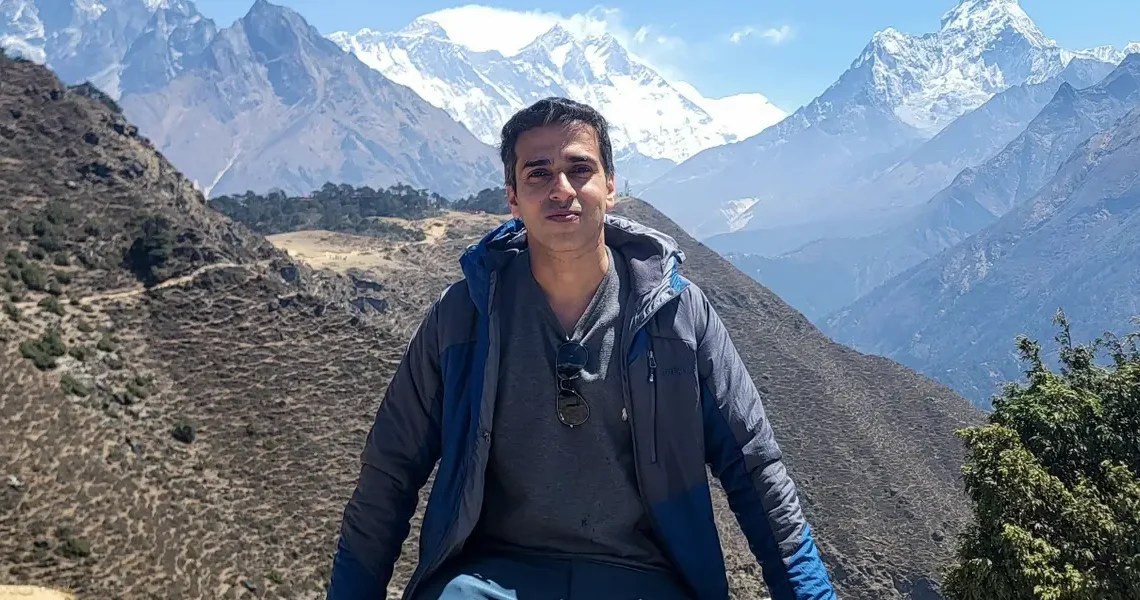

This as-told-to essay is based on a conversation with Mihirkant Upadhyaya, 42, who works at Intel and lives in Oregon. The following has been edited for length and clarity. Business Insider has verified his employment and education.
After studying computer engineering for my bachelor’s, I pivoted into physics.
Two master’s degrees and a Ph.D. in nanoscale science and engineering later, I got my dream job in the semiconductor industry at Intel in 2015.
As my career evolved, I realized I also wanted to do an MBA to step up my game.
My Ph.D. gave me relevant skills to take on the workforce
During my Ph.D., I focused on a semiconductor manufacturing technology called EUV lithography. I was excited to work at Intel because it does both chip design and manufacturing, so I knew I’d get a good overview of the chip-making process.
You don’t need a Ph.D. to work in semiconductors, as there are so many areas outside the lab you can work in, like finance and legal.
On a personal level, though, having a Ph.D. helped me feel prepared to step into the workforce. It gave me discipline and the ability to be comfortable with ambiguity. My research mindset and technical background gave me the confidence to take ownership of outcomes and tasks.
There were definitely moments where I had self-doubt doing a Ph.D. You watch your peers go on to earn big bucks after their bachelor’s and master’s while you live on a modest stipend. However, the experience shaped me into who I am. I’d say I’m more patient, sharper, and more resilient.
I reached a stage where I felt I needed more education to thrive in my job
After about five years in research and development at Intel, I moved into supply chain roles, which have involved managing relationships and negotiating contracts. At this point, I realized I was missing certain skills.
My current role has a greater emphasis on executive communication and financial analysis. When I presented to an executive team, my manager had to step in on a number of occasions to get the room to respond, making what I was saying more high-level using business-driven terms. I also didn’t quite understand certain things when I worked with the finance teams on contract negotiations.
To step up my game, I started a two-year hybrid MBA course in September 2025, alongside my full-time job. It was energizing to get back to the classroom at age 41.
I take one week off a quarter to do in-person sessions, and the rest of the time I’m doing online learning three days a week. My company is partly funding this, which is useful since MBAs can carry a $100,000 price tag.

By the time I’ve finished my MBA, I’ll have done nine years of postgraduate study, investing an estimated $100,000 into that education, aside from scholarships and tuition waivers. Without question, it’s been worth it. I haven’t pursued the degrees to accumulate credentials, but to serve my career at various stages of my life. The MBA is addressing a concrete skills gap I identified after years in my industry.
I believe higher education is helping me become more irreplaceable in the age of AI
The AI boom made me take a hard look at what I bring to the table. I saw that some of what I did could eventually be automated. That realization was humbling.
Instead of trying to compete with what AI is already good at, I wanted to strengthen the areas where I knew it fell short. AI is great at processing and analyzing information. It has scale and speed, but it lacks the truly insightful judgment that a person can gain from years of learning a skill.
In my previous role at Intel, I found that AI couldn’t tell me how to troubleshoot issues involving new or custom-made equipment because the context was so unique to my situation.
Meanwhile, in my current role, while AI could probably help me generate financial models, it can’t read the room, build relationships, or have synergy with another person. My MBA course benefits me in this regard because we do lots of group activities, even online through Zoom, where we can interact with each other.
I think that in the age of AI, finding a field you really care about, becoming an expert in it, and staying curious to keep learning can help you become irreplaceable.
Intel declined to comment in response to a request from Business Insider.
Read the original article on Business Insider
The post A Ph.D. led me to my dream job at Intel. At age 41, I started an MBA because I realised I was still missing key skills. appeared first on Business Insider.