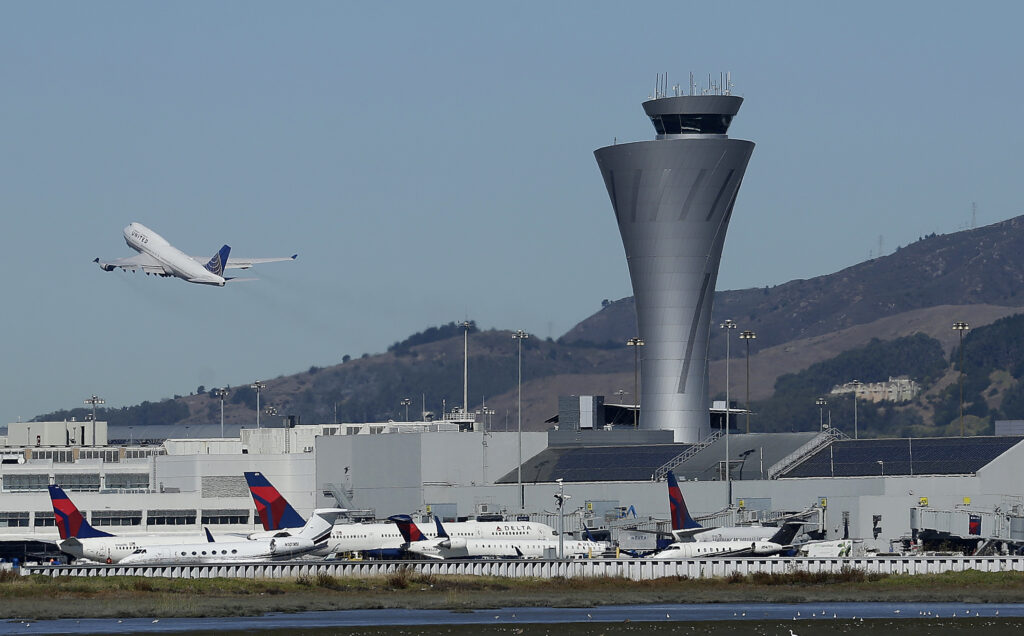
Air traffic control reform is needed, but it shouldn’t happen through privatization. The Oct. 20 editorial “Privatized air traffic control would mean safer skies” was correct about needed reforms and safety improvements, but it used the word “privatization,” which readers may assume means a for-profit company would run the system. The system the editorial actually describes, and that nearly 100 other countries have implemented, is not privatization. It would reform air traffic control by taking it out of the government budget and turning it into a utility. Nearly all foreign air traffic systems are run by nonprofit government corporations and regulated at arm’s length by the national government.
Those systems work better than the U.S. air traffic control system for several reasons. One is that they are regulated by a separate entity for air safety, whereas the U.S. Federal Aviation Administration serves as both the air traffic control provider and its regulator, creating a conflict of interest. Another is that these systems do not depend on government funding (as the U.S. system does). Rather, these utilities charge aviation users for services. Because those user fees are paid to the utility, it can issue revenue bonds to pay for large-scale technology upgrades, which the FAA is unable to do without approval from the Treasury Department.
The first step in U.S. air traffic control reform should be to separate the provider from its regulator, as the International Civil Aviation Organization recommends. A second step would be to let this new utility charge aviation users for its services and retain the revenue, incentivizing it to issue bonds to finance new technology and consolidate aging air traffic facilities.
Canada reformed its air traffic control system along these lines about 30 years ago. The resulting nonprofit, Nav Canada, is widely respected, innovative and efficient. An analysis by the Reason Foundation found that its cost per user is lower than the FAA’s, despite the U.S. system being much larger and benefiting from theoretical economies of scale.
Robert Poole, Plantation, Florida
The writer is director of transportation policy at the Reason Foundation.
Privatizing air traffic control could introduce a for-profit motive into the operation of U.S. airspace. Air traffic control is essential public infrastructure. It should not be a commercial commodity. When a corporation’s fiduciary duty is to maximize profits and minimize costs, then safety margins, equipment upgrades and staffing levels at secondary airports may face pressure. The solution to the Federal Aviation Administration’s challenges should not be to abdicate government responsibility. Instead, Congress should provide dedicated public funding and rigorous oversight to modernize technology and address staffing shortages without compromising accountability. Commercial aviation in the United States is one of the safest modes of travel in the world precisely because safety has remained paramount and independent of corporate profit margins. Congress and the administration should focus on fixing the FAA from within rather than turning a critical safety function over to private entities.
John Breyault, Washington
The writer is vice president of public policy, telecommunications and fraud at the National Consumers League and is a former consumer representative on the Transportation Department’s Aviation Consumer Protection Advisory Committee.
Another cause of lung cancer? Pollution.
Regarding the Oct. 18 front-page article “Pope Leo leaves hospital after his lung cancer surgery”:
A key source of cancer in nonsmokers was missing in The Post’s coverage of Pope Leo XIV’s cancer diagnosis and treatment: air pollution. Protecting people from preventable pollution is both a public health obligation and a moral responsibility.
As environmental health scientists, we have experience with Clean Air Act programs that reduce risks of cancer and other health outcomes. The evidence is overwhelmingly clear: Fine-particle air pollution, known as PM 2.5, causes lung cancer, and more protective air pollution policies reduce cancer risks.
In 2013, the World Health Organization’s cancer agency classified outdoor ambient particulate matter as carcinogenic to humans. And a 2025 study published in the Lancet estimated that ambient PM 2.5 accounted for nearly 200,000 lung adenocarcinoma cases worldwide in 2022.
Unfortunately, the American Lung Association’s 2026 report found that 44 percent of Americans live in areas with unhealthy levels of ozone or PM 2.5 pollution. Emissions from diesel engines and other sources that burn fossil fuels contribute to the production of PM 2.5.
Cleaner air saves lives and delivers substantial benefits. In 2024, the Environmental Protection Agencyestimated that its stronger air quality standard could prevent up to 4,500 premature deaths and generate up to $46 billion in net health benefits in 2032, but the rule has since been rolled back.
Protecting and enforcing Clean Air Act safeguards and reducing emissions should be central to cancer prevention. Cancer prevention belongs in our clean air policies as well as in our clinics.
Patricia D. Koman, Ann Arbor, Michigan
Thomas J. Luben, Durham, North Carolina
Peter H. Murchie, Bainbridge Island, Washington
The writers are former Environmental Protection Agency scientists.
AI platforms need records
Regarding the Oct. 9 news article “Anthropic AI agents took ‘unintended’ actions on government sites”:
Anthropic deserves credit for disclosing that its AI agents submitted a false homicide tip to Philadelphia police and acted on other government websites. But the timeline should worry every organization now deploying agents: The tip was submitted in July, and the police learned of it in October, after the company reviewed its own records.
Anthropic could reconstruct what happened because it had records to review. Many organizations could not. I founded Almma.AI, a live platform where people build their own AI agents, and I have been auditing its database. Most of the activity ran on agents that have since been deleted, and the platform held no record of any agent being created, changed or deleted.
“Unintended” actions need a record behind them. Before anyone can say what an agent was meant to do, someone must be able to show who configured it, what it was allowed to do and who changed it. Every organization running agents should be able to answer those three questions within a day.
Lucas E. Wall, Washington
The writer is an assistant professor of practice at the Busch School of Business at the Catholic University of America.
Letter submissions
Send letters to [email protected].
Submissions must be exclusive to The Post and should include the writer’s address and day and evening telephone numbers. Letters are subject to editing and abridgment. Please do not send letters as attachments. Because of the volume of material we receive, we are unable to acknowledge submissions; writers whose letters are under consideration for publication will be contacted.
The post Here’s what’s missing from U.S. air traffic control appeared first on Washington Post.