The Trump administration has filed a lawsuit pre-emptively challenging the certification of Alaska’s Senate election if the Republican candidate narrowly loses. But election law specialists said the litigation lacked any legitimate legal basis.
“It is one of the weakest election lawsuits I’ve ever seen,” said Richard H. Pildes, a New York University law professor who specializes in election issues. “It should have no realistic chance of success in the courts.”
Nevertheless, the lawsuit raised alarms as President Trump has sought to undermine confidence in the election when polls indicate that Republicans are likely to suffer sweeping losses, with control of Congress hanging in the balance. Mr. Trump tried to overturn his loss of the 2020 election, culminating in the Jan. 6, 2021, riot.
Neither the Justice Department nor the associate attorney general, Stanley E. Woodward Jr., who signed the lawsuit with an assistant U.S. attorney based in Anchorage, responded to a request for comment.
Here is a closer look.
What is the lawsuit about?
Voter confusion.
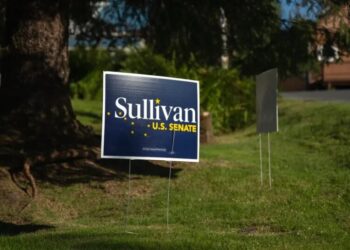
The litigation centers on an oddity in the four-candidate ballot. The incumbent Republican senator, Dan Sullivan, is being challenged not only by the Democrats’ nominee, former Representative Mary Peltola, but also by a novice candidate with almost the same name: Daniel J. Sullivan Jr.
Voters could mistakenly vote for the other Mr. Sullivan instead of the senator. The lawsuit seeks a judicial order blocking the state from certifying the results if Senator Sullivan loses to Ms. Peltola, but would have won had he received votes cast for the other Mr. Sullivan.
Is that outcome likely?
It is possible: Polls suggest that Ms. Peltola is narrowly ahead of Senator Sullivan, with the other Mr. Sullivan pulling single-digit support.
However, Senator Sullivan could still receive votes mistakenly cast for the other Mr. Sullivan because Alaska uses a ranked-choice system.
Under that system, people can rank multiple candidates in order of preference. Votes are tabulated in rounds. Each round, the candidate with the fewest votes is eliminated and those votes are reassigned to the voters’ next choice until one candidate has a majority. So if a confused voter picks both Sullivans but puts the “wrong” one first, the senator likely still will end up with that vote.
What does the lawsuit say should happen?
The lawsuit calls for an investigation, though it does not explain how one would work.
It asks the court to order “an investigation to determine whether votes cast for Daniel J. Sullivan were meant to be cast for Senator Sullivan and any further procedures or relief this court deems necessary and appropriate to determine what the result would have been absent Daniel J. Sullivan’s inclusion on the ballot.”
Does the Justice Department have legal standing?
None that is obvious, specialists said.
The Constitution empowers states to administer congressional elections unless Congress enacts a statute to alter such rules. Citing the National Voter Registration Act, the lawsuit claimed the department can sue to force the state to fulfill a duty it claims the act imposes on state officials to “protect the integrity of the electoral process.”
But the lawsuit takes that vague phrase out of context. It is part of the act’s preamble, which explains the law’s purpose but does not itself carry any affirmative legal force. And nothing in the act governs the kind of ballot access and certification issues at play in the dispute over the two Sullivans.
“It’s the worst complaint I’ve ever seen,” said Richard L. Hasen, a law professor at the University of California, Los Angeles, who specializes in election issues. “No federal statute gives D.O.J. the right to sue over these things. The Constitution doesn’t give it standing, either.”
Did Alaska state courts already address the issue?
Yes.
Carol Beecher, the director of the state’s Division of Elections, initially rejected the other Mr. Sullivan’s application to run for the Senate seat, finding that he was not a good-faith candidate and was trying to confuse or mislead voters. But Mr. Sullivan sued, and a trial court held in June that he could be on the ballot. The Alaska Supreme Court affirmed that ruling.
Has Alaska taken steps to reduce confusion?
Yes.
The Division of Elections has listed Senator Sullivan is on the ballot as Dan S. Sullivan and identified him as the incumbent officeholder and as a “registered Republican.” The ballot identifies the other candidate as “Daniel J. Sullivan Jr.” and does not list any party registration.
“It’s not a great situation, but the division of elections did an admirable job trying to minimize voter confusion,” Derek T. Muller, a University of Notre Dame law professor who specializes in election issues, said in an interview.
Why is the lawsuit being filed now?
The lawsuit seems too late — the ballot is already finalized. It also seems premature — the election has not happened yet. Either way, election law specialists said, its legal basis is so thin that it appeared to be more about messaging.
“It’s a press-release litigation,” Professor Muller said. “It is litigation that suggests the Department of Justice is fighting for a Republican senator who is facing a confusion campaign, frankly, from another candidate who entered in this race. But it’s left to the political process at this point. There is just not much for the legal process to do at this stage.”
Professor Hasen said one reason for filing before the election could be that courts have rejected legal challenges brought after elections over issues that could have been raised before them. This could therefore be a “place-holder lawsuit or zombie lawsuit” intended to come back to life after the election if Senator Sullivan loses narrowly — except even then, he said, such a challenge would be for the senator to bring in state court, not for the Justice Department to bring in federal court.
The post Why Legal Experts See the Justice Dept.’s Alaska Election Challenge as Dubious appeared first on New York Times.