The Newsom administration is coming under fire for paying $180 million to a private investment firm that speculates on water in exchange for a relatively small amount of additional water for Sacramento River salmon.
Some environmental advocates fear it could set a precedent for overcharging California taxpayers in a water-constrained future. State officials and supporters of the deal say it’s not that simple because, among other things, it’s a one-time payment for water in perpetuity, not just for one year.
This year, the Newsom administration reached the deal to purchase water used by a Northern California farm, saying the goal was to leave the water in the river to help fish and the environment.
But Barry Nelson, an advisor for the Golden State Salmon Assn., said the small amount doesn’t justify the cost.
“This is extraordinarily expensive water,” said Nelson, who, along with leaders of other environmental and fishing groups, wrote to state regulators raising concern. He said it “seems like a really bad investment for the public.”
Peter Drekmeier, policy director of the group Yosemite Rivers Alliance, agreed.
“The taxpayers are expected to pay top dollar for an amount of water that’s not really going to move the needle, and that’s just wrong,” Drekmeier said.
The Newsom administration defends the purchase. Ryan Endean, a spokesperson for the state Department of Water Resources, said it represents a win for salmon and water users.
“It will deliver water for the sake of native fish species … even in critically dry years when salmon will benefit the most,” Endean said.
The agency approved the agreement in June and paid with funds from a state water purchase program.
How the complex deal works
The $180 million was paid to RRG Capital Management, based in Los Angeles and part of Renewable Resources Group, which has made money from previous sales of land and water to government agencies.
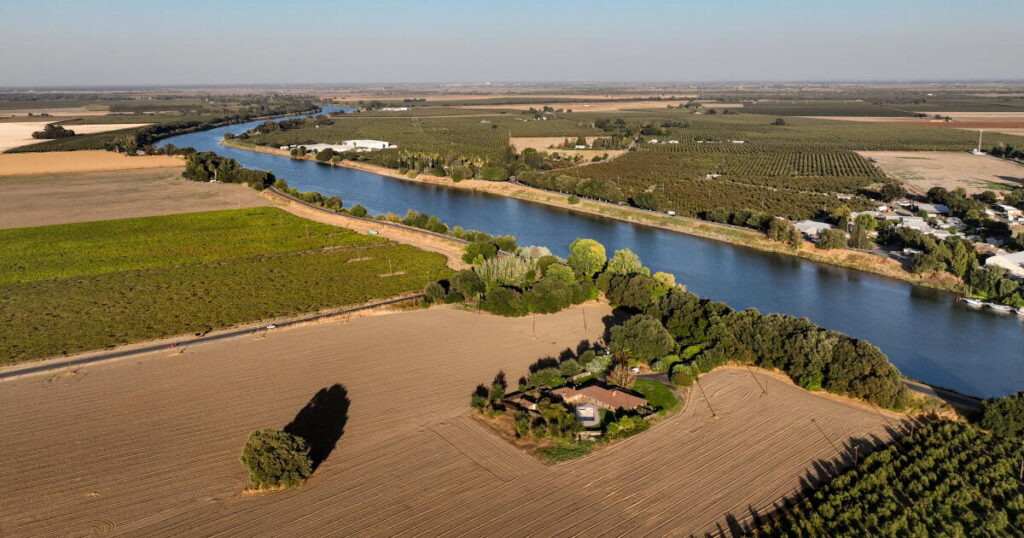
The water will come from a 7,500-acre farm called Fair Ranch, located along the Sacramento River near the small community of Knights Landing, northwest of Sacramento. RRG bought Fair Ranch as part of a larger property in 2021. It’s a rich piece of land that can grow a range of crops and has solid water rights.
As part of the deal, RRG transferred ownership of the farm to a local water agency called Reclamation District 108.
That agency plans to save water by leaving some fields dry and switching to crops that use less. Between 5,000 and 16,000 acre-feet of water will be dedicated each year “to improve fish and wildlife outcomes,” the agreement says.
In recent years, as global warming has intensified drought, salmon and other fish have suffered major declines. State agencies have responded with new efforts to restore river habitat to help fish recover.
The fact that this quantity of water will keep flowing to the environment year after year makes it “an especially valuable arrangement,” Endean said.
The agreement also means prime farmland won’t be taken out of production and gives the state a new water source to help the ecosystem, Endean said. “DWR is always looking to deliver the best value we can for Californians.”
Tom Eisenhauer, a spokesperson for RRG, which describes itself as an investment firm specializing in “sustainable real assets investing in land, water, and agri-food,” said in an email that it seeks “opportunities to invest in and create positive land and water-use transitions that support policy priorities.”
RRG leased the farm to tenants and also invested in efforts to improve wildlife habitat, Eisenhauer said. When the state asked for water available for sale in 2023, the company offered the farm.
The agreement is “a positive outcome for important California priorities,” Eisenhauer said, enabling the state “to permanently and immediately secure much needed water to support salmon, steelhead, and the Sacramento River ecosystem overall, in even the driest years when supplies are scarce and valuable.”
Lewis Bair, general manager of Reclamation District 108, said its leaders wanted to secure ownership of the farm because they felt it was “a real community asset, and wanted to see it continue to stay part of our community.”
Having the district own and manage the land was also a condition of a legal agreement that RRG reached to settle a lawsuit over an earlier iteration of the proposal, which Yolo County and a local groundwater agency had sued to challenge.
Under the water agreement, Bair said the district will continue leasing land to several farmers, but it will leave some fields dry and change some farming practices — switching from crops such as rice and alfalfa to tomatoes, melons or other crops that need less water.
As Reclamation District 108 leaves some fields dry, the goal will be to move a levee back so the river can spread out, restoring a natural floodplain, Bair said. This would require additional funding.
The reclamation district’s leaders are also interested in having an education center and trails for the public leading down to the river in a “park-like environment,” he said.
As for the cost of the water, Bair said “it’s tough to value something as unique as water availability in the driest of droughts, and especially when you do it permanently.”
“I think if you’re going to buy water, this is the most exceptional piece of land and opportunity that you could find,” he said.
Nelson, on the other hand, pointed out that based on the annual minimum water to be left in the river, the state paid roughly $36,000 per acre-foot — dozens of times what cities pay for a single year of water on average.
Yet the fact that the water will be provided for years makes cost comparison difficult.
A 2025 appraisal valued the entire property, including its water rights, at nearly $180 million. Of that, it estimated the market value of the permanent water to be between $40 million and $46 million.
The state has now paid that same amount for the water only, plus certain rules governing the farm.
How much water will it really be?
One criticism is that the amount of water provided in a given year seems to be largely up to Reclamation District 108. Some question how the state will ensure it gets what it’s been promised.
“How do you track this water? Are we really getting what we’re paying for?” Drekmeier said. “We know it’s really, really expensive water, and we don’t know how much of it’s actually going to end up in the ecosystem.”
Bair said the district plans to provide about 7,000 acre-feet of water next year. Each year, the agency’s staff will analyze how much water they can forgo for irrigation while continuing to lease the land to farmers to cover costs, he said, and will submit an annual plan to the state.
The agreement also allows the reclamation district to come up with water by cutting back irrigation at an adjacent farm it owns.
The nonprofit group River Partners originally proposed a different version of the plan, one that would have permanently dedicated up to 16,000 acre-feet of water to the river and restored up to 7,500 acres of floodplain habitat.
“The transaction that ultimately closed took a different shape,” said Julie Rentner, president of River Partners.
She said it’s unfortunate the final deal didn’t require any habitat restoration.
“We see that as a missed opportunity,” she said. “We’re optimistic it won’t be the norm.”
The wider context is that the Newsom administration is seeking more such arrangements.
It wants to move away from the traditional regulatory approach of limiting pumping from the Sacramento-San Joaquin River Delta to keep certain river flow levels, in favor of rules that give agencies greater leeway if they fund wetland habitat restoration.
This approach has generated heated debate, and the State Water Resources Control Board will hold hearings on Wednesday and Thursday to consider the so-called voluntary agreements — which state officials call the Healthy Rivers and Landscapes program — as part of new rules governing water in the Delta.
Environmental groups said in their letter to the board that the high price of the Fair Ranch deal “raises serious concerns” about the cost of these voluntary agreements to taxpayers.
If other landowners win what RRG did, they say, the total cost could balloon to $5.6 billion from an initial estimate of $1.1 billion.
The post Critics blast California’s $180-million water buy as ‘extraordinarily expensive’ appeared first on Los Angeles Times.