Hi Readers: Before we start with this column, I wanted to let you know that I’m starting a limited-run newsletter. Here’s a link to learn more about it; I’d love for you to sign up.
In 1971, a researcher at Stanford performed a landmark psychological study that has, for the past 55 years, shaped how we understand corrosive power. Twenty-four male college students were randomly assigned to be either “guards” or “inmates” and then put into a simulation of prison.
Almost immediately, the experiment turned horrifying. Guards acted sadistically: denying bathroom breaks, forcing inmates to wear bags over their heads, engaging in ritualized aggression and humiliation. Inmates broke down. The study was supposed to last two weeks; the professor running it ended it after just six days.
Why on earth would anyone want to recreate this hell? Because the original study was deeply flawed, behavioral psychologist Alison Wood Brooks tells us in the first episode of a new Netflix reality show, “The New Stanford Prison Experiment.” Modern academics have criticized the Stanford professor for inserting himself into his study (he role-played the superintendent) and engineering outcomes to fit his own preconceived notions.
Plus, in 2026 “the study of power couldn’t be more relevant,” Brooks says, apolitically. She thought that maybe it was time — accompanied by a former corrections officer and a journalist who writes about power dynamics — to try it again.
Great.
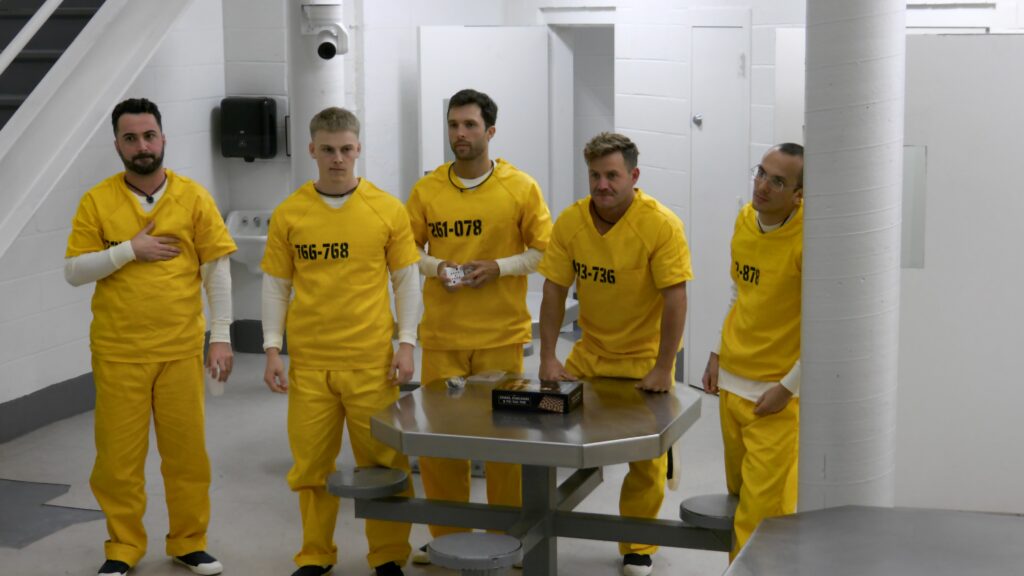
Hope springs infernal, so enter 30 recruits from around the country. We’ve got a sales rep, a motivational speaker, a couple of business owners, a glassmaker, a bartender. This time we’ve also got three women who all end up on the guard side — which will make you wonder whether this division into guards and prisoners was actually random — and then everyone takes up temporary residence in an unused wing of a county correctional facility.
And then I watched all six hours, fired up my laptop, and proceeded to eat a bag of cheese puffs while staring into space.
You might have wondered, as I did, whether it’s even possible to authentically recreate such a famous experiment. “Stanford Prison Experiment” has become a cultural shorthand for sinister power dynamics. As a participant, wouldn’t you know how things turned out last time? Wouldn’t you try, equipped with the knowledge that cameras were capturing your every move for millions of viewers, to make things not turn out that way?
We’re not told exactly whether these participants were given a debrief on the prior experiment, or how they were recruited, or whether they’re being paid, but in any case, let’s meet the castmates.
“If someone has a problem with authority in general, I absolutely want to break that person,” an oil rig supervisor named Hudson informs us, elaborating that society depends on rules and regulations.
“The guards are going to have to be strict, they’re going to have to be mean,” says Pete, a fifth-grade social studies teacher. “I don’t want to be mean.”
It’s not exactly a spoiler to ask the following questions: When the people who claim to place great importance on respecting authority learn that they will actually be inmates, subject to the rule of others, how important do you think they still find the concept of obedience? When the people who claim that it’s important to push back against power learn that they will be the ones in power, how mean are they willing to be?
It’s not that simple, of course. Humans never are, even in Netflix reality shows. The majority of the castmates in “The New Stanford Prison Experiment” are there to get along. To act peacefully as inmates, decently as guards, and philosophically as humans. One participant, a Black man assigned to be a prisoner, mentions that he’s fine with playing that role: he wants to demonstrate for his sons that dignity is innate, and that it is possible no matter your circumstances.
What this version of the experiment ends up revealing, at least as Netflix styles it, is not that all power corrupts all people, but rather that it really only takes a couple of tainted participants to turn the whole place (jail/neighborhood/country) into a toilet. In “The New Stanford Prison Experiment,” you will immediately hate exactly three people — possibly a fourth, but definitely these three — and you will hate them because you have met them in your real life, but in your real life at least there were doors on the bathroom stall.
There’s a Debate Me Bro, who you can tell has been waiting his entire life for a sanctioned excuse to act like a total ass: It’s a sociological experiment, he repeatedly jeers. There’s a sniveling toady whose desire for status leaves him both unliked and unrespected. There’s a bubba who always seems about two ticks from demanding a sammich and a back rub. There is, as previously mentioned, a motivational speaker.
It’s a real four-horseman-of-the-penitentiary collection of foreboding personality traits (okay, three horsemen and one Ted Lasso), and their actions constantly result in strife for everyone else: lost privileges, lost trust and general resentment. An observer might notice — though the experiment-runners providing steady analysis in the viewing booth never remark on it — that each of the dudes cockily swinging around their penal codes is a White man. The Black male participants on this show are generally more inclined to consider what true power and true rebellion look like, even if the American prison system they’re navigating on Netflix is a fictional one.
We’re not going to give the female guards a pass, either. One of them — who reveals that she’s excited to demonstrate feminine power here even as she submits to her husband at home — decides that a troublesome inmate should become a trustee with extra privileges because he has “Jesus eyes” (he shouldn’t; he doesn’t). This bad decision launches a domino chain of bad outcomes.
As for everyone else: What would you, a soft, law-abiding, reality-TV-watching citizen do if you were suddenly locked up for two weeks, with nothing to do but talk, notice, compare and plan?
“Let’s just do it,” one inmate says to another, as they contemplate trying to steal the guards’ keys and make a break for it.
“Not right now,” his compatriot replies, eyeing the cafeteria cart that has just rolled in. “Let’s eat first.”
“The New Stanford Prison Experiment” is hard to watch, but not for the reasons you might expect. Nobody ends up with a bag on his head or a boot on his back. There is one scene in which guards are told they must complete riot training — a drill that is scarring for everyone, and is one of several occasions that make you wonder exactly how ethical this generation of the experiment is — but there is no workplace sadism. Thanks, OSHA!
What there is, again and again, are a minority of people who have come to an experiment about power and authority with apparently no set definition of power and authority. People who believe that authority should look like authoritarianism if they are the ones in charge, but like anarchy if they are not. (The show incorporates a series of twists that allow us to see participants in various roles.)
“I’m just following all of our typical protocols,” one castmate says to another when they believe they are on the same side.
“They’re your protocols now,” his former friend replies.
It is maddening to watch these people. It is maddening to watch people who could be judicious choose instead to be punitive, and to witness the butterfly effect of those choices. A minor infraction results in a major punishment. The punishment creates group outrage that didn’t previously exist. The outrage results in a need for order, but how do you create it when you’ve already used up your biggest sanctions? One inmate keeps fiddling with a microwave dial after he’s been asked not to, and before long you’re thinking this is how wars start.
It’s also maddening to listen to the experiment-runners in the observation room, whose expert analysis is understandably informed by their areas of expertise: the corrections professional who chalks up every mishap to a need for more firm-handed structure. The psychologist who keeps introducing crazy variables and then murmuring, Interesting! as if she stumbled upon the lunacy rather than planted it. The steadiest commentator is the journalist, but then again I would think that.
In the end I’m not sure that this experiment is any more accurately revelatory than the one in 1971. Because everyone knows, throughout the whole trial, that they will be done in two weeks. And that they have the option, should they choose, to use the designated safe word and bow out even earlier.
In real life, we don’t have that. In real life, you can stand in front of a camera and scream “Pineapple” all you want, but you’re still going to be surrounded by the toadies and asses of the world, making it worse for the rest of us (in your jail/neighborhood/country) while nobody comes to open the door.
The post This landmark experiment was horrifying. Why is Netflix performing it again? appeared first on Washington Post.