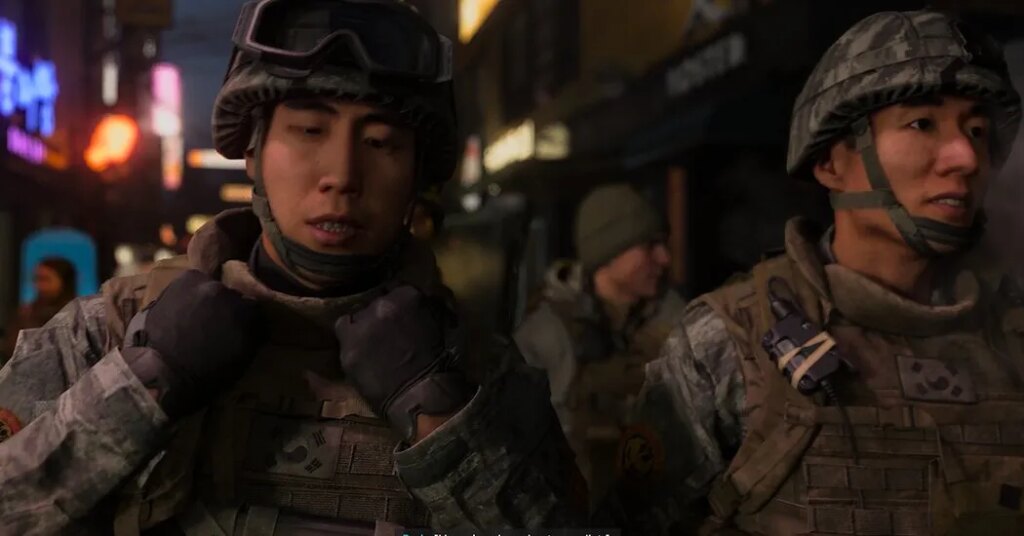
Five minutes into Call of Duty: Modern Warfare 4’s campaign, one of its main characters, Pfc. Park Hyun-jun (played by Young Mazino of the show “Beef”), talks briefly with his squad mate Sgt. So Jae-woo about possibly re-enlisting in the South Korean marines. While So wants to make a career in the military, Park wants out as soon as possible. When North Korea invades moments later, Park and his squad retreat into a supermarket as destruction engulfs the country around them.
Modern Warfare 4 imagines if the Korean War reignited. The conflict, which began in 1950, never technically ended; both the North and South agreed only to an armistice. To stave off future incursions, South Korean men must serve in the military for two years. It’s a policy that has become increasingly controversial.
By conveying the nuances of Korean life, the game’s developers at Infinity Ward hoped to set it apart from others that have touched on the conflict. To capture these details, the team spoke with North Korean defectors and mined the experiences of their South Korean and Korean American colleagues.
From a young age, Mazino, who is Korean American, knew well about the service requirement and how inescapable it could be, even for superstars like members of BTS. “There must be many Korean men like my character, who had to suddenly stop and put an abrupt pause on their lives for two years to do their service,” he said in an interview.
“Imagine being deeply in love with someone you’ve just started to build a relationship with,” he added, “only to have to leave for two years and live in a barracks surrounded by a bunch of crusty dudes you’ve never met in your life.”
A wartime Korea setting is rare in mainstream video games. The most notable one before Modern Warfare 4 was Homefront: The Revolution from 2016. Its 2011 predecessor, Homefront, was banned in South Korea for depicting a reunified Korea under the North’s leadership.
Infinity Ward, which made Modern Warfare 4, chose Korea as the primary setting because of the country’s historical and pop cultural relevance, said Jack O’Hara, co-leader of the studio. South Korean exports like K-pop and K-dramas, as well as films like “Parasite” and “Kpop Demon Hunters” are common global touch points. Additionally, the United States’ longtime military presence there allows for more comprehensive storytelling and character dynamics; Park’s squad comprises both Korean and American soldiers.
O’Hara also drew inspiration from real-world events, referencing a CNN article about North Korean artillery drills that seemingly got little attention. The war is “frozen in time, and people don’t really think about it that much,” he said. “When we interview people in South Korea, it’s not something that’s at the forefront of the mind, right? They know it’s in the background, but it’s not always there.”
O’Hara’s team took steps to make the game’s setting as authentic as possible, even down to the green roofs on buildings. “Back in the day, they used green urethane paint to waterproof all of the roofs because that was cheap and readily available at the time,” one of the game’s art directors, Haine Kim, explained.
Kim is one of many Koreans who work at the studio and its parent company, Activision, and many of them discussed how best to authentically portray the country and their culture. “We have a Slack channel with basically every South Korean that works in the company,” O’Hara said. In it, about 100 co-workers have easygoing discussions about South Korean death metal and how the game had a notable absence of billiard halls, which are popular in the country.
To capture the nuances of life north of the Demilitarized Zone that splits the Korean Peninsula, the team spoke with defectors from the North.
For the most part, Infinity Ward tried to stay true to real events, however, the team had to take some creative liberties, they said. The beginning of the game shows a fictional leader, Ri Seung-ho, succeeding his father as the leader of North Korea.
The development team didn’t have access to Kim Jong-un, obviously, “so we decided we’re going to make our own because we wanted to be able to go a little bit further in character development,” O’Hara said. “That’s where we make some small modifications to be able to both stay plausible, but also tell that story,” he said.
And perhaps that plausibility and attention to genuineness will keep Modern Warfare 4 from becoming as controversial as other games tackling a similar setting and subject matter.
“I mean, it’s always a risk when you make Call of Duty that somebody is going to find offense to it,” O’Hara said. “I don’t think so in this case.”
Still, he’s confident that Modern Warfare 4 won’t share the same fate as Homefront, which showed “a reunited peninsula, and it was probably a lot more science fiction perhaps than what we’ve tried to do.”
“For us, we’re trying to still stay grounded,” he said.
The post Modern Warfare 4: Why Its Green Roofs Matter appeared first on New York Times.