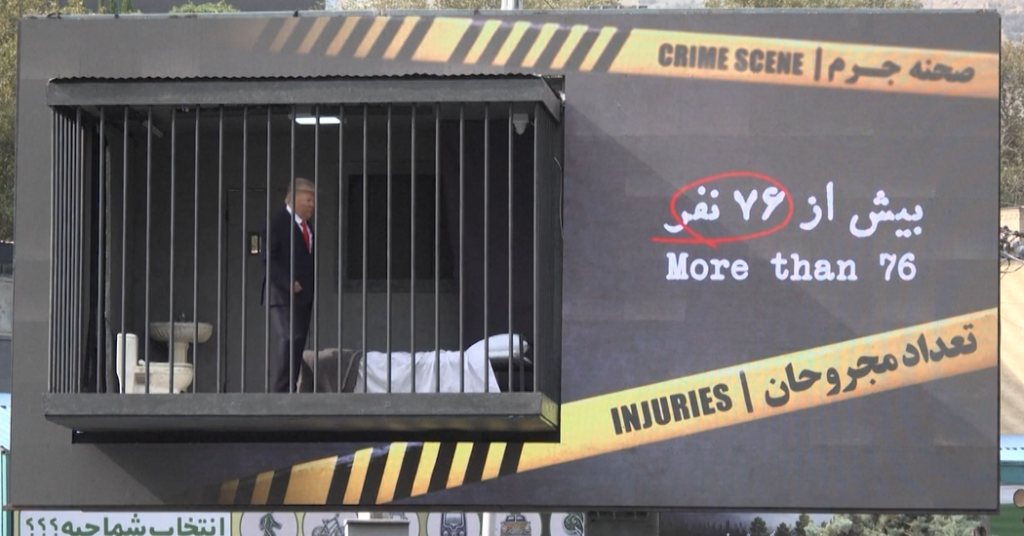
Mounted above one of Tehran’s busiest squares and affixed to a billboard is a cage designed to look like a jail cell. Inside it is an impersonator of President Trump. He rattles the bars, naps on his cell bed and mimics his famed Y.M.C.A. dance.
He does anything, that is, but look at the images flashing on the electronic billboard behind him, which depict a deadly American attack that struck an Iranian wedding last month.
“Failure to see this scene is a crime,” one of the scrolling images says, as rolls of yellow crime scene tape unfurl across the screen.
The piece of propagandistic performance art is one of the most eccentric in the Islamic republic’s long history of using billboards around the capital, Tehran, as a messaging tool.
Those messages reached new heights of provocation after the United States and Israel attacked Iran in February. Over the summer, for example, a billboard in Tehran’s central Enghelab Square showed an image of Mr. Trump lying in a graffitied coffin.
Mr. Trump has himself been an enthusiastic purveyor of politicized and ominous messaging to Iran. He has posted images on social media, usually generated using artificial intelligence, that mock Iran’s clerical rulers or depict their annihilation by American firepower.
Throughout the war, Iran’s government and its supporters have produced comedic memes and videos online that skewer the U.S. president and his decision to attack Iran.
Lego-styled music videos, mocking Trump administration officials, have frequently gone viral. Analysts said the videos, made by an anonymous group of content creators called “Explosive Media,” often attracted more interest abroad than inside the country.
Yet the Islamic republic’s latest gimmick — using a live actor in mask and wig to mimic Mr. Trump while marking a deadly attack — has grabbed public attention, even among Iranians who often walk right past such imagery on their streets.
Though the population is deeply divided in its feeling toward the regime, especially after a brutal crackdown on nationwide protests in January, there is widespread anger toward the U.S. leader for launching a devastating war on Iran.
International news agencies have published video reports showing the masked actor gesticulating to the crowd as he moves around his cell, which includes a bed, toilet and sink. Over the past few days, many have stopped to film, laugh and honk horns at the spectacle, mounted above an iconic square in one of the capital’s more affluent districts.
Tajrish Square, a bustling transportation hub in Tehran, is beloved among residents for its markets, where vendors sell nuts, fruits, clothing and gold. It is not a typical site for political statements, such as Enghelab Square, which means “Revolution Square” and is often the site of political gatherings and billboards.
The Trump performance, which has lasted into the night, was unveiled on Tuesday by Tehran’s Beautification Organization, affiliated with the city’s municipality, according to Iranian state media.
The White House did not immediately respond to a request for comment on the billboard. The installation appears to be part of a recently announced 15-day campaign in the capital intended to draw attention to the attack in the southern Iranian town of Kuhestak last month, in which at least one U.S. bomb hit a large wedding.
Asked about the attack at the time, U.S. Central Command, which coordinates American forces in the region, said that it was aware of Iranian news reports about the strike and that it doesn’t target civilians.
The wedding was struck by a bomb that, according to a weapons expert and a visual analysis by The New York Times, had been released by American forces as they carried out intense attacks in southern Iran.
For years, the Islamic republic struggled to make its anti-American messaging resonate beyond its hard-line base, said Omid Memarian, a senior Iran analyst at the Washington-based research group, DAWN.
“The war has altered that dynamic,” he said, with Iranians suffering days of bombardment and hearing Mr. Trump threaten to send Iran “back to the Stone Age.”
“The propaganda apparatus has gained renewed momentum,” Mr. Memarian said. “The message is that, despite America’s overwhelming military superiority, Iran is neither intimidated nor afraid to confront it.”
The post Above Iran’s Capital, a Trump Impersonator Dances in a Jail Cell appeared first on New York Times.